Saturday, December 25, 2010

10 Tips To Increase Fuel Efficiency Of Motorcycles


Service your motorcycle engine at regular intervals. An engine in a bike is the heart for a two wheeler machine. So try to make sure it stay healthy, out of unwanted sludge. The better way to achieve it is keep a record over service manual and look up into the brand booklet as when it is recommended to go for a new service.
One of the main factor that affects mileage on negative note is the quality of oil that the engine consumes to retain virtuosity. Always go for some better oils and the ones that are recommended as per engine configurations.
Stay tuned to mechanics! I am sure here you will be asking me virtually as what do we know about mechanics and how to apply same on our bike. A simple answer to your question goes as follows: Don't twist the throttle at sudden, let bike gain velocity by applying average acceleration. Also avoid playing with speed; never engage brakes at sudden to roll down speedo needle at once. Ride at uniform speeds!
You should not expect more mileage than a bike is capable of offering. For instance, a bike with curb weight of 150kg can offer much better mileage than a bike with higher curb weight. Also an engine with higher displacement will offer low mileage than a low displacement engine. So opt for a bike that suits your demands and later there shouldn't be any inane searches to increase mileage more and more.
Make sure you ride your bike when its engine is warm. No doubt you can not make sure that bike engine remains warm all the time, but you can organize your trip in better ways. Always remember, a cold engine consumes more fuel than a warmer one.
Tyres don't only ride your machine but they play a role in balancing fuel consumption too. Maintain tyre pressures on both ends. And the pressure units should be same as that prescribed over motorcycle booklet (usually written on a sticker over fuel tank).
Engine idling is very rare as a concept to maintain better fuel efficiency. Engine idling refers to the automatic acceleration in layman terms. Usually located as a knob under fuel tank. Just set it to 1000rpm and it should do well.
Now as you have noted the technical tips out here to increase mileage of bike, let's point out some conceptual tips:
Always select the route that offers lesser number of bumps, fewer traffic lights and uniform road to maintain speed. If it is not the short cut to your destiny, still prefer it as it will save your time as well as fuel. More miles spent in much efficient way will dominate lesser miles in low efficient manner.
Switch off the engines at halts like traffic lights and stopages. These days almost all bikes are equipped with self start so a rider will hardly mind to click a switch to get his bike started and it will surely affect mileage in better way.

A Winter Storage Guide For Motorcycles


In order to make sure that your motorcycle is in excellent condition when you want to use it, make sure that you properly winterise the vehicle. The following are a series of steps which will help you to make sure that your motorcycle stays in mint condition:
Step #1
Warm up the bike after the last ride you take so that all of the condensation in the bike is dried from the exhaust. Fill up the tank completely after your ride because unleaded petrol is able to evaporate when coming into contact with oxygen. This could lead to potential residue which can clog the carb.
Step #2
Turn the fuel tap off and make sure that the engine runs until it ceases to function.
Step #3
Remove all of the float bowl petrol after the engine stalls. If the bike is older than four years, you should think about completely emptying the tank as water may accumulate in the tank's base and cause rusting.
Step #4
Use WD40 or another oil spray to all metal parts except for the working surfaces such as the control levers, footrests, and brake discs. This will serve to prevent corrosion and spraying the metal several times throughout the winter will also help prevent damage. Additionally, inspect the bike to make sure that there is no grime or grit building up on the motorcycle.
Step #5
Clean all of the components of the bike where water or dirt may collect. This is particularly important with the shock absorber linkages, the radiator, and engine where dirt is more likely to collect.
Step #6
Make sure that all of the electrical connectors have been well oiled particularly on bikes which have numerous exposed components.
Step #7
If you intend to use your bike during the winter months, place mudguard extenders on the bike to protect against road dirt and salt. After each ride, wash away any salt or dirt and dry the bike thoroughly. The tyres should be particularly cared for during the winter as they are required to work harder so winter tyres are an excellent idea for colder weather.
Step #8
Make sure that the drive chain is lubricated to prevent rust and that all of the pivot points are oiled as well. The foot peg pivots are particularly important as they are likely to collect dirt and salt. When corrosion first occurs, act immediately so that it will not spread to other parts of the bike.
These tips to winterise the bike are not complete but provide a general guide to protect your bike during the colder months. Proper care and maintenance will ensure that your bike will withstand the winter and be in excellent condition and just as functional in the spring.

Suzuki Is Back for 2011


After cutting U.S. imports to the bone in 2010, Suzuki is ready to open the gates again for 2011.
The recent recession hit motorcycle manufacturers hard, and for Suzuki that meant almost no new 2010 models for the U.S., other than some off-road bikes and the GZ250 street bike. For 2011, however, it's a whole new world.
Sportbikes
Suzuki has five sportbikes for 2011, the GSX1340R Hayabusa, GSX1250FA, GSX-R1000, GSX-R750, and GSX-R600. Not an out-and-out sportbike, Suzuki also classifies the GSX1250FA as a standard. The company lists MSRP on these models in the range from $11,599 to $13,699.
The Hayabusa is the big dog of the group, with a liquid-cooled 1340cc inline-4 providing power. Says Suzuki, "With performance credentials that have established it as the hottest sportbike on the planet, the Suzuki Hayabusa is designed for the serious sport rider who will settle for nothing less than the best."
For those of more modest means or aspirations, the GSX-R600 makes for a nevertheless impressive bottom rung on this ladder. Its liquid-cooled 599cc DOHC power plant, lightweight chassis, and race-developed suspension make it agile and responsive on the track or the streets.
Cruisers
The Boulevard cruiser line-up includes the M109R, M109R Limited Edition, C50T, and S40. Of those four, the Boulevard C50T is also classed as a tourer.
Top of the Boulevard line is the M109R Limited Edition. With an MSRP of $14,499, this 1782cc fuel-injected v-twin is the most powerful cruiser Suzuki has ever produced. The company touts its "technically advanced chassis and suspension, matched by world-class brakes."
At the other end of the Boulevard line is the S40. The engine is a 652cc SOHC four-stroke single with the low-end grunt you expect from a thumper. MSRP on this machine is a modest $5,099.
Motocross
For Motocross fans, there are two 2011 machines to choose from, the RM-Z450 and RM-Z250. Both are 4-stroke, liquid-cooled singles.
For 2011 Suzuki has engineered the bikes to meet stricter AMA noise limits, while increasing the compression ratio for the RM-Z450. The 450, says Suzuki, "is a cutting-edge open-class motocross ride that's more potent than ever."
Another focus in new-for-2011 mods is attention to easier maintenance. The 250 features updated wiring harness routing and a fuel line cap. The 450 offers, as an option, couplers to change the EFI setting from richer to leaner. The 450 also features the fuel line cap to facilitate regular maintenance.
The RM-Z450 and RM-Z250 carry MSRPs of $8,149 and $7,299 respectively.
DualSport
For versatility, there are no bikes on the road that match dualsports, with their ability to go smoothly down the highway but also tackle the roughness off-pavement. Suzuki's DualSport models for 2011 include the V-Strom 650 ABS, the DR650SE, and the DR-Z400S.
At $8,099 MSRP, the V-Strom is light, has a low seat height, and offers a wide powerband that makes it easy for slow-going when the road gets really rough. The V-Strom also comes with an extra-large, 5.8-gallon fuel tank, to help ensure that you don't get stranded when the thrill of exploration carries you beyond your anticipated range. Plus, the bike comes with ABS stock for 2011.
While the V-Strom is a V-twin, both the DR650SE and the DR-Z400S are singles. Tuned more for dirt, both are still street legal. MSRPs are $5,899 and $6,199 respectively.
Standard
Rounding out the line-up is the entry level TU250X street bike, or standard. (The GSX1250FA is also considered a standard.) Evoking the '60s look in street bikes, this machine features a 249cc, 4-stroke, air-cooled single. Spoked wheels add to the retro styling, however, a modern fuel-injection system brings the overall unit up to date. The most economical of Suzuki's street bikes, the TU250X has an MSRP of $3,999, carries 3.2 gallons of fuel and will take you about 200 miles on one fill.
So there you have it. Conspicuous by their absence in 2010, Suzuki is definitely back with a slew of updated models for 2011. Now the only issue is deciding which one is the right fit for you.

Motorcycle Safety Tips For Bikers and Motorists

Bikers' Legal Responsibilities 
  • Obtain a license. It has been estimated that one-third of bikers killed in crashes aren't licensed or are improperly licensed. State licensing agencies make sure that motorcycle operators have the skills needed to safely operate a motorcycle.
  • Know your state's helmet laws.
  • Make sure you get insurance coverage. Most states require liability insurance.
  • Don't speed. In 2007, 36 percent of all fatal motorcycle crashes involved speeding.
  • Never drink alcohol and get on a motorcycle. In 2007, 27 percent of bikers involved in fatal crashes had a blood alcohol concentration over the legal limit.

Motorcycle Riding Gear
  • Helmet - Make sure your helmet has a sticker indicating DOT (Department of Transportation) compliance. This means that the helmet meets certain basic impact standards.
  • Eye Protection - Make sure your eye protection is clean and unscratched. If your lenses are tinted, also take some that are clear in case you ride at night.
  • Pants and jackets should be made of thick material, such as leather, to resist abrasion.
  • Gloves should be worn at all times to prevent any injury to hands or fingers.
  • Wear over-the-ankle boots made of strong leather to protect your ankles. Also, make sure your boots have rubber soles and a good tread design for easy gripping.
  • Wear high visibility gear like bright and reflective clothing.

Before You Ride
  • Read the owner's manual so that you understand how to operate and maintain your bike.
  • Check the tires for cuts, foreign objects, and pressure.
  • Check the following parts:
    1. Controls for kinks or stiffness
    2. Lights, turn signals, horn, and mirrors
    3. Oil, fuel, and coolant levels
    4. Sidestand and centerstand
    5. Brakes

Carrying a Passenger on Your Motorcycle
  • Be aware that some states have minimum age requirements for motorcycle passengers.
  • Review your owner's manual for tips on preparing for riding with a passenger.
  • If you decide to carry a child, make sure the child can handle the responsibilities, and reach the footrests. They must wear a helmet and other protective gear and hold onto you or the passenger hand-holds.
  • Remember that the extra weight from a passenger can affect braking procedures, starting from a stop, and riding through a corner.
  • Start the motorcycle before the passenger mounts.
  • Before riding, practice low-speed clutch/throttle control and normal and emergency braking in an open area, like a parking lot, with a passenger.

Group Riding
  • Before heading out, hold a riders' meeting and discuss the route, stops, hand signals, and what to do if there's an emergency or if someone is separated from the group.
  • At least one rider in each group should have a cell phone, first-aid kit, and full tool kit.
  • To allow for enough time and space for maneuvering and reacting to hazards, it's important to ride in formation.
  • Do not ride in side-by-side formations because they reduce the space cushion.
  • From time to time, check the riders following in your rear view mirror.

Motorcycle Maintenance
  • Follow your bike's regular service schedule that's listed in the owner's manual and have these inspections done by an authorized dealer.
  • Check your battery once a month and make sure that the fluid level is correct.
  • Always take your tool kit with you when you ride.
  • Your owner's manual can tell you what to do in emergency situations, so make sure it's always with the bike.

On the Road
  • Always be on the lookout for potential hazards, especially at intersections.
  • Keep your eyes moving. If they are locked on one thing for more than two seconds, you may not notice a potential hazard.
  • Make sure other drivers see you.
    • Your headlamps should be on (even during the day), wear bright clothes, and always signal your intentions.
    • Use your horn to make people aware of your presence.
    • Position your bike where it can be seen.

  • When you're riding in traffic at speeds under 40 mph, keep a two-second gap between you and the car in front of you.
  • If you're traveling at higher speeds, the gap should be at least three or four seconds.
  • Passing:
    • You should be at least two seconds behind the vehicle you want to pass.
    • Always turn and check your blind spot with your head.
    • Don't try to overtake another vehicle if a corner is coming up.

  • Night riding
    • Dusk is actually the most dangerous time to ride, because people's eyes are adjusting from daylight to headlights.
    • The distance between you and the vehicle in front of you becomes even more important as it gets darker.
    • Wear a clear faceshield without scratches. A scratch can create confusing light refractions.

MEANING OF COLOUR


A biker in black craves protection; those in green will keep the motorcycle in good condition and a biker in blue is an insurer's dream. These are just some of the results of a recent study by Devitt and a leading colour psychologist to evaluate what the colour of leathers and motorcycles say about the the individual.

According to Angela Wright of Colour Affects, each colour has slightly different implications: the colour someone chooses for a motorcycle indicates his/her attitude to the activity itself, while the colour of the leathers indicates attitudes to oneself.

Although the most popular colours are comparatively predictable - for motorcycles: red, blue and black; for leathers: black and red - what each colour says about its rider makes for very interesting reading. “Many people think that colour is just a matter of how things look and it is often dismissed as being purely cosmetic. However, the truth is that colour is light - the source of life itself; there is nowhere that colour does not exist and our instinctive, unconscious response to it is a vital element in our survival,” she says.

So, what, in Angela's opinion, can a biker learn from his or her own colours?
Beige: Calm, dependable, no fuss biker
Blue: A biker with clear thought, maturity and responsibility
Black: This biker requires protection from the outside world
Gold: Symbolises luxury, top-of-the-range, expense, sophistication and glamour
Green: Balanced and peaceful. The biker will keep the machine finely tuned
Grey: Enjoys a well-made, functional machine. Sometimes has slight low self-confidence
Mauve/Purple: Upmarket biker, but also rather naughty and self-indulgent.
Orange: A biker who likes physical comfort, pleasure and sensuality, though opposite to blue
Pink: A maternal biker, loving, nurturing and a strong assertion of the feminine
Red: The sign of strong and masculine biker, exhilarating and exciting
Silver: The biker who loves luxury, speed and fine engineering
White: The biker wants uncompromising, clean excellence and the world to keep away
Yellow: Self-confident and optimistic biker. Fun, yet more mature than the orange biker

Modifications don't mean big insurance price hikes


Too many motorcycle owners are failing to tell their insurers about modifications to their motorcycles either because they fear the changes will increase their insurance premiums, or because they don’t realise they need to. However, following a recent review, we can reveal that many of the most common modifications actually have little or no effect on premiums at all.

This contrasts with failing to tell an insurer about modifications which could result in the insurer refusing to pay when a claim is made - particularly if the modification is a factor in the claim. Many of Britain’s bikers’ favourite modifications have virtually no impact on insurance premiums. These include modifications such as crash bars, crash mushrooms, road legal after-market exhausts, huggers, up-rated braking systems and a five per cent increase in engine capacity.

Other modifications including wheels, suspension, Dynojet and tank pads may also be accepted by insurers and would result in only a moderate premium increase.
Modifications that are likely to be expensive to insure are: increasing engine capacity over five per cent, custom motorcycles and nitrous oxide injection.

Commenting on the review, Devitt’s Managing Director William Hughes said: “One of the most important principles underlying any kind of insurance is that all relevant information must be passed on to the insurance company. That’s the only way an insurer can understand precisely what risks they’re covering and calculate a fair price."

LIVE TO RIDE. RIDE TO LIVE


5 BITS OF KIT NO RIDER SHOULD BE WITHOUT

1)Leathers. There’s no doubt leathers are one of the best forms of protective clothing you can wear on your motorcycle. As well as offering great abrasion protection, in many cases they’ll have fitted body armour at the back too. Remember, when buying leathers always make sure they fit correctly.

2)Gloves. Another great form of protection is riding gloves, the thicker the better. But remember thick gloves will need breaking-in to ensure they give you enough brake and throttle control. In addition, it’s worth having a different pair for both summer and winter.

3)Boots. When choosing boots make sure they’re not too narrow or wide. Sit on your motorcycle and check they don’t interfere with the heel-plates or levers. And, although it may be tempting to buy racing boots, be aware that some styles won’t be waterproof.

4)Waterproofs. If you get caught in a downpour while you’re riding it can be very uncomfortable, which naturally means your concentration won’t be on the road. Make sure you always pack lightweight waterproofs in your backpack or under the pillion seat when you’re heading out.

5)Helmet. The best fitting helmets offer the best protection. When you’re buying a new helmet make sure you try on various sizes to find one that fits the unique size and shape of your head. Make sure it carries a BSI kite mark BS 6658 or European standard ECE 22 – 05. Never buy one second hand and make sure you replace your helmet at least every five years or after an accident. Always fasten your helmet while you’re riding, an unfastened helmet is next to useless in an accident.

SAFE RIDING: KNOW THE RISKS


The most unfortunate stats for any motorcycle rider are the numbers of accidents on two wheels. Here are some details you won’t like reading:
Motorcyclists as total percentage of traffic: 1%
Motorcyclists as total percentage of fatalities: 19%
Number of motorcyclist deaths in 2008: 493
Number of motorcyclist serious injuries in 2008: 5,556
We hope you agree that, unlike the performance stats for that superbike you’ve got your eye on, these figures are nothing worth boasting about.
And as a result, they can recommend some modifications to your road-going set up. Here are those canny adjustments in full:
  • Wear an approved motorcycle helmet
    Colour: white or at least bright.
    Requirements: undamaged, securely fitting
  • Wear protective clothing
    Colour: fluorescent (day), reflective (night).
    Look for: Good quality, CE seal of approval.
    Fine conditions: leathers offer unbeatable protection from grazing.
    Wet conditions: weatherproof armoured clothing keeps you dry and focussed
  • Check your visor
    Watch out for: dirt, scratches.
    Note: avoid tinted visor or goggles at night
The final component you might want to enhance in time for the next journey is YOU. Tighten up your technique, especially at T-junctions.

Know your sports bike and how to handle it under a wide range of conditions.


Learn everything you can possibly learn about your bike and how to ride it.
Read the motorcycle drivers’ manual for your location.
Find out where the local motorcycle safety courses are being given and sign up for one.
If you have taken the initial motorcycle safety course and it has been a while, take a refresher course. Most of all, practice riding your bike so you know how it handles under different conditions such uneven surfaces, wet pavement, loose gravel, sand and high winds.
The more you know, the better off you will be should the unexpected happen. Read as much as you can about motorcycle safety, potential hazards and how to handle inconviences such as flat tires, barking dogs and wild animals such as deer that come out of nowhere. Then practice, practice, practice.
Practice riding with someone on the back of your bike who is experienced.
As you gain confidence and ability you can begin to instruct other people how to be a good passenger and gain experience riding them.
If your bike came with a users’ manual, sit down and read it.
If it did not come with one, order one so you can become familiar with the way your particular bike works and how to handle break downs such as flat tires.
Finally, make sure you have a biker’s tool kit that you know how to use in your tool box on your bike.

Friday, December 24, 2010

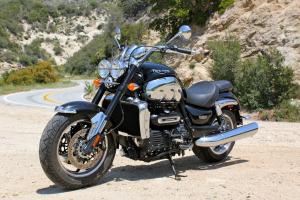
2010 Triumph Rocket III Roadster vs. 2010 Star VMax


Merely mentioning the VMax is sure to conjure images of a rear tire-roasting, muscle-bound, two-wheeled monster in the mind of just about any bike enthusiast old enough to recall the 1985 release of Mad Max.
And to this day the VMax retains much of its lore, even as a member of the Star Motorcycles brand.
A thorough and bold redesign of the VMax in 2009 – that included a massive boost in performance from its legendary V-4 engine – has not only stirred the souls of veteran riders, it’s also exposed a whole new generation of riders to the august Mr. Max.

Coupla hogzillas here. 2010 Triumph Rocket Roadster and 2010 Star VMax.

Although Triumph’s Rocket III is a babe in the woods next to the long-running Max, it made an indelible mark on all of motorcycledom when unveiled in 2004.
Its massive, longitudinally mounted inline-Triple and three prominent exhaust headers were, and still are, striking. The Rocket has an imposing but approachable presence, as if it were a Boss Hoss Lite.
The Rocket, like the VMax, continues to thrill and intrigue since its birth.
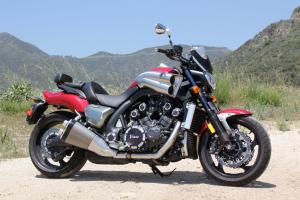
It’s the VMax. What else do you need to know?
However, unlike the VMax’s relative stagnation of design for 20-plus years, Triumph spawned a powerful, touring-capable cruiser, as well as a “classic” model, in the matter of only a few years from the original Rocket’s introduction.
For 2010, only six short years since the RIII was launched, the Roadster is with us. With this latest incarnation of the Rocket comes a breathed-on mill making this the most powerful Rocket III to date.
In many ways the Roadster and VMax are quite different. But the common denominator here, and the primary reason we brought them together, are the ridiculous amounts of horsepower and torque each produces.
Sure, modern literbikes like the BMW S1000RR are capable of more peak horsepower than the Rocket or Max; but good luck finding a production motorcycle engine that chugs out sizable hp numbers paralleled by plump torque figures like the Rocket and Vmax generate!
“I’ll have the 72-oz rib eye, please.”
We’re a nation that often embraces the ostentatious – we’re mostly to blame for professional wrestling and competitive eating! – so we figure you’re ready for the main course, to get to the meat of the matter: two over-the-top engines.
An outright leader here depends on your moto value system.
If you’re most enthralled by peak horsepower, then you’ll relish in the fact Big Max’s revvy 1679cc, liquid-cooled, four-valve-per-cylinder, 65-degree, DOHC, V-4 readily hands the Roadster its ass when comparing peak horsepower.

These ostentatious brutes are mostly about big muscle.

Mad Max managed 167.5 hp at roughly 9000 rpm (Star’s claim is 197 hp at the crank) when we strapped it to the dyno. From this we see why the VMax makes a good platform for a powerful dragster. The power of the Max is the key element behind its allure.
“Its power is nothing short of incredible,” says Kevin of the VMax. He went on to call it a “rubber-burner extraordinaire!”
Mad Max has the potential to post big top speed numbers, but it’s electronically limited to approximately 146 mph. The most sensible answer to this e-nanny is likely an issue of simple aerodynamics. Riding the naked VMax (or just about any unfaired bike for that matter) at higher speeds seems like a frightening, even hazardous prospect. And, well, we do live in a litigious society…
Although respectable by most standards, the Rocket’s best run of a little less than 119 ponies at 5300 rpm simply falls short of the Star’s sportbike-like peak power.
So there ya have it. If you’re looking for a horsepower king, crown Mr. Max.


The Rocket III Roadster shows up for the gunfight with a 2.3-liter cannon, a cannon lobbing fat torque bombs at its foe. A peak-torque reading of 136 ft-lbs at 3200 rpm is utterly impressive in its own right, but equally noteworthy is that it twisted out over 118 ft-lbs as early as 1500 rpm. WTF?
Even when the RIII’s peak hp tops out, the Big Triple is still making 117 ft-lbs. Short shift and fuhgeddaboudit!
The Max’s peak 107 ft-lbs at 6700 rpm is nothing to brush off, but in the low-rpm arena the Star’s torque production is shy of the Rocket’s by as much as 55% at some points. And that’s a conservative comparison.
As unique as the power curves are, so too is the character of each engine.
The Roadster’s large flywheel effect is notable as it rocks the bike sideways when the throttle is blipped. It feels as though there’s a deep well of irresistible force lurking in the bowels of the big Triple. Of course the Roadster accelerates with authority, but it does so in a deliberate, linear manner that mirrors its mostly flat torque curve.
A rocket indeed!
The Star’s engine complexion suits the bike’s Mad Max nickname. Like a Jekyll and Hyde, the VMax is as friendly as you like it. But a hideous mad man is only one quick twist of the throttle away.
“Even at low rpm, you can tell there is a brute between your legs. Just a whiff of throttle has major speed implications,” Kevin said with a tinge of fear in his voice (not really).
Indeed, the Max accelerates with the ferocity of most literbikes, as the V-4 spins up much quicker than the Trumpet’s inline. Yet there’s a degree of serenity to the engine thanks to its limited vibration.
On the subject of exhaust notes, the Max reminded Kevin of V-8 at idle, and under power it sounds like a modern, high-performance V-8. The Roadster has a throaty, menacing grumble at idle, too. Pull the trigger and the sound emanating out back is reminiscent of a built truck; like the older Chevy with glasspacks the local kid takes to the Tuesday night drags.
One does it on top, the other on the bottom. Different animals for sure; both big, but different.

If the VMax was good at only on thing, this is it. Of course, it does many things well.

The Rocket, as expected, can roast the rear tire from a stop, launches hard and will even hoist a sizeable wheelie providing the clutch is finessed just right along with a handful of throttle. But the Max will do the same and then some. Just a little slip of the clutch in second gear and the Star can bake its 200-section rear tire from a rolling start.
Both manufacturers have done a commendable job of mitigating engine vibes.
A V-4 design is inherently smooth running. In the VMax this trait is further enhanced via a contra-rotating balance shaft. Kudos to Triumph, as the big rigid-mount Trumpet Triple is generally free of major buzz, too.

Although the Roadster's final torque number is huge, its graph line looks like a blip on the radar next to the Max's. That's because the Rocket redlines around 6500 rpm; the Max around 9500. Yet again one of the many ways this pair differ.

More silky smooooveness is located in each bike’s 5-speed gearbox. Shifting action was light and precise on both sleds, although the shorty ASV accessory lever on the Max may have contributed to the sensation extra pull was required.
Good things come in big packages
The VMax brings hi-tech to the table in the form of various engine technologies borrowed from Yamaha’s sportbike line, like YCC-T, YCC-I and the well-known power-enhancing EXUP.
Equally techy is the VMax’s chassis, appropriately updated to match the new V4.
The Max’s skeletal composition boasts a cast-aluminum perimeter-style frame joined to an alloy swingarm; a subframe made of Controlled-Fill cast-aluminum and extruded aluminum pieces completes the package.
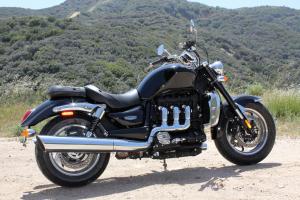
If the Roadster ate beef we suspect it would take it on the rare side.
We’d expect nothing less for a bike that was some 10 years in the making before its final unveiling. However, for all the VMax’s advanced chassis design it’s not necessarily light years ahead when it comes to real-world riding.
The Rocket’s chassis package is pretty basic cruiser-type stuff compared to the VMax frame.
A twin-spine tubular-steel frame holds the big Triple as a stressed member; the swingarm/shaft-drive housing is also steel. We don’t want to minimize the Rocket’s frame technology, but that’s about all there is to it.
Despite a suspension package (non-adjustable 43mm USD fork and twin coil-over shocks with 5-position ramp-style preload) as no-frills as the frame, the Triumph acquits itself quite well in just about every riding situation you can throw its way.
Considering the limited range of suspension adjustment on the RIII, overall ride quality is descent with sufficient damping.
The Rocket exhibited moderate-to-light steering effort; even low-speed, tight-radius turns are managed with marked ease. Excellent leverage provided by its wide, sweeping handlebar is a big contributor to the friendly handling.

Although Mighty Max doesn’t initiate turns as fluidly as the Roadster, it otherwise provides sure-footed, confidence-inspiring handling.

For a big, honking, 807-lb sporty cruiser, the newest of the Rockets carries its weight well when hustled down flowing canyon roads where a rider can quickly forget the Roadster rolls a fat 240-section rear tire. Motorcycles with such large rear tires often feel as though they want to right themselves only seconds after initiating a turn. Not so with the Rocket.
The portly Roadster further disguises its heft with a 66.7-inch wheelbase, 32.0-degree rake and 148mm of trail. This is nearly a carbon copy of the VMax’s dimensions save for the Max’s minor advantage of a 1.0-degree steeper steering angle.
Despite the opportunity to finally grace the VMax with fleet-footed steering geometry after all these years, Star (Yamaha) designers and engineers actually made the new Max’s chassis dimensions milder compared to VMax 1.0, as Kevin noted during the 2009 Max’s press launch.
The Roadster’s ability to handle like a motorcycle, say, 100-lbs lighter, is a defining quality of its character, a pleasantly surprising quality at that.
Rocket III Roadster: Not afraid of a twisty road.
It’s a safe bet the VMax’s aluminum chassis lends considerably to the bike’s middleweight-by-comparison claimed wet weight of 685 pounds. Yet the VMax doesn’t whip ‘round corners as briskly as you might expect.
There isn’t any discernable flex or wallow from the VMax’s stout chassis. However, Kevin noted that chopping the throttle mid-corner occasionally upsets the chassis, a condition he attributes partly to how the Yamaha Chip Controlled-Throttle (YCC-T) affects engine compression braking.
This annoyance aside, the VMax otherwise feels solid and planted, enough that new MO Editor, Jeff Cobb, said he was inspired to routinely drag the VMax’s footpeg feelers during a weekend-long trip up California’s twisty coastline near Big Sur and surrounding areas.
On the flipside, I was surprised at the initial effort required to turn Mr. Max, especially after time aboard the lighter-steering but heavier weight Rocket.
The Max exhibits a falling-into-the-corner sensation. Kevin referred to the feeling as steering “flop.” He also keenly noted the Max’s awkward feeling at low speeds, a trait reflective of what feels like a high CoG on the Star.
We suspect a narrower handlebar compared to the Triumph’s wide bar, and an 18-inch front wheel as opposed to the Rocket’s 17-incher, as culprits that prevent crisper steering on the Star.

Although the VMax lacks sportbike-like handling to mate up to its sportbike-like power, its suspension is polar-opposite of the Roadster’s springy parts.
The VMax’s 52mm fork and solo shock are fully adjustable. A rider benefits further from easily accessed knurled knobs for rebound and compression damping on both the shock and fork. A remote hydraulic adjuster on the bike's left side handles shock preload.
The Star’s ride is better damped overall than what the Rocket offers, but ultimately it’s difficult to get around the rear suspension-altering effects of a shaft drive.
Though shaft-jacking on the Vmax and Roadster’s traditional shaft drive systems isn’t as bad as shaft drives of yore, aggressive acceleration will nevertheless cause the rear suspension to “grow,” just as it does on all shaft final-drive motorcycles. Rear suspension thereby can seem momentarily overly stiff and unforgiving, especially if a handful of throttle is applied.
Braking on either bike is more than sufficient, especially considering the weights and monster power of these big boys.
The VMax wears an impressive-looking set of radial-mount, six-pot calipers clamping down on 320mm wave-type rotors; a Brembo master cylinder is a nice bonus. Braking is aided by the addition of ABS.

2012 Yamaha Super Tenere Review

BMW’s GS juggernaut finally becomes impossible for the Japanese to ignore. Yamaha’s Super Ténéré, an adventure-tourer with a 1200cc twin-cylinder engine, is set to go head to head against the iconic R1200GS when it arrives in America next spring.
Yamaha’s big A-T actually has its own off-road legacy. A single-cylinder Ténéré (no super) enduro first debuted back in 1983. The Ténéré went Super in 1989 when the twin-cylinder XTZ750 debuted in the European market, and it went on to win the grueling Paris/Dakar rally six times. Hence the name Ténéré (say ten-eh-ray), which is a region in the Sahara desert traversed in the P/D rally.
This new Super Ténéré was introduced in Europe earlier this year, and Yamaha recently announced it would be coming to America as a 2012 model. If the 750cc parallel-Twin XTZ was a Super Ténéré, this new model might well be called the Super Duper Ténéré, as it has a 450cc displacement advantage.

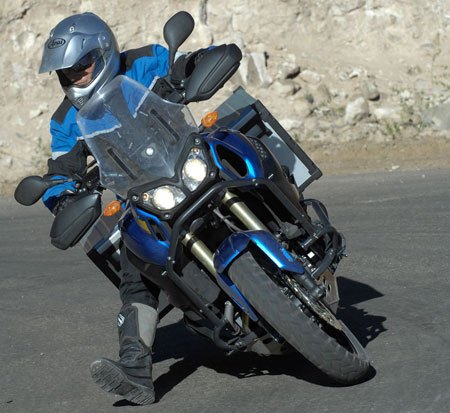
We were among the first to ride Yamaha’s new Super Ténéré on American soil. It’s a viable contender to BMW’s R1200GS, with standard traction control and antilock brakes.

The dual-purpose category, although just 6% of the total U.S. market, has shown steady growth since 2005, primarily in the 651cc-and-up segment that was primed by BMW’s R1200GS. The new Super-10 wants a slice of that lucrative market pie.

Roosting in the Arizona desert, the Super Ténéré will land in American dealers in May, 2011.

And after bashing Yamaha’s big trailie around the roads and deserts of Arizona for a couple of days, we found the Ténéré to be a good match for the dominating GS.
Key among the Super-10’s attributes is the features-per-dollar quotient. Its $13,900 base MSRP includes traction control, antilock brakes, dual-mode ride-by-wire mapping, tubeless spoked wheels and hand guards. In comparison, the rarely seen base version of the BMW retails for $14,950 but does without ABS or traction control or hand guards. BMW’s optional “Standard Package” includes ABS, hand guards and on-board computer but retails for $16,935. Spoked wheels are a $500 upgrade, and traction control is another $400.
"...we found the Ténéré to be a good match for the dominating GS."
Although no OEM will likely build a horizontally opposed Twin like the BMW’s Boxer motor, Yamaha has built a distinct but reasonable facsimile. Its Twin is rated at 108.5 crankshaft horsepower, nearly identical to the 110 ponies claimed for the GS.
But the cylinder arrangement of Ténéré’s inline-Twin stands apart. It uses a slightly smaller bore (98mm vs. 101mm) and longer stroke to yield 1199cc (the 1200GS displaces an actual 1170cc). It uses a 270-degree crankpin offset, which has cylinder 2 firing 270 degrees after cylinder 1, then cylinder 1 firing again 450 degrees later. This uneven firing order is said to improve a tire’s grip on slippery surfaces and also has the side benefit of creating an exhaust note very similar to that of a V-Twin.

The Ténéré is powered by a parallel-Twin engine with a 270-degree crankpin offset. A counterbalancer at the forward end quells vibration and drives the water pump (left).
A smallish radiator is mounted on the left side of the Ténéré. It wasn’t unusual to see the temperature gauge above 200 degrees and accompanied by a Buell-like whirring fan noise.
A nicely shaped cast-aluminum swingarm houses the Ténéré’s shaft final drive.

This uneven firing order creates a lot of vibration, so the Ténéré’s motor is equipped with twin counterbalancers to smooth things out. The balance shaft at the front of the cylinders doubles as the water pump drive. A dry-sump oil system helps the engine be mounted as low as possible so it can be placed optimally in the steel frame. A side-mount radiator allows the engine to be placed further forward, resulting in 50.5% of the bike’s weight to be on the front wheel.
Air is mixed with fuel inside 46mm throttle bodies with 12-hole injectors, firing inside twin-plug cylinder heads like the GS. A ride-by-wire throttle makes possible the traction-control system that has two settings and can also be disabled. It also allows switching maps from a softer Touring setting to a more aggressive Sport mode via a button on the right-side switchgear.
Ears are greeted with a pleasingly deep exhaust sound from a big muffler hidden along the bike’s left side. Its note is similar to a 90-degree V-Twin’s but with hints of the R1’s crossplane-Four and single-cylinder thumps.
"Ears are greeted with a pleasingly deep exhaust sound..."
A four-position clutch lever requires a moderately firm pull to actuate the burly clutch pack consisting of 9 friction plates. Shift action is pleasingly light and positive, and power is transferred to the rear wheel via a shaft to a hypoid gear-set on the rear wheel. The stronger hypoid design allows smaller gears than a spiral-bevel arrangement, which Yamaha says is 10% tidier. However, there is a price to be paid for the hypoid arrangement – gear whine, which is especially noticeable around 60 mph.
A cast-aluminum swingarm actuates a shock hydraulically adjustable for spring preload and rebound damping, just like the GS. Both adjustments require no tools. Like all shaft-driven motorcycles, the rear suspension kicks back over bumps while accelerating.
Rear-suspension travel is 7.5 inches, the same as in the 43mm inverted fork. Yamaha one-ups the BMW by having fork adjustments for compression and rebound damping plus preload. However, the Ténéré isn’t available with anything like BMW’s optional push-button Electronic Suspension Adjustment.
Whether on the street or in the dirt, the Ténéré’s suspension delivers action typical of its conventional design, as opposed to BMW’s interesting but oddball Telelever front end. On paved surfaces, the Yamaha’s long-travel suspenders nicely suck up bumps that would have R1 riders wincing. And it also performs competently on every dirt terrain we sampled, from blasting at 80-plus-mph on groomed dirt roads to hammering over rock-strewn canyon fireroads. 

The Super Ténéré’s suspension is almost fully adjustable, lacking only rear compression damping variance. It worked well both on-road and off.

Aiding the Super-10’s high-speed stability is a somewhat lazy rake angle of 28.0 degrees with 126mm of trail. Turn-in response is nice and neutral even if not especially quick – a GS (or Multistrada) requires considerably less effort to crank into a corner.
Tire sizes are the same as used on the R1200GS (110/80-19 in front; 150/70-17 out back), sourced from either Bridgestone or Metzeler in a tubeless design made possible by cross-spoke wheels using a raised rim center section so the spokes don’t reach into the wheel’s interior and release air.
Our test mules were fitted with ’Stone Battle Wing tires developed especially for the Ténéré, using what seem to be deeper tread grooves than off-the-shelf ’Wings to deliver surprisingly good traction in the dirt as long as it isn’t thick and loose like sand. Considering the street-biased nature of most adventure-touring riders, we consider the ‘Wings to be an excellent tire compromise.
Yamaha’s traction-control system provided seat-of-the-pants data for the efficacy of the tires. Toggled into the least intrusive TC mode via a button on the left side of the instrument pod, the Ténéré’s rear tire hooked up well enough in the dirt to keep the TC intervention (indicated by an amber light on the gauges) from cutting in too often.
The TC2 setting allows some sliding before ignition timing and fuel are throttled back to regain grip, and we were pleased to note the intervention was never harsh – the engine never fell flat on its face but instead modulated output rather subtly. The TC1 setting is more intrusive and would best be used only in the slickest of conditions.

At 540 pounds without fuel, the Super Ténéré isn’t a small bike. But that doesn’t mean it can’t be ridden like a supermoto!

Other rider aids lie in the braking system. In addition to standard antilock control, the Ténéré is equipped with Yamaha’s Unified Brake System that links the rear brake to the front lever, helping limit chassis pitching during hard braking that is typical of bikes with long-travel front suspension.

The 2012 Super Ténéré has got some dirt chops.

A pull of the brake lever actuates a pump under the seat to apply rear-brake pressure, and the system is smart enough to automatically apply more rear brake when the bike is loaded with the extra weight of a passenger (based on lever pressure) and when the deceleration rate is high. The back of your helmet and the front of your passenger’s will appreciate less bonking when braking, and the UBS operates seamlessly with a solo rider.
A pair of 4-piston monoblock calipers clamp on 310mm wave rotors up front, while a single-piston rear caliper bites on a 282mm wave-style disc. Feedback is quite good through the levers. A 32-bit ECU samples wheel-speed and other data every 1000th of a second, and these tight parameters result in an ABS system that doesn’t kick in easily and quickly reapplies the brakes for minimal freewheeling sensations.
However, we think it’s an enduro-bike faux pas to not have the ability to turn off the ABS system in off-road conditions, especially during hill descents in slippery conditions, when a locked back wheel offers greater deceleration than the on-and-off effect of ABS intervention.  

Although it’s a nice feature to have ABS as standard equipment, experienced dirt riders will wish Yamaha would have included a way to switch it off for off-road work.

BMW’s ABS system can be disabled, and so can the Multistrada’s, so we’ll have to give Yamaha a demerit point for not giving its riders that option. Yamaha’s ABS isn’t bad in the dirt and much better than earlier antilock systems, but hardcore dirt riders will wish for an off switch.
A little web searching reveals a simple way to disable the ABS, which we only discovered after we rode it. Just put the Tenere on its centerstand and run the bike in gear for a bit. This creates an error signal for the ABS system, so it shuts itself off. An ABS error code light illuminates on the instruments, and a rider is now free to lock up and slide the back tire with impunity! 
The Ténéré’s engine boasts a wide and torquey powerband, but considering the GS was obviously in Yamaha’s crosshairs, it was a little surprising to find the Super-10’s engine to be not superior to the Boxer. Seat-of-the pants impressions are of a motor not quite able to tractor away at low revs as the Beemer, and yet it also doesn’t have the top-end lunge expected of such a high-tech powerplant.
Motor Cycle News, a UK-based bike rag, strapped both bikes to a dyno, and it discovered remarkably similar powerbands up until 6000 rpm when the Boxer takes over with a stronger surge up top. The Ténéré peaked at 90.3 hp at rear wheel vs. 99.6 hp for the GS. The Beemer’s stronger engine is allied by its 30-some less pounds to handily beat the Ténéré in dragstrip, roll-on and top-speed performances.
Yamaha claims a curb weight of 575 lbs with its 6.1-gallon tank filled (mostly carried low and between rider’s legs), and MCN’s GS scaled in at 544 lbs with its smaller 5.3-gallon tank topped off.
Despite the deficit in engine performance, the Ténéré is nonetheless an appealing adventure-tourer. It has a satisfying midrange surge and is capable of exceeding 130 mph. Throttle response is quite smooth, even in the Sport setting, and engine vibration is a non-issue. An overdriven sixth gear helps supply a relaxed highway cruise.

The Super Ténéré offers reliable on-road composure despite its tall stature.

The Ténéré’s riding position is very roomy, with tall riders enjoying an extra inch of legroom with its adjustable gripper-type seat set to its highest (34.3 inches) position. An optional low saddle ($239.95) reduces seat height by 1.4 inches to a more easily manageable 31.9 inches in its lowest position but offers significantly reduced padding and, hence, comfort. Its tapered handlebar isn’t too wide and suited riders of all sizes, making it comfortable when sitting and when standing during off-road work. Clever footpegs feature a rubber center section that compresses when standing to set boot soles on the pegs’ clawed outer edges for secure grip.

The Super Ténéré’s two-position seat can be adjusted from 33.3 inches to an inch taller.

Protection from the elements is quite good. The standard windscreen deflects enough air to allow for faceshield-up riding with minimal buffeting, and the hand guards and pods around the side of the engine provide augmented wind protection for legs. The windshield adjusts to two heights, but unlike the GS’s hand-turnable knobs, the Ténéré requires removing four screws. Enhanced wind protection is available from an accessory windscreen 2.4 inches taller and adjustable over 3 positions, retailing for $119.95. Side wind deflectors made from 4mm polycarbonate are also optional ($79.95).

A rear luggage rack is standard equipment, and it can be expanded by removing the pillion seat to reveal a flat surface to strap down large items. The rear carrier also serves as a mount for an accessory cargo box ($369.95) big enough (30 liters) to hold a full-face helmet.
Greater stowage capacity is offered by optional saddlebags with 61 liters of combined capacity, and all bags can be keyed to the ignition key. They are built around rugged injection-molded nylon frames with aluminum skins and retail for $1089.85 including a mounting kit. We mostly liked them, but the lid latches are finicky and need to be firmly pressed shut to close properly. I wasn’t the only one at the launch who rode away mistakenly thinking the bags were latched.

Should your adventures take you far, you’ll probably want to fit your Ténéré with the optional aluminum-skinned luggage.

The instruments include good stuff like an analog tach (with 8000-rpm redline) next to an LCD info screen that includes speed, drive modes, clock, dual tripmeters, average and instant fuel consumption and air temperature. A fuel tripmeter counts up the miles since switching to the 1.0-gallon reserve, but the instruments lack a range-to-empty feature and a gear-position indicator. A single DC power plug resides beside the gauges.
Some other optional equipment might be considered necessities for those who are serious off-roaders. Key among them is a bash plate to protect the header pipes and oil filter that are otherwise vulnerable to damage – since the engine is mounted as a stressed member, there are no lower frame rails to offer protection, and only a small plastic guard is fitted as stock. The Yamaha accessory skid plate ($199.95) is constructed of 3mm thick aluminum which appears to be quite sturdy, suffering without damage several big rock hits during our ride.

Visible in this shot are the optional aluminum bash plate and steel crash guards surrounding the engine. A centerstand is included as standard equipment.

Your globe-trotting adventures should also be accompanied by the optional crash bars that will protect the side-mounted radiator and other stuff you don’t want broken in a spill. Consider the powder-coated steel cage ($449.95) to be proactive roadside insurance.
Heated grips are another nice option that matches up to BMW’s GS, and they retail for $399.95. Also like BMW, Yamaha has combined several accessories into three optional packages, all of which include a GoPro Hero onboard camera.
The X-Country Terrain package includes the crash bars, skid plate and a polycarbonate headlight protector for $749.95. The Comfort & Convenience bundle includes the top case and liner, heated grips, tall windscreen and wind deflector kit for $1,019.75. At the upper end of the price scale is the Adventure Touring Kit for $1,519.60 that includes saddlebags and bag liners, a tank bag, tall windshield and wind deflector kit.

The Super Ténéré can provide inspiration to take your riding adventures to the next level.

ConclusionYamaha’s Super Ténéré brings a worthy foe to the adventure-touring class by virtue of its versatile set of capabilities. It’s one of the rare motorcycles that can easily knock out 500-plus miles of highway travel in a day and also allow exploration of uncharted and unpaved trails off the beaten path. But so does BMW’s R1200GS and GS Adventure, a thoroughly developed all-terrain vehicle that has become a class icon.
That the Ténéré mostly matches the formidable GS is no small feat, and that it accomplishes this at a price thousands of dollars less than its German rival makes it a real player in this market.

Whether on asphalt or dirt, the Super Ténéré can get you to nearly any destination.

If you want a Ténéré of your own, you’ll need to put down a $500 deposit to reserve your bike through Yamaha’s Pre-Delivery Deposit Program, the same as used for the FJR1300 and V-Max. Pre-orders close on March 31, 2011. Deliveries begin in May.