Friday, December 24, 2010

2010 Triumph Rocket III Roadster vs. 2010 Star VMax


Merely mentioning the VMax is sure to conjure images of a rear tire-roasting, muscle-bound, two-wheeled monster in the mind of just about any bike enthusiast old enough to recall the 1985 release of Mad Max.
And to this day the VMax retains much of its lore, even as a member of the Star Motorcycles brand.
A thorough and bold redesign of the VMax in 2009 – that included a massive boost in performance from its legendary V-4 engine – has not only stirred the souls of veteran riders, it’s also exposed a whole new generation of riders to the august Mr. Max.

Coupla hogzillas here. 2010 Triumph Rocket Roadster and 2010 Star VMax.

Although Triumph’s Rocket III is a babe in the woods next to the long-running Max, it made an indelible mark on all of motorcycledom when unveiled in 2004.
Its massive, longitudinally mounted inline-Triple and three prominent exhaust headers were, and still are, striking. The Rocket has an imposing but approachable presence, as if it were a Boss Hoss Lite.
The Rocket, like the VMax, continues to thrill and intrigue since its birth.
It’s the VMax. What else do you need to know?
However, unlike the VMax’s relative stagnation of design for 20-plus years, Triumph spawned a powerful, touring-capable cruiser, as well as a “classic” model, in the matter of only a few years from the original Rocket’s introduction.
For 2010, only six short years since the RIII was launched, the Roadster is with us. With this latest incarnation of the Rocket comes a breathed-on mill making this the most powerful Rocket III to date.
In many ways the Roadster and VMax are quite different. But the common denominator here, and the primary reason we brought them together, are the ridiculous amounts of horsepower and torque each produces.
Sure, modern literbikes like the BMW S1000RR are capable of more peak horsepower than the Rocket or Max; but good luck finding a production motorcycle engine that chugs out sizable hp numbers paralleled by plump torque figures like the Rocket and Vmax generate!
“I’ll have the 72-oz rib eye, please.”
We’re a nation that often embraces the ostentatious – we’re mostly to blame for professional wrestling and competitive eating! – so we figure you’re ready for the main course, to get to the meat of the matter: two over-the-top engines.
An outright leader here depends on your moto value system.
If you’re most enthralled by peak horsepower, then you’ll relish in the fact Big Max’s revvy 1679cc, liquid-cooled, four-valve-per-cylinder, 65-degree, DOHC, V-4 readily hands the Roadster its ass when comparing peak horsepower.

These ostentatious brutes are mostly about big muscle.

Mad Max managed 167.5 hp at roughly 9000 rpm (Star’s claim is 197 hp at the crank) when we strapped it to the dyno. From this we see why the VMax makes a good platform for a powerful dragster. The power of the Max is the key element behind its allure.
“Its power is nothing short of incredible,” says Kevin of the VMax. He went on to call it a “rubber-burner extraordinaire!”
Mad Max has the potential to post big top speed numbers, but it’s electronically limited to approximately 146 mph. The most sensible answer to this e-nanny is likely an issue of simple aerodynamics. Riding the naked VMax (or just about any unfaired bike for that matter) at higher speeds seems like a frightening, even hazardous prospect. And, well, we do live in a litigious society…
Although respectable by most standards, the Rocket’s best run of a little less than 119 ponies at 5300 rpm simply falls short of the Star’s sportbike-like peak power.
So there ya have it. If you’re looking for a horsepower king, crown Mr. Max.


The Rocket III Roadster shows up for the gunfight with a 2.3-liter cannon, a cannon lobbing fat torque bombs at its foe. A peak-torque reading of 136 ft-lbs at 3200 rpm is utterly impressive in its own right, but equally noteworthy is that it twisted out over 118 ft-lbs as early as 1500 rpm. WTF?
Even when the RIII’s peak hp tops out, the Big Triple is still making 117 ft-lbs. Short shift and fuhgeddaboudit!
The Max’s peak 107 ft-lbs at 6700 rpm is nothing to brush off, but in the low-rpm arena the Star’s torque production is shy of the Rocket’s by as much as 55% at some points. And that’s a conservative comparison.
As unique as the power curves are, so too is the character of each engine.
The Roadster’s large flywheel effect is notable as it rocks the bike sideways when the throttle is blipped. It feels as though there’s a deep well of irresistible force lurking in the bowels of the big Triple. Of course the Roadster accelerates with authority, but it does so in a deliberate, linear manner that mirrors its mostly flat torque curve.
A rocket indeed!
The Star’s engine complexion suits the bike’s Mad Max nickname. Like a Jekyll and Hyde, the VMax is as friendly as you like it. But a hideous mad man is only one quick twist of the throttle away.
“Even at low rpm, you can tell there is a brute between your legs. Just a whiff of throttle has major speed implications,” Kevin said with a tinge of fear in his voice (not really).
Indeed, the Max accelerates with the ferocity of most literbikes, as the V-4 spins up much quicker than the Trumpet’s inline. Yet there’s a degree of serenity to the engine thanks to its limited vibration.
On the subject of exhaust notes, the Max reminded Kevin of V-8 at idle, and under power it sounds like a modern, high-performance V-8. The Roadster has a throaty, menacing grumble at idle, too. Pull the trigger and the sound emanating out back is reminiscent of a built truck; like the older Chevy with glasspacks the local kid takes to the Tuesday night drags.
One does it on top, the other on the bottom. Different animals for sure; both big, but different.

If the VMax was good at only on thing, this is it. Of course, it does many things well.

The Rocket, as expected, can roast the rear tire from a stop, launches hard and will even hoist a sizeable wheelie providing the clutch is finessed just right along with a handful of throttle. But the Max will do the same and then some. Just a little slip of the clutch in second gear and the Star can bake its 200-section rear tire from a rolling start.
Both manufacturers have done a commendable job of mitigating engine vibes.
A V-4 design is inherently smooth running. In the VMax this trait is further enhanced via a contra-rotating balance shaft. Kudos to Triumph, as the big rigid-mount Trumpet Triple is generally free of major buzz, too.

Although the Roadster's final torque number is huge, its graph line looks like a blip on the radar next to the Max's. That's because the Rocket redlines around 6500 rpm; the Max around 9500. Yet again one of the many ways this pair differ.

More silky smooooveness is located in each bike’s 5-speed gearbox. Shifting action was light and precise on both sleds, although the shorty ASV accessory lever on the Max may have contributed to the sensation extra pull was required.
Good things come in big packages
The VMax brings hi-tech to the table in the form of various engine technologies borrowed from Yamaha’s sportbike line, like YCC-T, YCC-I and the well-known power-enhancing EXUP.
Equally techy is the VMax’s chassis, appropriately updated to match the new V4.
The Max’s skeletal composition boasts a cast-aluminum perimeter-style frame joined to an alloy swingarm; a subframe made of Controlled-Fill cast-aluminum and extruded aluminum pieces completes the package.
If the Roadster ate beef we suspect it would take it on the rare side.
We’d expect nothing less for a bike that was some 10 years in the making before its final unveiling. However, for all the VMax’s advanced chassis design it’s not necessarily light years ahead when it comes to real-world riding.
The Rocket’s chassis package is pretty basic cruiser-type stuff compared to the VMax frame.
A twin-spine tubular-steel frame holds the big Triple as a stressed member; the swingarm/shaft-drive housing is also steel. We don’t want to minimize the Rocket’s frame technology, but that’s about all there is to it.
Despite a suspension package (non-adjustable 43mm USD fork and twin coil-over shocks with 5-position ramp-style preload) as no-frills as the frame, the Triumph acquits itself quite well in just about every riding situation you can throw its way.
Considering the limited range of suspension adjustment on the RIII, overall ride quality is descent with sufficient damping.
The Rocket exhibited moderate-to-light steering effort; even low-speed, tight-radius turns are managed with marked ease. Excellent leverage provided by its wide, sweeping handlebar is a big contributor to the friendly handling.

Although Mighty Max doesn’t initiate turns as fluidly as the Roadster, it otherwise provides sure-footed, confidence-inspiring handling.

For a big, honking, 807-lb sporty cruiser, the newest of the Rockets carries its weight well when hustled down flowing canyon roads where a rider can quickly forget the Roadster rolls a fat 240-section rear tire. Motorcycles with such large rear tires often feel as though they want to right themselves only seconds after initiating a turn. Not so with the Rocket.
The portly Roadster further disguises its heft with a 66.7-inch wheelbase, 32.0-degree rake and 148mm of trail. This is nearly a carbon copy of the VMax’s dimensions save for the Max’s minor advantage of a 1.0-degree steeper steering angle.
Despite the opportunity to finally grace the VMax with fleet-footed steering geometry after all these years, Star (Yamaha) designers and engineers actually made the new Max’s chassis dimensions milder compared to VMax 1.0, as Kevin noted during the 2009 Max’s press launch.
The Roadster’s ability to handle like a motorcycle, say, 100-lbs lighter, is a defining quality of its character, a pleasantly surprising quality at that.
Rocket III Roadster: Not afraid of a twisty road.
It’s a safe bet the VMax’s aluminum chassis lends considerably to the bike’s middleweight-by-comparison claimed wet weight of 685 pounds. Yet the VMax doesn’t whip ‘round corners as briskly as you might expect.
There isn’t any discernable flex or wallow from the VMax’s stout chassis. However, Kevin noted that chopping the throttle mid-corner occasionally upsets the chassis, a condition he attributes partly to how the Yamaha Chip Controlled-Throttle (YCC-T) affects engine compression braking.
This annoyance aside, the VMax otherwise feels solid and planted, enough that new MO Editor, Jeff Cobb, said he was inspired to routinely drag the VMax’s footpeg feelers during a weekend-long trip up California’s twisty coastline near Big Sur and surrounding areas.
On the flipside, I was surprised at the initial effort required to turn Mr. Max, especially after time aboard the lighter-steering but heavier weight Rocket.
The Max exhibits a falling-into-the-corner sensation. Kevin referred to the feeling as steering “flop.” He also keenly noted the Max’s awkward feeling at low speeds, a trait reflective of what feels like a high CoG on the Star.
We suspect a narrower handlebar compared to the Triumph’s wide bar, and an 18-inch front wheel as opposed to the Rocket’s 17-incher, as culprits that prevent crisper steering on the Star.

Although the VMax lacks sportbike-like handling to mate up to its sportbike-like power, its suspension is polar-opposite of the Roadster’s springy parts.
The VMax’s 52mm fork and solo shock are fully adjustable. A rider benefits further from easily accessed knurled knobs for rebound and compression damping on both the shock and fork. A remote hydraulic adjuster on the bike's left side handles shock preload.
The Star’s ride is better damped overall than what the Rocket offers, but ultimately it’s difficult to get around the rear suspension-altering effects of a shaft drive.
Though shaft-jacking on the Vmax and Roadster’s traditional shaft drive systems isn’t as bad as shaft drives of yore, aggressive acceleration will nevertheless cause the rear suspension to “grow,” just as it does on all shaft final-drive motorcycles. Rear suspension thereby can seem momentarily overly stiff and unforgiving, especially if a handful of throttle is applied.
Braking on either bike is more than sufficient, especially considering the weights and monster power of these big boys.
The VMax wears an impressive-looking set of radial-mount, six-pot calipers clamping down on 320mm wave-type rotors; a Brembo master cylinder is a nice bonus. Braking is aided by the addition of ABS.

2012 Yamaha Super Tenere Review

BMW’s GS juggernaut finally becomes impossible for the Japanese to ignore. Yamaha’s Super Ténéré, an adventure-tourer with a 1200cc twin-cylinder engine, is set to go head to head against the iconic R1200GS when it arrives in America next spring.
Yamaha’s big A-T actually has its own off-road legacy. A single-cylinder Ténéré (no super) enduro first debuted back in 1983. The Ténéré went Super in 1989 when the twin-cylinder XTZ750 debuted in the European market, and it went on to win the grueling Paris/Dakar rally six times. Hence the name Ténéré (say ten-eh-ray), which is a region in the Sahara desert traversed in the P/D rally.
This new Super Ténéré was introduced in Europe earlier this year, and Yamaha recently announced it would be coming to America as a 2012 model. If the 750cc parallel-Twin XTZ was a Super Ténéré, this new model might well be called the Super Duper Ténéré, as it has a 450cc displacement advantage.

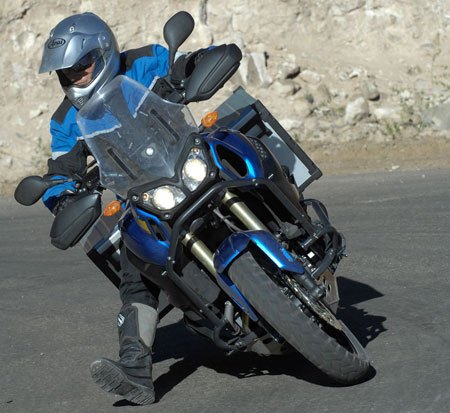
We were among the first to ride Yamaha’s new Super Ténéré on American soil. It’s a viable contender to BMW’s R1200GS, with standard traction control and antilock brakes.

The dual-purpose category, although just 6% of the total U.S. market, has shown steady growth since 2005, primarily in the 651cc-and-up segment that was primed by BMW’s R1200GS. The new Super-10 wants a slice of that lucrative market pie.

Roosting in the Arizona desert, the Super Ténéré will land in American dealers in May, 2011.

And after bashing Yamaha’s big trailie around the roads and deserts of Arizona for a couple of days, we found the Ténéré to be a good match for the dominating GS.
Key among the Super-10’s attributes is the features-per-dollar quotient. Its $13,900 base MSRP includes traction control, antilock brakes, dual-mode ride-by-wire mapping, tubeless spoked wheels and hand guards. In comparison, the rarely seen base version of the BMW retails for $14,950 but does without ABS or traction control or hand guards. BMW’s optional “Standard Package” includes ABS, hand guards and on-board computer but retails for $16,935. Spoked wheels are a $500 upgrade, and traction control is another $400.
"...we found the Ténéré to be a good match for the dominating GS."
Although no OEM will likely build a horizontally opposed Twin like the BMW’s Boxer motor, Yamaha has built a distinct but reasonable facsimile. Its Twin is rated at 108.5 crankshaft horsepower, nearly identical to the 110 ponies claimed for the GS.
But the cylinder arrangement of Ténéré’s inline-Twin stands apart. It uses a slightly smaller bore (98mm vs. 101mm) and longer stroke to yield 1199cc (the 1200GS displaces an actual 1170cc). It uses a 270-degree crankpin offset, which has cylinder 2 firing 270 degrees after cylinder 1, then cylinder 1 firing again 450 degrees later. This uneven firing order is said to improve a tire’s grip on slippery surfaces and also has the side benefit of creating an exhaust note very similar to that of a V-Twin.

The Ténéré is powered by a parallel-Twin engine with a 270-degree crankpin offset. A counterbalancer at the forward end quells vibration and drives the water pump (left).
A smallish radiator is mounted on the left side of the Ténéré. It wasn’t unusual to see the temperature gauge above 200 degrees and accompanied by a Buell-like whirring fan noise.
A nicely shaped cast-aluminum swingarm houses the Ténéré’s shaft final drive.

This uneven firing order creates a lot of vibration, so the Ténéré’s motor is equipped with twin counterbalancers to smooth things out. The balance shaft at the front of the cylinders doubles as the water pump drive. A dry-sump oil system helps the engine be mounted as low as possible so it can be placed optimally in the steel frame. A side-mount radiator allows the engine to be placed further forward, resulting in 50.5% of the bike’s weight to be on the front wheel.
Air is mixed with fuel inside 46mm throttle bodies with 12-hole injectors, firing inside twin-plug cylinder heads like the GS. A ride-by-wire throttle makes possible the traction-control system that has two settings and can also be disabled. It also allows switching maps from a softer Touring setting to a more aggressive Sport mode via a button on the right-side switchgear.
Ears are greeted with a pleasingly deep exhaust sound from a big muffler hidden along the bike’s left side. Its note is similar to a 90-degree V-Twin’s but with hints of the R1’s crossplane-Four and single-cylinder thumps.
"Ears are greeted with a pleasingly deep exhaust sound..."
A four-position clutch lever requires a moderately firm pull to actuate the burly clutch pack consisting of 9 friction plates. Shift action is pleasingly light and positive, and power is transferred to the rear wheel via a shaft to a hypoid gear-set on the rear wheel. The stronger hypoid design allows smaller gears than a spiral-bevel arrangement, which Yamaha says is 10% tidier. However, there is a price to be paid for the hypoid arrangement – gear whine, which is especially noticeable around 60 mph.
A cast-aluminum swingarm actuates a shock hydraulically adjustable for spring preload and rebound damping, just like the GS. Both adjustments require no tools. Like all shaft-driven motorcycles, the rear suspension kicks back over bumps while accelerating.
Rear-suspension travel is 7.5 inches, the same as in the 43mm inverted fork. Yamaha one-ups the BMW by having fork adjustments for compression and rebound damping plus preload. However, the Ténéré isn’t available with anything like BMW’s optional push-button Electronic Suspension Adjustment.
Whether on the street or in the dirt, the Ténéré’s suspension delivers action typical of its conventional design, as opposed to BMW’s interesting but oddball Telelever front end. On paved surfaces, the Yamaha’s long-travel suspenders nicely suck up bumps that would have R1 riders wincing. And it also performs competently on every dirt terrain we sampled, from blasting at 80-plus-mph on groomed dirt roads to hammering over rock-strewn canyon fireroads. 

The Super Ténéré’s suspension is almost fully adjustable, lacking only rear compression damping variance. It worked well both on-road and off.

Aiding the Super-10’s high-speed stability is a somewhat lazy rake angle of 28.0 degrees with 126mm of trail. Turn-in response is nice and neutral even if not especially quick – a GS (or Multistrada) requires considerably less effort to crank into a corner.
Tire sizes are the same as used on the R1200GS (110/80-19 in front; 150/70-17 out back), sourced from either Bridgestone or Metzeler in a tubeless design made possible by cross-spoke wheels using a raised rim center section so the spokes don’t reach into the wheel’s interior and release air.
Our test mules were fitted with ’Stone Battle Wing tires developed especially for the Ténéré, using what seem to be deeper tread grooves than off-the-shelf ’Wings to deliver surprisingly good traction in the dirt as long as it isn’t thick and loose like sand. Considering the street-biased nature of most adventure-touring riders, we consider the ‘Wings to be an excellent tire compromise.
Yamaha’s traction-control system provided seat-of-the-pants data for the efficacy of the tires. Toggled into the least intrusive TC mode via a button on the left side of the instrument pod, the Ténéré’s rear tire hooked up well enough in the dirt to keep the TC intervention (indicated by an amber light on the gauges) from cutting in too often.
The TC2 setting allows some sliding before ignition timing and fuel are throttled back to regain grip, and we were pleased to note the intervention was never harsh – the engine never fell flat on its face but instead modulated output rather subtly. The TC1 setting is more intrusive and would best be used only in the slickest of conditions.

At 540 pounds without fuel, the Super Ténéré isn’t a small bike. But that doesn’t mean it can’t be ridden like a supermoto!

Other rider aids lie in the braking system. In addition to standard antilock control, the Ténéré is equipped with Yamaha’s Unified Brake System that links the rear brake to the front lever, helping limit chassis pitching during hard braking that is typical of bikes with long-travel front suspension.

The 2012 Super Ténéré has got some dirt chops.

A pull of the brake lever actuates a pump under the seat to apply rear-brake pressure, and the system is smart enough to automatically apply more rear brake when the bike is loaded with the extra weight of a passenger (based on lever pressure) and when the deceleration rate is high. The back of your helmet and the front of your passenger’s will appreciate less bonking when braking, and the UBS operates seamlessly with a solo rider.
A pair of 4-piston monoblock calipers clamp on 310mm wave rotors up front, while a single-piston rear caliper bites on a 282mm wave-style disc. Feedback is quite good through the levers. A 32-bit ECU samples wheel-speed and other data every 1000th of a second, and these tight parameters result in an ABS system that doesn’t kick in easily and quickly reapplies the brakes for minimal freewheeling sensations.
However, we think it’s an enduro-bike faux pas to not have the ability to turn off the ABS system in off-road conditions, especially during hill descents in slippery conditions, when a locked back wheel offers greater deceleration than the on-and-off effect of ABS intervention.  

Although it’s a nice feature to have ABS as standard equipment, experienced dirt riders will wish Yamaha would have included a way to switch it off for off-road work.

BMW’s ABS system can be disabled, and so can the Multistrada’s, so we’ll have to give Yamaha a demerit point for not giving its riders that option. Yamaha’s ABS isn’t bad in the dirt and much better than earlier antilock systems, but hardcore dirt riders will wish for an off switch.
A little web searching reveals a simple way to disable the ABS, which we only discovered after we rode it. Just put the Tenere on its centerstand and run the bike in gear for a bit. This creates an error signal for the ABS system, so it shuts itself off. An ABS error code light illuminates on the instruments, and a rider is now free to lock up and slide the back tire with impunity! 
The Ténéré’s engine boasts a wide and torquey powerband, but considering the GS was obviously in Yamaha’s crosshairs, it was a little surprising to find the Super-10’s engine to be not superior to the Boxer. Seat-of-the pants impressions are of a motor not quite able to tractor away at low revs as the Beemer, and yet it also doesn’t have the top-end lunge expected of such a high-tech powerplant.
Motor Cycle News, a UK-based bike rag, strapped both bikes to a dyno, and it discovered remarkably similar powerbands up until 6000 rpm when the Boxer takes over with a stronger surge up top. The Ténéré peaked at 90.3 hp at rear wheel vs. 99.6 hp for the GS. The Beemer’s stronger engine is allied by its 30-some less pounds to handily beat the Ténéré in dragstrip, roll-on and top-speed performances.
Yamaha claims a curb weight of 575 lbs with its 6.1-gallon tank filled (mostly carried low and between rider’s legs), and MCN’s GS scaled in at 544 lbs with its smaller 5.3-gallon tank topped off.
Despite the deficit in engine performance, the Ténéré is nonetheless an appealing adventure-tourer. It has a satisfying midrange surge and is capable of exceeding 130 mph. Throttle response is quite smooth, even in the Sport setting, and engine vibration is a non-issue. An overdriven sixth gear helps supply a relaxed highway cruise.

The Super Ténéré offers reliable on-road composure despite its tall stature.

The Ténéré’s riding position is very roomy, with tall riders enjoying an extra inch of legroom with its adjustable gripper-type seat set to its highest (34.3 inches) position. An optional low saddle ($239.95) reduces seat height by 1.4 inches to a more easily manageable 31.9 inches in its lowest position but offers significantly reduced padding and, hence, comfort. Its tapered handlebar isn’t too wide and suited riders of all sizes, making it comfortable when sitting and when standing during off-road work. Clever footpegs feature a rubber center section that compresses when standing to set boot soles on the pegs’ clawed outer edges for secure grip.

The Super Ténéré’s two-position seat can be adjusted from 33.3 inches to an inch taller.

Protection from the elements is quite good. The standard windscreen deflects enough air to allow for faceshield-up riding with minimal buffeting, and the hand guards and pods around the side of the engine provide augmented wind protection for legs. The windshield adjusts to two heights, but unlike the GS’s hand-turnable knobs, the Ténéré requires removing four screws. Enhanced wind protection is available from an accessory windscreen 2.4 inches taller and adjustable over 3 positions, retailing for $119.95. Side wind deflectors made from 4mm polycarbonate are also optional ($79.95).

A rear luggage rack is standard equipment, and it can be expanded by removing the pillion seat to reveal a flat surface to strap down large items. The rear carrier also serves as a mount for an accessory cargo box ($369.95) big enough (30 liters) to hold a full-face helmet.
Greater stowage capacity is offered by optional saddlebags with 61 liters of combined capacity, and all bags can be keyed to the ignition key. They are built around rugged injection-molded nylon frames with aluminum skins and retail for $1089.85 including a mounting kit. We mostly liked them, but the lid latches are finicky and need to be firmly pressed shut to close properly. I wasn’t the only one at the launch who rode away mistakenly thinking the bags were latched.

Should your adventures take you far, you’ll probably want to fit your Ténéré with the optional aluminum-skinned luggage.

The instruments include good stuff like an analog tach (with 8000-rpm redline) next to an LCD info screen that includes speed, drive modes, clock, dual tripmeters, average and instant fuel consumption and air temperature. A fuel tripmeter counts up the miles since switching to the 1.0-gallon reserve, but the instruments lack a range-to-empty feature and a gear-position indicator. A single DC power plug resides beside the gauges.
Some other optional equipment might be considered necessities for those who are serious off-roaders. Key among them is a bash plate to protect the header pipes and oil filter that are otherwise vulnerable to damage – since the engine is mounted as a stressed member, there are no lower frame rails to offer protection, and only a small plastic guard is fitted as stock. The Yamaha accessory skid plate ($199.95) is constructed of 3mm thick aluminum which appears to be quite sturdy, suffering without damage several big rock hits during our ride.

Visible in this shot are the optional aluminum bash plate and steel crash guards surrounding the engine. A centerstand is included as standard equipment.

Your globe-trotting adventures should also be accompanied by the optional crash bars that will protect the side-mounted radiator and other stuff you don’t want broken in a spill. Consider the powder-coated steel cage ($449.95) to be proactive roadside insurance.
Heated grips are another nice option that matches up to BMW’s GS, and they retail for $399.95. Also like BMW, Yamaha has combined several accessories into three optional packages, all of which include a GoPro Hero onboard camera.
The X-Country Terrain package includes the crash bars, skid plate and a polycarbonate headlight protector for $749.95. The Comfort & Convenience bundle includes the top case and liner, heated grips, tall windscreen and wind deflector kit for $1,019.75. At the upper end of the price scale is the Adventure Touring Kit for $1,519.60 that includes saddlebags and bag liners, a tank bag, tall windshield and wind deflector kit.

The Super Ténéré can provide inspiration to take your riding adventures to the next level.

ConclusionYamaha’s Super Ténéré brings a worthy foe to the adventure-touring class by virtue of its versatile set of capabilities. It’s one of the rare motorcycles that can easily knock out 500-plus miles of highway travel in a day and also allow exploration of uncharted and unpaved trails off the beaten path. But so does BMW’s R1200GS and GS Adventure, a thoroughly developed all-terrain vehicle that has become a class icon.
That the Ténéré mostly matches the formidable GS is no small feat, and that it accomplishes this at a price thousands of dollars less than its German rival makes it a real player in this market.

Whether on asphalt or dirt, the Super Ténéré can get you to nearly any destination.

If you want a Ténéré of your own, you’ll need to put down a $500 deposit to reserve your bike through Yamaha’s Pre-Delivery Deposit Program, the same as used for the FJR1300 and V-Max. Pre-orders close on March 31, 2011. Deliveries begin in May.

2010 Yamaha YZ250F Review

Yamaha claims to have sold over 60,000 YZ250F motocross bikes since the model was first introduced in 2001. How’s that for an opening statement? Sixty thousand units, in motocross terms, is gigantic. The five-valve Thumper redefined the small-bore class, made 125s obsolete overnight and its torquey, easy to ride nature made amateurs feel like Pros.
This fall, the 2010 YZ450F received the lion’s share of updates and media hype due to its fuel injection system and reversed cylinder. Those sweeping changes on the big bike forced the carbureted 250 back into the shadows, but they shouldn¹t have. The YZ250F saw big changes of it’s own for 2010, without taking away from the vital ingredients that have made it such a success for Yamaha.
On the track, the new YZ250F is easy to ride aggressively.
Lets start with the new bilateral aluminum frame, constructed from a combination of forged, extruded and sheet aluminum welded to form a single unit. This makes the new bike more compact than previous models, more rigid and much easier to access the top-end of the engine for service with the engine in the frame. The wheelbase, rake and trail were massaged to enhance steering and stability; the damping and rigidity characteristics of the KYB fork were also updated and the rear shock spring now sits lower to accommodate a new airbox.
This new frame is dressed with slimmer, more aggressively European style plastic that ages better than years past and is also available in white. This new chassis has slimmer, trimmer ergonomics than ever before. There are adjustable handlebar perches on the new triple clamps, and the new fuel tank carries gas lower and further back than in 2009. Yamaha claims a wet weight of just 224.4 pounds for the new machine.
You might think the five-valve engine is unchanged, but you’d be wrong. The cylinder head features a new ‘D’ shaped exhaust port to increase exhaust gas velocity, plus lighter weight aluminum valve retainers and new softer-rate valve springs. The transmission ratios in third and fourth have also been changed to better suit the new engine’s powerband. The clutch is now actuated by a revised push lever cam, which reduces clutch pull effort.

The new frame and a lower spring position on the rear shock allowed engineers to design a new intake to boost low end responseThe new YZ-F has bigger radiators, a new cylinder head and improved cylinder head access.

Feeding the new mill is a revised airbox, with a funnel shaped intake designed to improve low and mid-range power. That air gets a straight shot into the Keihin FCR-MX37 carb, which has been updated with a new accelerator pump cam and a reshaped carb throat. Keeping the engine cool are bigger and stronger radiators than last year’s model. Spent gases get shot from a new exhaust system that uses a 50mm longer muffler to reduce noise without hurting performance.

A welcome improvement is the new muffler, which is bigger and quieter than years past.

Enough already, what’s it like to ride this sucker? The new engine barks hard off the bottom, with enough torque to make one of our intermediate-level testers remark, “Are you sure this is a 250F?” From mid-range and up the power builds strongly and controllably, right up until it hits the rev-limiter. Clutch and shifting action are flawless as well, but with so much bottom end you don’t need to shift as often or resort to clutch abuse as you do on other 250Fs.
That great powerband should work wonderfully off the track as well, and it does…to a point. It’s here where the carburetor-blues haunt the bike. In low-rpm technical off-road situations the YZ250F still exhibits the old four-stroke "cough and die" syndrome that drives woods racers mental. When it happens it takes several healthy kicks and use of the hot-start button to relight. On a motocross track you’ll never notice this tendency, but off-road you never get over the feeling that the carb could flame out when the going gets tight. That’s a shame, because that snappy low-end biased powerband makes hopping over logs and rocks a breeze.
In the woods is where you’ll find those nasty old four-stroke gremlins. Out there, the torquey YZ-F motor is handicapped by low-rpm cough and die syndrome.
Cornering with the new chassis and suspension is great, though the Bridgestone tires weren’t well suited to our wet track conditions. Stability at speed is very impressive, without a surprise wiggle or squirm at high speeds over nasty whoops. No doubt the great suspension and ergonomics contribute to the bike’s prowess in that department.
The bike feels light, slim and aggressive to ride. Coupled with its aggressive powerband, the YZ250F inspires riders to go faster. That light feel helps it work in the woods as well, and backing off the compression on the fork seven or eight clicks lets it work acceptably off-road for all of you one-bike-does-it-all riders. There’s even a sturdy plastic skid plate to protect the oil tank and lower frame rails! The final drive gearing is too tall for tight woods work, so we’d recommend adding a couple of teeth to the rear sprocket if you are racing off-road. The new, bigger radiators help cooling as well. Our test YZ-F never steamed no matter how much we abused the clutch on hilly singletrack trails or on the muddy motocross track.
So what do we think? The most recent bike we can compare the YZ250F to is the 2010 Honda CRF250R. The CRF had a more refined feel to it, started easily and never misbehaved even when we chugged around on it like a trials bike. The YZ250F has more power everywhere than the Honda, better clutch feel and more aggressive suspension settings. As such, we’d say the YZ250F is a superior motocross-only weapon than the Honda, but it never lets you forget you’re on a race bike if you take it off the track. The Honda is a great motocross bike that is equally happy pretending to be a docile playbike when you aren’t racing.

The new Yamaha feels light, aggressive and craves tight, jump-filled motocross tracks.

Other stuff? The Yamaha looked fresher and sounded tighter at the end of the test than the Honda did after a similar amount of riding time, so kudos to Yamaha for their build quality and improved plastic. The Yamaha also looks more modern and by virtue of its long history has huge aftermarket support for the engine. Support for the new Honda will catch up, but at this point the reliability of the all new CRF250R engine and EFI system is unproven.
So, how does the new YZ-F really stack up? You have to decide if you want to race motocross only or will be mixing it up with some off-road racing. These days, with such huge growth in GNCC, WORCS, Enduro and Endurocross racing, a motocross bike has to be able do everything to be a runaway sales success. The Yamaha YZ250F will do whatever you ask of it, but where it really shines is on the motocross track.

2011 Yamaha FZ8 coming to the U.S.

Yamaha announced today that it will be importing its sporty FZ8 naked sportster to the U.S. for 2011.
The fuel-injected, 779cc, alloy perimeter-framed four-cylinder has been on sale in Europe since last year, and it’s being touted as a compromise between the less-powerful 600cc middleweights and the bigger literbikes like Yamaha’s R1-based FZ1 and Kawasaki’s Z1000.
The FZ8 actually has much in common with the FZ1. Its engine – six-point mounted as a stressed, chassis-reinforcing member – shares the same 53.6mm stroke, but its bore size is 9mm smaller, at 68mm, instead of 77mm as found on the FZ1.
The FZ8’s 464-lb curb weight comes in at mere 23 lbs under its 487-lb liter-sized big brother. Part of the weight savings is nothing more than a slight loss of fuel capacity, as its 4.5 gallon fuel capacity is about one quart less than the FZ1’s.

Yamaha’s FZ8 will come to the U.S. in December. What do we call it, a mid-heavyweight? Unlike in Europe, there will be no ABS available for U.S. consumers. This helps it achieve its reasonable price of $8,490.

Likewise, the FZ8’s twin front disc brake specs are nearly identical, at 310mm front compared to the 320mm discs for the FZ1. A single 267mm disc in back contrasts with a 245mm rear disc on the FZ1. Both are pinched by similar four-piston front, and single-piston rear calipers.
Both ride on a similar 43mm inverted fork and a link-type Monocross rear shock, sharing a 57.5-inch wheelbase. The FZ8’s suspension is adjustable only for rear preload.
The FZ8 is not merely a gelded and cheaper FZ1. It utilizes a new crankshaft and new four-valve-per cylinder head instead of the five-valve-per-cylinder head of the FZ1 – which is itself an adaptation from the first-generation R1.

Gotta love that Euro style. Check out those curvaceous header pipes.

The new head breathes through 26mm intake valves and 22mm exhaust valves, a 12:1 compression ratio instead of the FZ1’s 11.5:1, and cam profiles tuned toward a fatter midrange. Yamaha boasts also that the intake funnels for cylinders two and three are 25mm longer than those of the two outside cylinders to help achieve a broad torque curve. In all, the package promises to be at least quasi-unique, and certainly street worthy.
Unfortunately, ABS will not be available in the U.S., as it is on this model in Europe, nor will its twin model – the Fazer 8 – which is being imported to Canada.
The FZ8’s moderately upright riding position and minimalistic bikini fairing ought to coordinate well with a sportbike-inspired 51% front and 49% rear weight bias. Its wheel sizes mimics what’s normally found on a 600cc supersport, with a 120/70-ZR17 radial up front and 180/55-ZR17 rear.
With a purported 105 hp and 61 ft-lb, the FZ8 is poised to fill the shoes of what used to be industry standard in the 750cc class.
With the power, running gear and chassis of a true sportbike combined with a comfortable riding position, the FZ8 ought to make a very sensible but powerful bike for riders who realize a 140-155 hp ballistic literbike may not always be necessary.


Further, the FZ8 at this juncture may have little apples-to-apples competition.
On the smaller side of things, there is the aforementioned ER-6n, Yamaha’s faired FZ-6R and Suzuki’s GSF650, but these are only marginally in the same category. Also, in a way, the Triumph Street Triple could be considered similar.
The FZ8 ought to have significantly more grunt than these lighter bikes, without being insanely fast to the point of testing fate.
As for bikes to compare it to on the larger side are machines like the Triumph’s Speed Triple, Kawasaki’s Z1000 and Ducati’s Twin-cylinder Monster 796. But all of these are quite a bit more pricey.
So, the FZ8 is actually in a fairly unique position in the marketplace, and is a new option for American riders.
At a list price of $8,490, the 2011 FZ8 undercuts the FZ1 by a fair margin. The 2010 FZ1 carried an MSRP of $10,290, and we expect that to increase for 2011. In simplistic terms, the FZ8 provides an unfaired and 200cc smaller FZ1 at a savings of around $2,000 or so.