Thursday, January 27, 2011

2011 Husaberg FX450 Review

The Husaberg is powered by what is essentially a KTM engine that has been folded, turned around and contorted to meet the engineers’ goals of mass centralization. The heaviest parts of the Husaberg engine, like the crankshaft, are located where they should have the least effect on handling. The oddities don’t stop with the pretzel shaped engine either. The Husaberg line features plastic subframes, a front mounted airbox and a unique steel frame. KTM provides the WP suspension components, and in the case of the FX450 they are off the KTM XC line. The rear shock doesn’t use a linkage but has different valving and reservoir placement than a KTM shock.
2011 Husaberg FX450
Husaberg has seen international success in the most grueling races on earth with its FE line of enduro bikes. When Motorcycle.com tested the FE570 we found it to be a light handling and torquey machine bristling with high quality components. What we didn’t like was the wide-ratio transmission, super-soft front suspension and the bike’s weight. The FE570 didn’t feel heavy to ride; just the opposite, it felt surprisingly light on the trail. It was only when hoisting it onto a bike stand, picking it up after a fall, under heavy downhill braking or charging into turns that you really noticed its true weight.
This summer, in Alberta Canada at the Xtinction Extreme Enduro, we rode an FE570 belonging to Dave French of A&E Racing. His bike had been modified with a stiffer fork from the FX model, changing the character of the bike completely. We found it to be a great motorcycle on such technical, hilly terrain. Canadian Extreme Enduro racer Shane Cuthbertson raved to us about how much better his more aggressive FX450 worked for extreme races, and ever since then we’ve been on the gas to try an FX450 for ourselves.
Husaberg made the FE into an FX by removing most of the enduro equipment and installing a 19-inch rear wheel, a better flowing muffler, a close-ratio six-speed transmission and stiffer suspension. Before you ask, no, the Husaberg FX450 at around 248 pounds isn’t as light as a converted Japanese 450 motocross bike. Husaberg did, however, read our minds by removing most of the stuff we don’t like about enduro bikes without losing an enduro bike’s user-friendly character or making the FX as sharp as a full-on motocross bike.

2011 Husaberg FX450
Our test bike was Canadian Husaberg dealer Scott Rocher’s personal bike. It was new but had been modified by Enduro Engineering with Rocher’s personal suspension settings, handlebar, hand guards and graphics. As such we can’t talk too much about suspension performance of this bike, but here’s what Rocher did: Fork: stock .48kg springs with slightly lighter high-speed damping. Shock: stiffer 8.0kg spring (7.2 stock). Naturally we would have preferred a stock machine to evaluate, but as you can imagine Husaberg FX450s are elusive animals that are hard to catch, so we took what we could get!
2011 Husaberg FX450
The fuel injected engine starts quickly with a stab at the button. No kickstarter is offered, but since new fuel injected dirt bikes start so easily these days we wonder if Husaberg could have simply used a kicker to save weight? In any case the Husaberg fuel injection performs flawlessly. It’s quick to warm up and runs cleanly at all engine speeds, with excellent throttle response. The FX450 powerband is smooth and ultra controllable, but it isn’t exactly a rocket ship. The Husaberg makes comparable horsepower and torque numbers to any other 450, but in reality you won’t be getting holeshot awards. The Husaberg’s engine shines at cutting fast lap times, not winning drag races. The mile-wide powerband is coupled to an excellent hydraulic clutch and a slick close-ratio six-speed transmission, making it easy to bomb through slippery or technical terrain without frustrating the rider.
Like most European bikes, the Husaberg excels at fast and slippery Euro-style grass tracks. It puts power to the ground at high speeds effectively, but will also pull like a trials bike when it needs to. No wonder Endurocross and Extreme Enduro guys love these bikes! Put the Husaberg FX450 on a tight, jump-filled motocross track with good traction and the story changes. Sometimes you need a big, solid blast of instant power. Husaberg Power Parts makes a switch that allows the rider to change ignition map settings from soft to normal to aggressive. Our bike didn’t have that switch, but we wish it did! Fuel Injection tuning can be further altered with a laptop computer and an EFI tuning program available from Husaberg Power Parts.

2011 Husaberg FX450
We should mention the FX450, despite having a better flowing non-spark arrested muffler than the FE model, remains fairly quiet. We don’t like to say this, but we bet with a less restrictive muffler and appropriate EFI tuning this motor could scream. If we were racing an FX450 in motocross or at wide-open ‘new school’ cross-country races we’d be trying a pipe and tuning for sure! In any case, we’ve already established raw power isn’t why Husabergs are seen on podiums all over the world. The biggest part of the Husaberg success story doesn’t revolve around horsepower, it revolves around the machine’s surprising agility.
2011 Husaberg FX450
The FX450 is stable at speed, and the unique engine placement gives the bike a light feel that hides its real weight. In fact, sometimes the front end feels almost too light. If you like doing long wheelies you’ll love this thing! We raised the fork 15mm above the tripleclamps to put more weight on the front wheel and to tighten the steering geometry, which resulted in much improved cornering habits. We have noticed with Husabergs, the Yamaha YZ450F and the BMW G450X - with non-traditional engine designs or mid-mounted fuel tanks - that they can be super-sensitive to very minor chassis and suspension adjustments. Take the time to properly dial in the Husaberg for your terrain and riding style and you will be rewarded with great handling. Don’t be lazy or you’ll be disappointed. No other 450 handles technical terrain as well as a properly tuned Husaberg.
We loved the 19-inch rear wheel. Husaberg, like us, has decided the benefits of the 19-inch hoop are well worth the trade off of slightly increased risk of flats, possible rim damage or endless repetition of old wives’ tales about why 19s don’t work off-road.

2011 Husaberg FX450
As mentioned, the suspension was set up to the owner’s preference. Rear suspension performance was average and similar to any KTM, but if this were our bike we’d try heavier valving and stiffer springs in the fork. To us the Husaberg felt too low up front, especially after we raised the fork in the tripleclamps. Our testers range in weight from 150 to 230, of different riding abilities and ages, but all remarked on this trait. We bet the standard rear spring coupled with stiffer fork springs would reduce the nosedive feel and make the bike sit more level.
2011 Husaberg FX450
The ergonomics of the FX450 are okay, but a little wide. The width of the seat/tank junction caused us to wear holes in the seat cover with our knee braces in record time. The rear fender is short and flexible and needs to be longer to be effective. There are lift points in the plastic subframe but they are too high and too far forward to be really useful.

We like how a rider can slide way up to the front of the Husaberg easily and how all the controls are intelligently placed. We also love the translucent plastic gas tank under the seat that lets you instantly check fuel level. Brakes were strong and easy to modulate and by yanking a ripcord the airbox and battery access couldn’t be easier. Everywhere you look at the Husaberg you notice ISDE-inspired touches. Even the kickstand works! The FX450 has superb ground clearance, high foot pegs and most everything is tucked out of the way and doesn’t collect mud. Riding the FX450 is an ego trip, feeding a crowd wherever you go.

2011 Husaberg FX450
Thankfully the days of squishy-soft and obese enduro bikes are long gone, at least at the National and International level of competition. It’s easier to convert a motocross bike for off-road racing than ever, but it still expensive. So is carving weight and adding power and moto-ready suspension to an enduro bike. The Husaberg FX450 is cool because the engineers have already done all the hard work for you. Yes, it is a bit fat and will need careful tuning for your riding style, but all the good stuff is already there. We really like the FX450, and we know with a little engine and suspension fine-tuning we’d love it!

Thanks to Ross Rocher Sales and KTM Canada for providing our test bike, the Corner Grass Racing Team for its input and set-up advice and the private landowners who provided facilities for this test!

2011 Harley-Davidson CVO Road Glide Ultra Review

Well-heeled riders such as these don’t choke when they are told the $35,999 MSRP of the 2011 CVO Road Glide Ultra. If you’re trying to eke out another 500 miles from your old KLR650’s tires, perhaps you’re not the customer the CVO group is targeting.

The Road Glide Ultra is the latest addition to Harley-Davidson’s high-end CVO line. This Rio Red and Black Ember with Quartzite graphics package is one of three color schemes to choose from.The Road Glide Ultra is the latest addition to Harley-Davidson’s high-end CVO line. This Rio Red and Black Ember with Quartzite graphics package is one of three color schemes to choose from.
According to Harley, the average age of a CVO customer is 54-55, right in their prime earning years. Harley research reveals that CVO customers buy $3,500 of accessories on average, roughly double that of the average H-D OE customer despite the CVOs already being fantastically tricked out.
Like last year’s CVO lineup, all 2011 CVOs are set apart from their lesser brethren by the implementation of the Screamin’ Eagle Twin-Cam 110-cubic-inch motor, hot-rodded from the standard H-D TC96 and even the TC103 in the 2010 Harley Electra Glide Ultra Limited we tested last year. The TC103 is also standard equipment in the OE 2011 Road Glide Ultra we tested last week, and also as part of an optional “Power Pak” upgrade package on any 2011 OE Harley.

If there’s a motorcycle cockpit more visually impressive than the Road Glide Ultra’s, we’ve never seen it. If there’s a motorcycle cockpit more visually impressive than the Road Glide Ultra’s, we’ve never seen it.
If you can’t convince a passenger to ride with you on a seat like this, you may have deep personality issues. If you can’t convince a passenger to ride with you on a seat like this, you may have deep personality issues.
This year marks the first time there has been an Ultra version of the Road Glide, and Harley describes it as “a super-premium touring motorcycle.” As such, the RGU is gussied up with every luxury-touring amenity Harley can think of. And, like all CVO’s, it makes for an impressive sight, with rich custom paint, deep and lustrous chrome, and wonderful finish quality.
It’s a fact that if you’ve got stacks of cash, you’re more likely to have a grateful companion along for the ride. CVO engineers obviously have learned that if momma ain’t happy, nobody’s happy, because the RGU’s pillion seat is a sumptuous place to plant a pair of cheeks. 
Both rider and passenger get electric heating, leather inserts and matching adjustable backrests. The reshaped saddle also has another trick up its sleeve, having a hammock-style suspension for the rider and a spring-board suspension for the pillion under its thick padding. Passengers will also appreciate the air-adjustable lumbar support that can be positioned in four areas of height.
Behind all that queenly luxury is a Deluxe Tour Pak top-box with interior lighting, an internal 12-volt power port, and color-matched LED brake/tail lamps. Its lock (and those for the saddlebags and ignition) is remotely operable – all at the push of a button on the bike’s key fob. Carry-out luggage liners ease the walk up a B&B’s steps, and an Air Wing luggage rack provides a place to strap on a trinket from the antique store.
Along with the typical RG cockpit features, the CVO version adds cruise control, four BOOM! speakers driven by a Harmon/Kardon 40-watt-per-channel amp, and an 8GB iPod nano that automatically charges itself when stored in its saddlebag pouch. The audio system (including XM radio and intercom) offers an iPod interface via the audio system’s screen and is controlled by handlebar switches. The Glide’s chrome 1-inch handlebar is slightly reshaped for extra comfort, and most wiring is routed internally. A tri-phase charging system generates 650 watts, enough to power all the trick convenience gizmos.

The Road Glide Ultra has a vast array of accoutrements to make its riders as comfy and entertained as possible. Heated seats and grips, dual backrests, cruise control, audio system and ABS only touch on a few of its features.The Road Glide Ultra has a vast array of accoutrements to make its riders as comfy and entertained as possible. Heated seats and grips, dual backrests, cruise control, audio system and ABS only touch on a few of its features.
The Road Glide is distinguished by its distinctive dual-headlight prow of the frame-mounted fairing. This CVO version is visually set apart by its Mirror Chrome Agitator wheels, 18 inches in diameter front and rear, and new billet muffler end caps with black spears. You’ll also notice the Rumble Collection foot controls, mirrors and saddlebag latch covers, all bathed in rich, deep chrome. Trim panels for the CB pod insert, Screamin’ Eagle 110 intake insert, and Tour-Pak lid insert feature a new diamond-cut pattern.

Harley’s CVO division always delivers superlative paint and finish work. Seen here is the Frosted Ivory and Vintage Gold with Quartzite graphics version.Harley’s CVO division always delivers superlative paint and finish work. Seen here is the Frosted Ivory and Vintage Gold with Quartzite graphics version.
Glide Ride
First impressions of the RG Ultra are of its physically imposing size and its brilliant finish quality. There’s a lot of stuff to look at on this huge machine, and all of it is of a very high quality. The RG’s massive fairing presents to a rider a lustrous cockpit with a bold instrument panel that is painted to match the body panels. The Rio Red version features deep red metallic paint that a rider can admire all day long.

Although the Road Glide Ultra is ponderous at low speeds, it can carve up a twisty road at a fair pace. Harley says it can be leaned over to the right up to 33 degrees.Although the Road Glide Ultra is ponderous at low speeds, it can carve up a twisty road at a fair pace. Harley says it can be leaned over to the right up to 33 degrees.
Speaking of all day, the RGU’s pillowy saddles seem fully up to the task – this could be the cushiest seat combo in motorcycledom, made even more pleasing by their heating elements. The newly shaped handlebar is a comfortable reach, and it also includes a mount for the Road Tech zumo 660 GPS navigation system. A small ergonomic niggle for shorter riders is the high angle of the audio display. I also had problems navigating through the iPod menu, but I have little doubt it would become second nature after more miles.
The RGU is said to scale in at 943 lbs full of fuel, and it certainly feels it when lifting the bike off its chrome sidestand. Rubber-mount handlebars and a lot of weight carried high (fairing and top case) conspire to made the RGU a little unwieldy below 5 mph – the big Glide is daunting at walking speeds.
But once underway, the newest CVO seems to shed some of its considerable weight, and it adroitly bends into corners better than you might expect. Air-adjustable shocks allow the RGU to adapt to various loads, all the way up to its 1360-lb GVWR. Harley claims an available lean angle of 33 degrees (30 degrees on the pipe side), more than many cruisers.

This Charcoal Slate and Black Twilight with Quartzite graphics version is the most understated of the three available color schemes for the Road Glide Ultra.This Charcoal Slate and Black Twilight with Quartzite graphics version is the most understated of the three available color schemes for the Road Glide Ultra.
Hauling all that weight down from speed is a fairly potent brake system. Triple Brembo four-piston calipers offer strong bite on the trio of 300mm rotors, with smooth initial power progressing linearly to the ABS system’s reasonably high limits.
Performance from the Screamin’ Eagle TC110 was muted because of the mile-plus-high elevations around the Lake Tahoe area in which we rode. But despite the thin air and a half-ton of weight, the burly TC110 never felt out of breath. Throttle response is impeccable, with ultra-smooth pickup from a closed throttle. The rubber-mounted V-Twin is exceptionally smooth on the road, with vibes only noticeable at idle. The addition of a high-torque starter ensures the big-cube motor fires up easily.

Chrome, glorious chrome! The Road Glide Ultra is slathered in it, looking especially tasty in the Screamin’ Eagle TC110 engine compartment. Note the heat deflector behind the rear cylinder to deflect hot air away from a rider’s leg. Chrome, glorious chrome! The Road Glide Ultra is slathered in it, looking especially tasty in the Screamin’ Eagle TC110 engine compartment. Note the heat deflector behind the rear cylinder to deflect hot air away from a rider’s leg.
The RGU is EPA-rated at 47 mpg on the highway (32 mpg city), so as much as 280 miles on a single 6.0-gallon full tank might be achievable on the open road.
The distinctive Road Glide fairing is capped by a newly angled windscreen tested in a wind tunnel. The distinctive Road Glide fairing is capped by a newly angled windscreen tested in a wind tunnel.

Wind tunnel testing was used to design a new mounting angle for the 16-inch Road Glide smoked windscreen, and we found its new design to offer excellent protection for its size. Wind deflectors on the top of the engine guards force more air around a rider for greater protection from the elements.
"Throttle response is impeccable, with ultra-smooth pickup from a closed throttle."
Suspension control is quite good, especially considering the rear end has just 3.0 inches to work with, a nominal amount that helps achieve a low-ish 29.5-inch seat height. Dunlop D408/407 dual-compound tires offer acceptable grip along with the expectation of greater life from the more durable center compounds. Our least-favorite aspect of the RGU is its rubbery feel from the front end. Feedback through the rubber-isolated handlebar is indirect, and this makes itself known at parking-lot speeds and during quick steering inputs. I rode the RGU back to back with the CVO Street Glide, and the SG offers more secure feedback due to its lower-profile front tire and less weight up high from its smaller fairing and lack of a Tour Pak.
The Verdict
Okay, so the Road Glide Ultra won’t appeal to everyone – its price guarantees this even if its style doesn’t. In fact, like all CVOs, production numbers are finite - the RGU will be limited to about 3,000 units (never mind the fact that any Victory model would be lucky to sell 3K annual units).
We’ll bet that, even in this current gloomy economy, Harley will have no trouble finding 3,000 customers for this exclusive touring machine. After all, it’s the first time there has been a Road Glide Ultra to be given the CVO treatment, and CVO customers really enjoy standing apart from the crowd.
There is so much to like here, including several luxury and convenience upgrades that will coddle and soothe on road trips of every length. And, at the risk of belaboring the point, the finish quality on this and every CVO is beyond reproach. And everything is backed by a two-year warranty
Harley reps describe CVO customers as “alpha riders,” always at the front of the pack. For those who want to make a bold statement and have the bucks to afford it, this CVO Road Glide Ultra is a distinctive and stylish way to lead the parade.

The open road beckons the CVO Road Glide Ultra. Comfort will never be an issue.The open road beckons the CVO Road Glide Ultra. Comfort will never be an issue.

2011 Triumph Sprint GT Review

The formerly designated Sprint ST (Sport Tourer) has now evolved into the 2011 Sprint GT (Grand Tourer). In becoming so, it delivers more cargo room and a plusher ride, while not losing much of its edge as a respectable canyon carver with bags.
The newly aggrandized model achieves its status in part by a 3.2-inch longer wheelbase (60.5-inches compared to a previous 57.3 inches), while offering updated styling to modernize the ST’s five-year-old design. The penalty for the new Sprint’s stretching and aesthetic sharpening is an additional 60 lbs – a more than 10% curb weight increase over its predecessor, now at 591 lbs full of fuel.

The UK-designed Sprint GT edges toward upscale without the sting in price and stands alone without any direct price-to-performance and features competitors.The UK-designed Sprint GT edges toward upscale without the sting in price and stands alone without any direct price-to-performance and features competitors.
Triumph says the retuned version of the same fuel-injected three-cylinder engine that powered the ST now makes 5 more hp (128 hp vs. 123 hp). Claimed torque is increased by just under 4 ft-lbs to 79.7 ft-lbs, and now comes in at 6300 rpm -- 1200 rpm sooner than on the ST.
Overview

The new rear view of the Sprint includes a single exhaust in place of the triple trumpet found on the previous ST version.The new rear view of the Sprint includes a single exhaust in place of the triple trumpet found on the previous ST version.
Tidy details abound. The black-finished cast bits, and polished pieces complement the single-sided swingarm. The ignition key detaches the one-piece saddle.Tidy details abound. The black-finished cast bits, and polished pieces complement the single-sided swingarm. The ignition key detaches the one-piece saddle.
Triumph says it has tipped the balance more toward “touring” in the sport-touring equation. Although we’re not overawed by the extra bulk with only some extra muscle to push it, we’ll still say that the bike works very well as the sporting tourer it’s intended to be, and we really like it.
Improvements include a stainless steel side-mounted muffler, instead of the signature three-pipe underseat exhaust that, while stylish, caught criticism by some for cooking the rider.
The GT’s wide, mildly stepped saddle provides all-day comfort and accommodates a variety of riders, although its claimed 32.1-inch height is pessimistic. “My inseam measures about 32 inches,” says Duke, “and there’s no way I can flat-foot the Sprint at a stop.” Coupled with a sufficiently broad and well-finished fairing, this still-potent bike is a mile eater.
A Sprint rider has a greater reach for the bars than its larger sport-touring rivals like the Yamaha FJR1300 and Kawi Concours 14, but ergos are nonetheless reasonably upright. The relatively tall seat height allows a comfortable amount of legroom despite the moderately rear-set, rubber-topped footpegs.
The alloy perimeter frame – tastefully finished in black and accenting nicely against black wheels and other black pieces – rides rock steady, and is coupled with a conventional Showa 43mm cartridge fork. Canted at a steep 23.5-degree rake and providing 84mm trail, the preload-adjustable fork has dual-rate springs, and, while simple, it is effective.
Out back is a monoshock that’s easily adjusted for preload by a large, right-side-mounted knob. The overall ride is quite plush on the freeway, and the fairing effectively deflects wind to shoulder height.
The single-sided cast alloy swingarm with eccentric chain adjuster, plus other castings, machined bits, hardware, and overall fit and finish are a pleasing sight to those who appreciate attention to detail.

This knob adjusts the rear spring preload.This knob adjusts the rear spring preload.
Front Nissin four-pot calipers clamping 320mm rotors, and matching dual-piston rear caliper putting the squeeze to a 255mm rotor, are strong and reliable. Braided brake lines provide good feedback. The anti-lock system has a fairly high threshold up front, but intervention comes up easily from the rear.
One nitpick in this department is the rather long reach to the front brake lever. Both the front brake and clutch lever are adjustable to four positions, but there is a significant disparity in reach between the two. Even large hands have a longish reach to the brake lever when set to the shortest position.
Less easy to criticize, but also not utopian, is the 5.3-gallon fuel tank. Triumph claims about 200 miles per tank-full. Our testing confirmed this could be possible, but aggressive solo riding will tip this to closer to 170 miles or less. This is not so bad, and a lot of riders will be satisfied with this. Even so, we’d have liked to have seen a 6-gallon tank on a bike with this long-legged two-up potential. However with its curb weight already knocking on the back door of 600 lbs, and perhaps other design considerations, the fuel capacity is what it is.

Headlights are improved, and look bright enough here. We’d still opt for aftermarket extra lighting if it were ours.Headlights are improved, and look bright enough here. We’d still opt for aftermarket extra lighting if it were ours.
Another issue we’d observe is with the headlights. The Sprint ST was known to have only so-so illumination. Triumph says the Sprint GT’s halogens replacing the projector setup on the previous model are better, and we agree. However, they are only okay. The twin low beams on either side leave dim spots in the beam pattern, and have only adequate peripheral coverage (for cornering or to spot animals crossing the road, etc.). The cycloptic center-mounted high beam gives good illumination of trees and overhead signs on the highway, but does little to fill in the voids left by the low beams or add to the side view. We think one high-beam bulb for two low beams is inadequate for a high-speed tourer, and believe more lighting might have been had by better engineered use of reflector space and other lighting technology now available.

Cockpit view: Instruments are functional. Polished handlebar weights roll freely when twisted. Hitting the red right-side kill button shuts off the electricity to the instruments but leaves headlights on. Note lockable right side compartment in fairing. Very handy.Cockpit view: Instruments are functional. Polished handlebar weights roll freely when twisted. Hitting the red right-side kill button shuts off the electricity to the instruments but leaves headlights on. Note lockable right side compartment in fairing. Very handy.
If purchasing this bike – and by no means are we saying we would still not recommend it – we’d nevertheless factor in an auxiliary headlight arrangement to put the finishing touches on this bike’s after-hours back-road potential.

Large 31 L: (8.2 gallon) saddlebags detach and attach easily. Large 31 L: (8.2 gallon) saddlebags detach and attach easily.
Additional very minor complaints would be for an LCD bar graph-style fuel gauge that’s slow to register after a fill-up. Also, our bike would stall when coming to a stop while the engine was still warming.
Speaking of instrument functions, the trip computer on the GT complements the normal data readout one would expect with additional features travelers might want to know. These include clock, instantaneous fuel consumption, average fuel consumption, range, trip distance, average and maximum speed.
The icing on the new, larger Sprint GT cake comes from well-designed panniers featuring a rather generous 8.2-gallon capacity, and a max laden weight of 16.5 lbs per bag. They are easy to open and close, remove and install, and they lock with the ignition key. Closing with a deep lip into a rubber gasket, they are tight, and hosing them down with a direct blast of water at the seam verified their water resistance.
On the Road
You’ve heard the extent of the gripes up front. No issue was enough to really raise much of an eyebrow, and at this point, we have mostly praise for this unique motorcycle.
Most noticeable is a grunty motor that lets the machine pull away from a stop with poise and ease. Although the power-to-weight ratio is down from the ST, the engine still has enough torque to loft the wheel in first gear with a snap of the throttle or a little clutch slip.
At low-to-moderate speeds the exhaust note grows from burbly to authoritative. On the boil, the Triple’s wailing soundtrack is agreeable, although some of the good vibes felt include those transmitted from the revving engine. This resonance can be perceived through the tank when resting against it. It’s buzzier than the velvety but approximately $5,000-more-as-equipped Honda VFR1200F, for example, but only when revs are higher than normal cruising speeds.

With chain drive, single-sided swingarm, large bags, ABS and centerstand included, the Sprint GT is an able-bodied pavement scraper that encourages riders to keep dipping it lower.With chain drive, single-sided swingarm, large bags, ABS and centerstand included, the Sprint GT is an able-bodied pavement scraper that encourages riders to keep dipping it lower.
As for its handling manners, the Triumph leaves little to be desired. Turn in response is suitably quick at any speed, and the GT proves to be much more agile than any of its 1300cc-plus competitors. The Sprint’s aggressive chassis geometry – coupled with the 10mm narrower than some rear tire – encourages riders to whip this 600-pounder around like they stole it, and implicitly coaxes them to try to go deeper and deeper. Cornering grip from the Bridgestone BT-021 ZR-rated Sport Touring tires (120/20-17 front, 180/55-17 rear) is enough to scuff the peg feelers on good pavement at a brisk pace.

I could get used to this. Longish peg feelers touch down first. I could get used to this. Longish peg feelers touch down first.
Most refreshing of all is the Sprint GT’s chain drive.
For those of us still biased toward the “sport” side of the sport-touring equation, we find this to be a terrific asset on a bike like this, and not much of a liability as some shaft-drive advocates might purport. Since it comes with a centerstand, a long-distance rider can easily lube the high-quality DID X-ring chain as needed. If it actually stretches on your circumnavigation of North America, then get out the tools and adjust it.
For aggressive riders, chain maintenance is worth the effort compared to the dynamic compromises inherent in a shaft-drive system. In our view, the Sprint out viffs the Honda VFR in this performance category.
Honda says its new Viffer was created to satisfy long-time sportriders, and it designed an offset shaft drive said to let the VFR accelerate and handle practically the same as a chain-driven bike, but aggressive riders still notice the shaft on the VFR. Between the two, the Sprint GT delivers power more “like a chain” because, indeed, it has one.

Safety first! How do you like my sporty blaze-orange hunting vest and classic white AGV T-2 helmet? If the cagers tailgate me with this get-up on, it’s purely negligence or malice, but no worries here, because they’ll never keep up.Safety first! How do you like my sporty blaze-orange hunting vest and classic white AGV T-2 helmet? If the cagers tailgate me with this get-up on, it’s purely negligence or malice, but no worries here, because they’ll never keep up.
On the highway, the Sprint GT is every bit as unflappable as the ST ever was. Here its longer wheelbase and extra heft are purely assets. With its suspension set stiff, expansion joints might still jostle the rider, but not so much, and this motorcycle, with its larger-than-sportbike fairing, otherwise feels like an airplane on two wheels.
We were often surprised to see how fast we were really going when it felt so sedate and often had to back off the throttle. This is a bike that likes to get up to 90 mph in half the time it takes you to read this sentence. This range seems to be about its ideal cruising speed. Of course 55-75 mph is no problem to maintain either, but if you want to know, these are the facts.
In the interest of science and two-wheeled felicity, we can also report that the 10,000 rpm-redlined GT will pull hard well over 100 mph, but not as freely as a Japanese liter-size repli-racer when set to warp drive. This is probably a good thing since a bike like this could get you on the wrong side of the law easily and you wouldn’t want it to aid and abet you toward that any more than it already does.

We loaded the bags to near their max recommended weight. The bike falls into corners better with weight in it.We loaded the bags to near their max recommended weight. The bike falls into corners better with weight in it.
Conclusion
The Sprint GT is a bike we could live with day in and day out, and would make a great commuter, grocery-getter, weekend bike, and will accommodate two-up riding very well.
We expect Triumph will continue to attract new fans with this $13,199 machine because with chain drive, panniers, ABS, and a centerstand included, it remains with no direct competitors.
We did not test it with the optional top box that’s supposed to hold two full-face helmets, but can tell you it comes as three parts, including the $479.99 box itself, a $129.99 painted lid, and $129.99 sliding rack, for a total of $739.97.

The Triumph Sprint GT is a handsome bike, and ready to carry on the legacy of the former ST.The Triumph Sprint GT is a handsome bike, and ready to carry on the legacy of the former ST.
Our bike’s deep blue hue is very tasteful to our eye, and this new age Brit bike has a great degree of character, not lost on passers by.
Coming to a stop light, I waited as a grizzled, long-haired, white-bearded fellow, walked past with a cane. As he caught my eye, he held it, and drawing closer, he commented, “Trumpet eh?” as he continued to amble by. “Yes it is! It’s a 2011,” I replied brightly, assuming he’d been a rider long before. “That’s a nice looking scooter,” he said, as he continued toward the other side. 
Fact is, it’s a nice performing scooter, too, and after riding it hard and putting it away wet, we think this gentleman’s spur-of-the moment summation is just about spot on.

Moriwaki MD250H vs Aprilia RS125 Shootout

So, how about if you could have a sportbike that weighs fully half of what a Yamaha R6 does?
Well, the Moriwaki MD250H fits the bill, with a sub-200-lb claimed tally of pounds.
So we loaded up the race-only Moriwaki alongside a revvy Aprilia RS125 two-stroker and headed off to the Streets of Willow racetrack to gauge the performance of these GP-bred tiddlers.  Despite ultra-modest power output, the ring-dinger and the thumper were able to dance around much more powerful literbikes thanks to their incredible agility. Our day at a Fastrack Riders event was more thrilling than it would’ve been with larger and more powerful bikes, and it proved to be one of our most memorable days at the track.

On the left is the Moriwaki MD250H powered by a four-stroke Honda motor. On the right is the Aprilia RS125, one of the last sport motorcycles available with a two-stroke engine.On the left is the Moriwaki MD250H powered by a four-stroke Honda motor. On the right is the Aprilia RS125, one of the last sport motorcycles available with a two-stroke engine.
Changing of the Guard?
When the opportunity to test these bikes together opened up, we envisioned the shootout as a two-stroke-versus-four-stroke comparo, delving into the positive attributes of each. However, it soon became apparent the Moriwaki is a pure-bred racebike while the Aprilia is a hot-rodded streetbike. As such, the differences were too huge for a true shootout, but our findings were nevertheless interesting.
Aprilia RS125 – Almost Streetable
The RS125 is a mixture of disparate qualities. On one hand(lebar), it’s a tiddler GP bike in the traditional sense, characterized by its two-stroke 125cc engine. The RS125 comes by its Grand Prix persona authentically, as Aprilia has had much success in the 125cc and 250cc GP categories. The RS comes equipped with the racing livery of Jorge Lorenzo’s 2007 world championship-winning 250cc GP bike, a Fortuna cigarettes sponsor that displayed “Spain’s No.1” in countries where tobacco sponsorship is outlawed.

Aprilia leans on its multitude of roadracing world championships to deliver its two-strokin’ RS125. Although street-legal in Europe, American imports are limited only to racetrack use. Italian exotica doesn’t come any cheaper than its $5,499 MSRP.Aprilia leans on its multitude of roadracing world championships to deliver its two-strokin’ RS125. Although street-legal in Europe, American imports are limited only to racetrack use. Italian exotica doesn’t come any cheaper than its $5,499 MSRP.
On the other handlebar, the RS125 has few parts in common with Aprilia’s actual 125cc GP bike. This RS is instead built for an entry-level sportbike rider in Europe, so it is a larger, heavier and less powerful machine than its GP brethren. It’s also cleaner, incorporating a catalytic converter in European versions to meet emissions regulations.
Unfortunately for North Americans, the RS125’s tuning can’t meet our EPA regs, so the little Aprilia is imported only for racetrack use. U.S.-spec RS125s are shipped with a power-up kit that includes a freer-flowing exhaust system, a new ECU with special tuning for the race-type exhaust valve, and tweaked jetting for its 28mm carburetor.
Moriwaki MD250H – Breeding improving the race
Japan’s Moriwaki Engineering plucked four-stroke Honda CRF250X dirtbike engines and installed them in a bespoke aluminum beam grand-prix-style frame as an evolution from the 125cc two-stroke GP engines. It is perhaps the narrowest four-stroke motorcycle you can buy.Japan’s Moriwaki Engineering plucked four-stroke Honda CRF250X dirtbike engines and installed them in a bespoke aluminum beam grand-prix-style frame as an evolution from the 125cc two-stroke GP engines. It is perhaps the narrowest four-stroke motorcycle you can buy.

Japan’s Moriwaki Engineering has long history of building racebikes, and the MD250H is what it sees as the evolution of the 125cc two-stroke GP racing platform, recognizing the gradual extinction of two-stroke motorcycle engines.
As in motocross, the theory is that a 250cc four-stroke powerplant is roughly the equivalent of a 125cc two-cycle engine, so Moriwaki hatched a deal with Honda to supply the liquid-cooled 250cc single-cylinder powerplant from the CRF250X off-road dirtbike.
"...the Moriwaki is built from the ground up as a pure racing machine..."
The MD250H borrows heavily from the Honda RS125 racebike platform, using its fork, wheels, brakes and radiator attached to a bespoke Moriwaki-designed aluminum twin-spar frame designed to hold the Honda dirtbike engine. Moriwaki also builds its own swingarms and exhaust systems.
Unlike the Aprilia, the Moriwaki is built from the ground up as a pure racing machine, and it’s so tiny that the RS125 looks like a liter-sized sportbike in comparison. Its wheelbase of 48.4 inches is nearly 10 inches shorter than a Ducati Streetfighter, and its claimed tank-empty weight of just 194 pounds is about 200 pounds less than a GSX-R600!
Corner Speed Connection
With only around 30 mild but enthusiastic horses at the rear wheel, these lightweights rely on corner speed to yield quick lap times. And what fun it was riding around the outside of literbikes ridden by moderately talented trackday pilots! It was oddly and deeply satisfying to keep the throttle pinned through the track’s Turn 1 kink on both bikes.

Tearing around on these tiddlers at Streets of Willow was hugely entertaining.Tearing around on these tiddlers at Streets of Willow was hugely entertaining.
We need to give a shout-out to the friendly crew at Fastrack Riders who let us barge in to their event. For more about the trackday provider, check out this article we wrote.
I couldn’t wait to sample the racy Moriwaki, so I quickly called dibs before Pete did. Swinging a leg over its short 29.0-inch seat is ridiculously easy, but finding the ultra-rear-set footpegs is a challenge. Tight ergos require much folding of limbs – this wouldn’t be a good choice for those who shop at the Big & Tall store. Unlike most GP bikes, this one fires up with electric assist.
With just 15 degrees of steering sweep to each side, the MD’s turning radius is approximately the same as a Kenworth’s. It is so limited that no less than two (!) journos from another magazine tipped it over while turning around in the pits at a previous test!
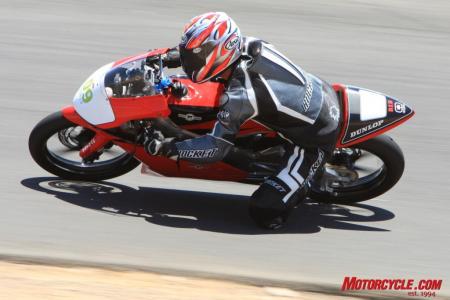
The MD250H is an amazingly potent track tool.The MD250H is an amazingly potent track tool.

It's a well-worn cliché to say, “You only have to think about a turn and you're leaning into it,” but it's truly not hyperbole with this bike! It’s so responsive that it requires several laps before your gray matter can tune in to its incredible agility. A 24.5-degree rake and 122mm of trail don’t sound very aggressive, but the bike is so light and the wheelbase so short that it can be bent onto its side in less time than you can say MotoGP.
“Truly telepathic steering response!” raved Senior Editor Pete Brissette. “I’ve never ridden a bike that’s so sensitive to the slightest change in body position or minor steering inputs. It’s almost unnatural. My first session or two on the MD was spent learning to not over steer or apex multiple times in some of the larger turns.”
Feedback at both ends is very direct, especially through the spindly-looking but effective 35mm fork and its low-mount clip-ons. The MD is very low and mass-centralized, and its little 1.8-gallon fuel tank is filled with a high-tech foam insert that eliminates fuel sloshing that can subtly alter weight distribution when accelerating and braking.
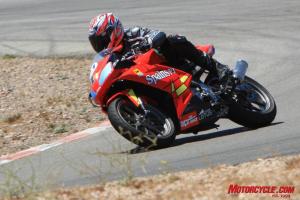
The Aprilia RS125 is considerably larger and heavier than the Moriwaki, but it still comports itself well on a racetrack. The Aprilia RS125 is considerably larger and heavier than the Moriwaki, but it still comports itself well on a racetrack.

Super-narrow (95/70-17, 115/70-17) slick-type Dunlop KR racing tires contribute to the Moriwaki’s nimbleness, and we were impressed with their grip, never really finding their limits. “Never any question of loss of side grip,” Pete notes, “and they translated plenty of feel.”
In comparison to the diminutive MD250, Aprilia’s RS125 seems like a 600cc sportbike, with much roomier and humane ergonomics that can accommodate full-size adults. Aside from its engine displacement, everything is bigger with the Aprilia – including its weight, about 100 lbs heftier than the Moriwaki.
The RS125 actually steers with 600-killing dexterity, but it requires much greater effort to turn quickly than the incredible Moriwaki. A lazy 25.5-degree rake and wider tires (110/70-17, 150/60-17) contribute to its blunter handling.
“The Aprilia has a stable and responsive chassis, but still not as lightning-quick steering as the Honda,” says Pete.
Similarly, the RS125’s suspension isn’t in the same league as the MD250, with softish, street-biased springs and shock preload the only adjustment. Conversely, the higher-end Showa suspension on the Moriwaki is race ready with full adjustability. The racetrack also revealed the Aprilia’s relative lack of ground clearance, as there was more than enough grip from the Dunlop GPR-A tires to scrape its footpegs

The RS125 is equipped with Aprilia’s typically excellent detailing, but the Moriwaki exemplifies a higher level of componentry and refinement.The RS125 is equipped with Aprilia’s typically excellent detailing, but the Moriwaki exemplifies a higher level of componentry and refinement.
The RS125’s braking performance is quite good, as it uses a large 320mm single-disc brake and a radially mounted 4-piston differential-bore caliper. However, it can’t top the exemplary feel and performance of the Moriwaki’s Nissin 4-piston caliper biting on a 296mm floating rotor. Having to slow 100 fewer pounds contributes greatly to its ability to get it quickly slowed.
Engine-eering
Both bikes are powered by a liquid-cooled single-cylinder engine fed by a carburetor, and that’s where any similarities end. The Aprilia is handicapped in this comparison because of its street-legal roots. A full-race 125cc two-stroke GP motor will annihilate the Moriwaki’s CRF250X mill in terms of peak power.
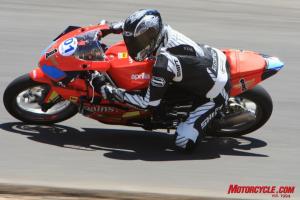
Despite the Aprilia’s power-up kit, its 125cc two-stroke motor struggled to keep pace with the four-strokin’ Moriwaki.Despite the Aprilia’s power-up kit, its 125cc two-stroke motor struggled to keep pace with the four-strokin’ Moriwaki.

The two-stroke Aprilia RS125 engine was co-developed by Rotax, and it incorporates an anti-vibration balance shaft, crankcase reed-valve intake and an oil-injection system to automatically mix oil with fuel. Some Aprilia scooters use “Pure Jet” technology to clean two-stroke exhaust emissions, but the company’s Rick Panettieri says its addition to the RS125 would bump up the MSRP by about $1,500, giving it an unappealing $7,000 price tag for such a lightweight street machine.
As expected from a small two-cycle engine, torque isn’t a strong suit. It needs to be turning at least 7500 rpm before any meaningful power is delivered, and peak torque (if you can call it that) of 17.6 ft-lbs arrives way up at 10,000 rpm. Max horsepower of 27.0 hits just 250 rpm later, and power falls of precipitously almost immediately after. Despite the racier pipe and ECU tuning, the motor feels corked up. Much of every lap was spent with the throttle at its stop.
This narrow range of power forces a rider to be precise during every gear shift, as there’s not much pull on tap even when in its optimum rev range.
“The 2000-rpm powerband range is too small,” Pete laments. “It demands the bike be on the pipe almost all the time. If I weren’t well into the powerband, or even a bit beyond, into over-rev, shifting would drop me out of the powerband.”
Thwarting perfect shifts is a gearbox not as slick as we would like. The two-cycle motor supplies almost non-existent engine braking, making the first few corner entries more adrenaline-inducing than expected.
The Honda-sourced four-stroke mill in the Moriwaki feels muscle-bound in comparison. Aside from being reluctant to pull full throttle cleanly until 6000 rpm, it proved to be incredibly cooperative with its broad spread of power. Thanks to Gene Thomason Racing in Torrance, California (310/618-1908) which strapped these bikes to the dyno for accurate rear-wheel power figures.
The MD’s motor tugs surprisingly strong from 8000 to 12,000 rpm, aided by the bike’s scarcity of mass. Peak torque of 17.6 ft-lbs hits at 7500 rpm, so there’s enough grunt to allow a short-shift and still maintain a quick pace, even able to run a gear high without losing much time. A maximum of 32.6 hp is reached at 11,000 rpm, and there’s a generous 2000-rpm over-rev zone in which power gently tapers off.
“Using this tiny 250cc Single to chase down 1000cc superbikes was nothing short of invigorating fun!” Pete exclaims. “Once again I realized that it’s much more entertaining to go fast on slow bikes than to go slow on fast bikes.”
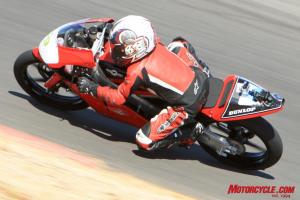
Current 125 GP racer Daytona Anderson tearing it up on the four-stroke Moriwaki. This 12-year-old rips!Current 125 GP racer Daytona Anderson tearing it up on the four-stroke Moriwaki. This 12-year-old rips!

The burly sound the thumper emits belies its small displacement. The 250X powertrain has some wide gear spacings in its 5-speed tranny, so it's sometimes preferable to rev it out to the 13K rev limit so engine speeds don't drop too low during upshifts. The gearbox is smooth and slick, and there’s barely any engine braking so there's no real need for a slipper clutch.
If there’s a negative about the Honda CRF250X motor, it’s that it’s not the more powerful CRF250R motocross bike engine that can better compete with race-spec 125cc two-stroke powerplants. Competitive power is said to be available by bolting in the 250R’s lumpier camshafts.
As it is, the 250X motor doesn’t have the top-end pull of a 125cc two-stroke such as a Honda RS125 like we got to sample for a few laps. Raced by 12-year-old Daytona Anderson, the Honda GP bike accelerated much more vigorously at full revs, a result of more power and slightly less weight. It would be quicker than a stock MD250H in the hands of an expert, but it was so incredibly peaky that it was very difficult to manage. I surely turned  better lap times on the easier-to-ride Moriwaki.
After winning the SCMiniGP overall title in 2009, Anderson is devoting the 2010 race season to riding his 125 in WERA and USGPRU competition (which both have classes and generous contingency programs for the MD250H). The kid shows amazing speed for being so young and only recently beginning racing on pavement. Keep an eye on him at DaytonaAnderson.com.

The ultra-peaky powerband of Anderson’s Honda RS125 racebike proved tricky to master.The ultra-peaky powerband of Anderson’s Honda RS125 racebike proved tricky to master.
The Verdict
This bike pairing was brought together by their small displacements and track-only intentions, but yet they exist on different planes altogether. The MD250H is a pure racing machine, stripped down to the bare minimum to achieve the ultimate goal of quick lap times. Its Honda engine is superior to the Aprilia’s lump in every performance measure, and its one-third less weight is a huge advantage when cutting fast laps.
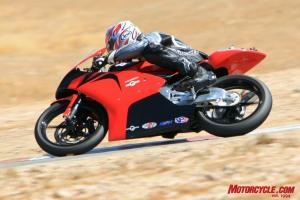
The MD250H is a stunningly intoxicating motorcycle. Pricey, though.The MD250H is a stunningly intoxicating motorcycle. Pricey, though.

Our seat-of-the-pants impressions were corroborated by Fastrack’s lap timers. Pete went 3.1 seconds faster on the Moriwaki, and I clocked a time 6.3 seconds quicker on it. Let there be no doubt the MD250H gets around a racetrack more rapidly than the RS125. There were several track sessions in which not a single rider overtook the scything Moriwaki.
"Let there be no doubt the MD250H gets around a racetrack more rapidly than the RS125."
However, GP levels of performance don’t come cheap. The Moriwaki has a retail price of a haughty $12,699, more than twice the RS125’s MSRP of $5,499. Also factor in a larger chunk of change when it comes time to rebuild the more complicated four-stroke powerplant. Considering the Aprilia’s rational ergonomic package and its exotic nature despite a reasonable price, a convincing case can be made for the highly amusing Italian bike. 
The Aprilia RS125 is a more accessible bike in terms of both ergonomics and price.The Aprilia RS125 is a more accessible bike in terms of both ergonomics and price.

“Despite the Aprilia’s lily-livered power,” says Pete, “I think I’d still prefer it to the MD for the simple fact that its ergos are more sensible for adults, even shorter folks. And considering the MSRP is around half that of the MD, I could spend, I dunno, another $3Gs to tune the engine and upgrade the suspension, and still have money left over to spend on finding someone willing to legalize (wink) the Aprilia for the street.”
But if you’re looking for a small-bore track bike, the Moriwaki/Honda machine has much higher capabilities that proved to be endlessly entertaining. It must have been demoralizing for the ZX-10R and CBR1000RR riders at Willow who were regularly ridden around the outside of turns by the toy-sized Moriwaki. But those frowns were totally upside down inside the helmets of the MD250 rider screaming around the track with improbable speed. It makes a rider feel like an underdog even though he or she might have the best bike on the track.
The MD250H’s combination of track focus, composure, extremely light weight, incredible agility and shockingly flexible engine gives it a personality and effectiveness that can’t be matched by any other production machine. The price is lofty, but the rewards are extraordinary.

Chasing each other around the racetrack has rarely been this much fun.Chasing each other around the racetrack has rarely been this much fun.


2012 BMW K1600GT and GTL Six-cylinder Unveiled

That’s why we’ve been pleased to provide several glimpses of BMW’s upcoming K1600 series, boasting the first inline-Six seen on a motorcycle since Kawasaki’s KZ1300 bit the dust at the close of the 1980s, some seven years after Honda’s legendary CBX ceased production in 1982.
We were first teased with the six-cylinder theme 11 months ago at the Milan motorcycle show when BMW displayed the Concept 6, a streetfighter prototype with an inline-Six powerplant as its centerpiece. More news broke in July, first with the release of a design sketch and engine details, then a few days later with a report from correspondent Jeff Buchanan who got a chance to hear the ultra-touring bike in person. And then full details and pictures emerged of the production bikes at Intermot last week.
Gearhead extraordinaire Jay Leno hosted the American unveiling of BMW’s K1600GTL at his splendid facility. Legendary actor Harrison Ford rode his BMW F800GS in the rain to check it out.
On the same day the K1600 GT and GTL were shown at Cologne, we were invited to take an in-person look at a pre-production GTL during a special event at noted gearhead and funnyman Jay Leno’s sensational Big Dog Garage. The Tonight Show host opened up his sprawling facility in Burbank, Calif., to host the American unveiling of BMW’s new “top-touring” bike. Leno loves unique engines, so the K16 found an appropriate venue for its U.S. debut.
So, after perusing Leno’s amazing collection, including a rotary-engined Suzuki RE-5, a liquid-cooled parallel-Twin two-stroke Scott from the 1920s, a square-Four two-stroke Suzuki RG500 and a 1980s Honda I-6 CBX, we were given a presentation about BMW’s impressive new Six.
"Leno loves unique engines, so the K16 found an appropriate venue for its U.S. debut."
Putting six cylinders inline across a motorcycle has always resulted in a wide powerplant prone to ground clearance issues, but BMW’s Six uses several technological tricks to keep the 1649cc mill to a width of just 21.9 inches, not much more than large-capacity inline-Fours and narrower than any other I-6 ever produced.
A slightly undersquare bore/stroke ratio, whereby the bore (67.5mm) is less than the stroke (72.0mm), keeps the cylinders narrow, aided by a tiny cylinder spacing of just 5mm, a closeness unachievable in decades past. Because an inline-Six has perfect primary and secondary balance, it doesn’t require a counterbalancer and its associated drive elements.

BMW’s automotive division has had a long history with inline-Six motors, but it’s never produced one as compact as this undersquare 1649cc engine.
Note the inclined angle of the cylinders that allow space behind for the stacked transmission shafts and ancillary components.
At a reasonable 226 lbs, the engine is lighter than the CBX and KZ1300 motors. Its cylinders are canted forward at 55 degrees, the same angle as the existing K1300 I-4 engine, clearing space for a rider’s knees. A dry-sump lubrication system allows the engine to be placed lower in the frame, and tightly stacked transmission shafts keep the engine short. 
BMW claims peak horsepower is a plentiful 160 at 7750 rpm when measured at the crankshaft, but it’s the torque numbers that are most impressive. A gigantic 129 ft-lb is on tap at 5250 rpm, and a mountainous 92 ft-lb is available at just 1500 rpm. 
In comparison, the four-cylinder K1300GT, which will be dropped from BMW’s American market in favor of the K1600GT, has the same peak horsepower but is down 30 ft-lb in torque. And the lightly stressed K16 engine is claimed to be more fuel efficient than K1300’s powerplant. Although its rev ceiling is a rather modest 9000 rpm, it nevertheless has an appealing musical exhaust note when revved.
The GT version of the K1600 is the sporty iteration, featuring what BMW calls a “proactive” seating position that translates into a semi-sporting ergonomic triangle. The GT’s standard features include xenon headlamps, heated grips and (height-adjustable) seat, cruise control and an on-board computer.
The more luxurious GTL iteration is plusher, with wider saddles for both perches, larger electrically adjustable windscreen (with memory function), handlebars 2 inches further back, and footpegs positioned lower and further forward. It also gets a 7.0-gallon fuel tank rather than the GT’s 6.3 gallons, a standard top case, plus a few extra chrome accents. But BMW reps note that the GTL “is a shark, not a whale.”
Several premium materials are used to limit the heft of the K1600s. Magnesium is employed for the engine’s valve and clutch covers and front fairing bracket. Aluminum is used for the bridge-type frame and the subframe. It adds up to 703 lbs for the K1600GT without its saddlebags but full of fuel. The GTL, with its bags and top case, scales in at 767 lbs. In comparison, the 1832cc flat-Six Honda Gold Wing measures around 900 pounds.

The GTL version of the K1600 is the most luxurious, offering greater comfort and convenience accessories at the expense of some of the GT’s sportiness.
Multi-mode engine mapping is part of the “e-gas” ride-by-wire technology, giving a choice between Rain, Road and Dynamic settings depending on riding conditions. Dynamic traction control is an extra-cost option. BMW Motorrad’s Integral ABS system is standard equipment, partially linking the front and rear brakes.

Although not quite the Millennium Falcon, the K1600GTL still impressed Harrison Ford.
Suspension components are as expected from BMW. Its familiar Paralever shaft-drive system controls the rear, while the front is a Duolever fork similar to the K1300 series. An optional upgrade is BMW’s ESA II electronic suspension adjustment that delivers the choice of Sport, Normal and Comfort settings at the touch of a button.
Speaking of hand controls, the K1600s features an innovative new interface in the form of BMW’s Multi Controller. A click wheel is fitted to the left handlebar between the grip and switch housing, and it can be pushed left or right or rotated forward and back, and also includes a push function to select menu choices. It offers positive mechanical feedback so it can be navigated without having to take your eyes off the road.
The various menus are easily read on the 5.7-inch TFT (Thin Film Transistor) color display panel that offers excellent contrast for clear visibility. Two large analog dials supply speed and tachometer information. The audio system (optional on the GT) comes prepped for navigation and a controllable interface for iPod, MP3, USB, Bluetooth and satellite radio.

BMW’s Todd Anderson explains the intricacies of BMW’s Adaptive Headlight.
Also of note is the optional "Adaptive Headlight." This center-bulb arrangement supplements the standard xenon dual headlamps by adjusting in relation to the bike’s pitch and roll. So, if you’re trail-braking into a left-hand corner, the headlight path automatically raises up (to compensate for the bike pitching down while braking) and turns to the left (to shine around the corner) based on gyro sensors. This is the first time this technology has been introduced on a motorcycle.

With standard ABS and optional traction control, Jay can ride the K1600GTL with his eyes closed. Note the bike’s relaxed ergonomics.
BMW supplied some data to prove the touring market has the potential to be quite lucrative. The Touring and Luxury-Touring segments account for a significant 26% of U.S. motorcycle sales (mostly Harley-Davidsons). This compares quite favourably to the Supersport and Sport-Touring categories that add up to only 18% of the market.
The K1600s are scheduled to hit dealers in the late spring of 2011 as 2012 models. Like the S1000, K1600 customers can pre-order the bike now to reserve their place in line. The GT is available in Light Grey metallic or Vermilion Red metallic, while the GTL can be had in Mineral Silver metallic or Royal Blue metallic.
Prices have not yet been set, but we were given the impression that MSRPs won’t be far in excess of their touring competition, similar to how well the S1000RR was priced compared to its Japanese rivals. A Gold Wing starts at $23,000 and goes up to around $27K, so we predict the K1600GT’s base MSRP will be around $24,000, with a fully loaded GTL pushing the $30K mark.

You can be sure this guy will have a K1600 in his mind-blowing garage. Leno impresses not only for his collection, but more notably for his great depth of knowledge about everything he owns.