Thursday, January 20, 2011

2000 Honda RC-51 Street Ride

Irregardless of how phenomenal the RC-51's track manners may be, the majority will end up in the garages of enthusiasts who aren't necessarily racers. After all, even though the 929 looks poised to be a better all-around street bike, who doesn't want to wake up Sunday mornings and pretend they're Nicky and Colin?
In a remarkably short period of time we've seen Honda take the RC-51 from crate-to-race-track and, in its AMA debut, finish in second place at Daytona by mere tenths of a second after 200 miles of racing.
Then, just this past weekend, Colin Edwards rode his RC-51 (VTR1000SP) to a first and a second place finish in the bikes WSBK debut at Kyalami. Granted, some of the credit goes to the riders, but even Suzuki, with their talented riders, could only muster one podium finish after one year on the AMA Superbike circuit with their TL 1000R V-twin. Honda has, so far, landed on the podium three times in three races.
When a manufacturer infuses a motorcycle with the sort of characteristics that allow it to be such a force on race tracks, the bike in question is often a uncompromising pain-in-the-ass on the road, particularly for everyday use. Hondas are regarded generally as motorcycles that work well on both the track and street, but when they talked of racetrack domination with such focus, we began to worry about whether or not the new RC-51 would be any good on the street.
White Lines and Road Signs
To get the bad stuff out of the way, we feel that the RC-51 is not the visually stunning masterpiece we hoped for. Yes, it looks racy and every picture we see of it makes us drool, but in person it just doesn't look as sexy. The Ducati 748, for instance, evokes deep emotions even while it sits on its side stand and, when parked next to the RC-51, it leaves the Honda looking, well, a bit more generic.
Fortunately, when we rode the bike, it was sexy again. The RC-51 feels significantly more high-dollar than its $9,999 USD price tag would suggest. From the moment you pull in the clutch and click into the first of six gears, you feel the refinement that has gone into every piece of this machine.
Immediately after receiving our RC-51, the bike was taken for a brief ride to warm it up and then placed on our Dynojet model 250 dyno. Sure, looks and racetrack performance count, but the first question we are usually asked is "how fast will she go?"
On the track, the power of this twin made its way to the ground smoothly and seamlessly while providing just enough of the vibes common to V-twin motors to keep things in character without too much harshness. On the road, the vibes are thick below 5,500 rpm, but we accepted the vibes as part of the V-twin experience, at least as long as they didn't get too severe. Once the revs climbed above 6,300 rpm, however, the motor spun so smoothly that we wondered if Honda added a counterbalancer.
On the freeway, sixth gear feels like an overdrive since it keeps the revs so low, and we often rode in fifth gear unless cruising around 75 mph. When shifting between the gears, the transmission surprised us. Many big twins have a tendency to shift with a clunk and, although there is a bit of a thud when shifting from first to second, the change of gears was positive and smooth. Clutch operation is also smooth and it feels like it can withstand a lot of abuse.
The only negative comment about the gearbox was clutch chatter while pulling away from a stop on one particularly cold morning. However, once the bike was warmed to a proper operating temperature, the clatter disappeared.
The spacing of the transmission that worked so well on the track (taller first and fourth gears compared to the VTR 996 Superhawk) worked equally as well on the street. Our main concern was that the taller first gear would necessitate slipping the clutch to pull away cleanly from a stop, but this proved to be an unwarranted concern since the RC-51 has so much power down low.
On tight back roads, where we expected the tall first gear to be a problem, we actually preferred this setup to the traditionally shorter first gear. Instead of having to decide between a too short first gear and a too tall second gear, the RC-51's first gear was perfect for tight bends.
If you're used to riding a high-revving inline four, this bike might take a bit of getting used to because of the lower revs and the prodigious amounts of torque which find their way to the rear Dunlop. Where a rider on a four-cylinder bike would have to keep the revs up to get a good drive out of a corner, an RC-51 pilot has far less to worry about, and a twist of the throttle anywhere above 5,000 rpm will be rewarded with brisk acceleration all the way to redline.
Though the dyno chart doesn't really represent it, we felt a noticeable "hit" in the power at around 6,300 rpm which, in an otherwise flat power curve, adds a little bit of personality. The motor revs freely and pulls extremely hard by the time the rev-limiter impedes forward progress.
In freeway mode, the RC-51 shows its displeasure with highway droning though suspension that is sprung too stiffly for street duty. Still, where most stiffly-sprung suspensions tend to be rather harsh, this Honda's front and rear Showas take most of the sharp pain out of the pounding. The ride is stiff, but not bone-jarring like so many other race replicas, the Ducati 996 and 748 in particular.
Faster than a Speeding Ticket?
"What a great bike ... gawd, I suck." This was common refrain heard after riding the RC-51. When you ride this motorcycle it's as much a showcase for the bike's abilities as it is a way to confirm that you completely lack riding talent. This is not to say that the RC-51 is not fun to ride: It couldn't be any more fun (though we are dying to install a Jardine exhaust system like the HRC race bikes.). It's just that when you ride a bike that is so capable but you still find yourself going slow, there is nobody to blame but yourself.
While the RC-51 can be ridden on the street in relative comfort, we wouldn't recommend this bike if you plan on having a one-bike garage unless you live on your favorite bit of twisty tarmac. Honda's new 929 is a much better choice for an all-around street bike, and if you need that V-twin feel, there's always the good old 996 VTR Superhawk.
The Honda RC-51 V-twin is a race bike first and foremost and it makes no bones letting you know it. If that's what you're in the market for, there are few better choices. Even when the more expensive Aprilia RSV Mille and Ducati 996 are thrown into the V-twin mix, we expect Honda's latest attempt at world dominance to rise to the top. The new RC-51 is that good -- at any price.

1997 Triumph T595 Daytona

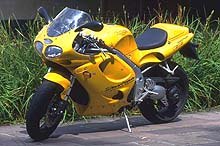
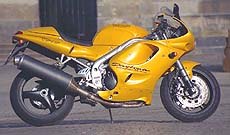
Triumph's T595 is an extraordinary motorcycle. If you consider the fact it's built by a company that didn't exist 15 years ago, that 10 years ago had no production facilities and five years ago produced less than 5000 bikes, its existence is nothing short of remarkable. Even more remarkable is that the Daytona series' lack of pedigree could justifiably be used to spin out a slew of excuses for faults in the T595, but that's not necessary. Triumph has produced a bike that can sit at the pinnacle of Open Sportbike excellence alongside the 916, Fireblade, YZF and ZXR and kick ass. It is quite simply a miracle in our time. It can't be said that the new generation Triumph Company was built out of the ashes of the company that was once an epitome of post-war British motorcycling.
Those ashes were long cold when in 1984 John Bloor bought the rights to the legendary name and put a small team together to design a modular engine and produce bread-and-butter motorcycles that would kickstart the company back into existence. Six models were presented to the world at the 1990 Cologne show and six months later motorcycle production started. After a cautious couple of years exporting to Europe and Australia, Triumph hit the USA with their '95 season models arriving stateside in October, 1994. After an absence of 20 years, they were back on the radar screens.
The first generation new Triumphs were safe motorcycles, designed and built to show the world that a Brit bike didn't have to shake itself to death, its oily fluids seeping out of every gasketed seal. Styling took a back seat to engineering, and the Trophy, Sprint, Daytona and even the naked Speed Triple models were a tad down on character. These bikes were over-engineered and under-styled, but they served their purpose in getting Triumph back on the map with a reputation for producing good quality -- if slightly bland -- motorcycles.

"Triumph, like a Phoenix, could flex its wings and design a bike to go head-on with the best of the world's Super Sport machines."

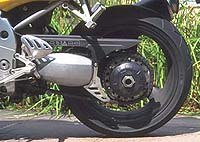
One of the first components junked was the old spine frame that had been vital to the modular concept Triumph adopted. A perimeter frame gave designers more freedom to locate the engine for optimum chassis performance. After a couple of exploratory designs in conjunction with Harris, the British frame builders, Triumph adopted a perimeter frame using distinctive oval-section aluminum extrusions. With their mandate to make a strong styling statement, a single-sided rear swingarm has been utilized, providing lots of room to tuck away the oval exhaust can that compliments the cross-section of the frame tubes. Third-party technology has been brought in from Showa for the suspension and Nissin for the brakes.
Current King-of-Stick Bridgestone BT56 Battlax tires are also used as stock equipment. Triumph's original Daytona 900 lump was used as the basis for the T595, but it has lost 26.4 pounds and gained 60cc in the metamorphosis from Jekyl to Hyde. Common consensus is that there is probably another 25 pounds that could be shaved off the T595's mill. With assistance from F1 auto-engineering consultants Lotus, a new top end was designed with bigger valves and new cams contributing to better engine breathing and combustion. Fresh gas is supplied by a Sagem Electronic Fuel Injection (EFI) system, primarily to simplify setting the bike up to meet the wide variety of emission controls from different countries. Its brains are found in the MC2000 Engine Management System that uses sensors sprinkled around the bike to work out the fuel delivery and ignition position, and chokes the engine for you on cold starts. If technology is your bag, you'll find all you need on the T595.
Thank God the technology works. Wheel the bike out of the garage, slip the key in the slot and thumb the starter - nothing happens. Pull the clutch in, try again and the engine fires up instantly, revs holding 2000 for a few seconds before slipping back to a smooth tick-over at 1100 rpm, a unique growl emitting from the three-cylinder powerplant. The engine pulls cleanly with the throttle just cracked open. There's no drive-line snatch at all. Although one of Triumph's goals was to produce a light and compact bike, they have not been entirely successful. With a dry weight of 436 pounds, it's 33 pounds heavier than the CBR900RR, and at slow speeds it feels large -- not heavy, but bulky. The handlebars are clip-ons mounted on the top of the forks and the riding position puts a lot of weight onto the rider's arms. There is something not quite right about the ergonomics, its foot rests being a tad too far forward and the bars both too low and wide. Thankfully, one of the few changes planned for the '98 model is revised handlebar geometry.
"It might look heavy on paper, but the steering is light and neutral."
Riding any bike at street-legal speeds is frustration incarnate. With five percent of the brain active, the other 95 percent has nothing better to do than check the bike for glitches. Freeway speed limits of 75 mph has the Triumph ticking over at 4500 rpm in top gear, and it's here that the only significant problem with its engine appears. Wind the throttle open for a quick decisive passing maneuver, and it hesitates a split-second before pulling cleanly past 5000 rpm. This is the infamous 1000 rpm- wide carburetion hole that becomes so visible when the T595 meets the dyno. The culprit is a restrictive exhaust at this engine speed, a trick used by many manufacturers to meet homologation noise tests. Often this results in slight dips in the power curve around 5000 rpm, but not usually on this scale, as the Triumph sees its torque output drop by 20 percent until the engine pulls through to 7000 rpm.

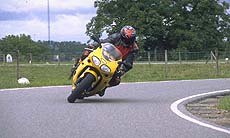
The bike is completely stable and accurate. Flop it back over to its other side for those lovely, tight Z-bends and the T595 works with you, lining you up wherever you want. Changing lines while cranked over in the corner is no problem, a slight tug on the bars is all that it is needed to move over another 12 inches and cheat Death yet again. The steering is not super-quick like on the new generation GSXR's and the 'Blade, but it inspires absolute confidence.

A conventionally carbureted engine would have a major flat spot in these circumstances, but being less dependent on airflow for fuel metering, the FI system can mask the glitch's side-effects. It's not quite un-noticeable, but damn close. The hot setup to alleviate this is to fit Triumph's after-market race exhaust can. Pull off the freeway, onto your favorite stretch of twisties and blast away into Super Sport heaven.
The bike pulls strongly, with an extra kick as it clears 7000 rpm and growls through to the healthy maximum torque output of 64 lbs/ft.

Gear changes keep the bike pulling like a Saturn 5, giving you another 2000 rpm of some of the highest torque values from any production bike. As the first bend flashes towards you, it's time to check out the Nissin brakes, which are superb, and every fractional change in pressure on the lever has the bike slowing a little faster. The braided steel brake lines eliminates any trace of sponginess. The moment of truth arrives as the bike is tipped into the corner. It might look heavy on paper, but the steering is light and neutral. Pick a line, flip the bike into it and gas it through the corner.
The Bridgestones live up to their reputation for excellent grip and stability. The T595 does need a little work on the suspension, however, to get the best out of the bike. It's adjustable for everything except ride-height on the rear shock. There is not a lot of adjustment on the bump and rebound screws, maybe 5 turns, max. But every half turn makes a noticeable difference, and the bike needs to be softened up both front and rear. With bump and rebound just 1.5 turns off the softest settings, it does a much better job soaking up stutter bumps and ripples without diving significantly under heavy braking. The twisties are a delight, and should you open up enough for some serious speed, the T595 will top out at an indicated 160 mph. It's not the fastest bike in the world, but at that velocity speed is academic. High-speed travel is comfortable, with good protection from the fairing, a little buzz through the handlebars and vibration-free foot rests. There is also a dual-seat option for those wanting to squeeze some poor sod on the back, but that's not what this bike is about.

What is it about? In its sales hype, Triumph names the 'Blade and 916 as being the bikes most heavily influencing the T595's design. But that's not the way it turned out, as the T595 misses the light-weight sharpness of those other bikes. Also, the 916's styling is still unsurpassed. Instead, Triumph has produced a British version of Yamaha's YZF1000R (winner of Motorcycle Online's '97 Open Sportbike Shoot-out). With rumors of the imminent arrival of a cut-down, powered-up version of the YZF for 1998, Triumph may be alone in placing more emphasis on stability than weight, torque than power, acceleration than top speed. Maybe the miracle will be complete and a British bike will once again be the best in the world.
Who would have thought it possible?

Specifications: Manufacturer: Triumph 
Model: 1997 T595
Engine: Liquid-cooled, DOHC 4-stroke, 4-valve triple-cylinder
Bore x stroke: 79 x 65 mm
Displacement: 955cc
Compression Ratio:  11.2:1
Carburetion: Sagem Electronic Fuel Injection
Transmission: 6-speed
Wheelbase: 44.9 in. (1140.5 mm)
Seat Height: 33.1 in. (840.7 mm)
Fuel Capacity: 4.8 gal. (18 L)
Claimed Dry Weight: 435.6 lbs. (197.6 Kg)

1999 Buell M2 Cyclone

Why call it a Cyclone anyway? And what is up with Buell's obsession with atmospheric phenomena? Perhaps someday they'll branch out into related topical names and release a Harley-powered scooter christened the Buell Breeze. And who wouldn't want an around-town thumper called the Buell Toto? We will concede, however, that 'Cyclone' seems an apt choice for the bike that has become MO's preferred Buell for 1999.
In addition to the Thunderstorm heads, the new frame allows the header pipes to be routed farther away from the rider's right leg. While it cuts down the heat, it doesn't negate it altogether. Slap on some Thunderstorm heads for '99 -- the same ones first found on the White Lightning -- and see what those fat valves can do for you. Quite a bit it turns out, which is quickly realized when your arms are straining at their sockets after an uninformed first twist of the throttle. The Cyclone is sick of apologizing for being a standard.
Moreover, shorter-duration cams than those found on other Buells might rob a little hay from the ponies up top but give it back to the chargers at the lower revs, leaving you with seemingly enough torque to crank-start a battleship.


What the Cyclone doesn't get in 1999 may be its biggest gain. The M2 retains a single, 40 mm Keihin CV carb rather than receiving the new, dynamic digital fuel injection (DDFI) system. This is Buell's first attempt at EFI and while the system should continue to improve, the present EFI Buells have first-year glitches such as a slight dead spot in the middle of the powerband. Check out the dyno chart to the right and you'll notice that the M2's torque band is flat from 3000 rpm to redline.
The M2 is the smoothest Buell in their '99 line-up. "Translation? Big, fat fun."
Power feels like it's mostly everywhere, and if you're not pouring it on for that last 1000 rpm, well, you're not having any trouble hanging some obese wheelies either or dusting your Rides-from-the-Rising-Sun-mounted buds at the stoplights. The new Showa rear-shock escapes the recall. The Cyclone's got a few new suspension tricks, too. Showa is master of ceremonies this year, providing the conventional forks with adjustable pre-load and rebound and a rear shock with adjustable spring pre-load and compression.
It's hard to get a stiff ride, however, since the whole assembly is designed with all-around performance in mind, not just the twisty stuff. But the bike handles so well, you almost don't notice it. It turns in easily, smoothly -- counter-steering is very responsive -- and holds the line with little else on its mind.
Enjoy it: The force is with you. The force is also with your butt, or more appropriately, off it. In between those porky wheel-raisers and peg-dragging moments, you'll appreciate that Buell has had mercy and increased seat width by three inches while rethinking the foam thickness.
It took them a while, but in 1999 Buell finally got the seat right. Now, instead of wondering just how many Buell engineers are having a good laugh while you're coming off two hundred miles feeling as though you've been wearing some of those sumo panties with the manly butt-strap, you'll just swing your leg over, grab one of Paco's Supermex Burritos and then be ready for the next two hundred.
Unless, of course, you've really enjoyed that sumo feeling in the past -- then you'll be bummed.
There are some other changes of note. In addition to the redesigned tail section, a new five-gallon gas tank has been fitted, and the styling change is a plus. The ignition key is now up on the dash, where it's always longed to be. There's a new, more attractive swingarm.
The engine gets some new paint with a silver-bead blast finish and black heads. The total fit and finish of the bike seems to be at a higher standard, which is nice, makes you all the prouder to show the thing off. The odometer and trip meter are digital. And the key is finally where it belongs.
"Styling-wise it's an attractive bike that gained many compliments around town over the past few months."
As Buell's entry-level motorcycle, the Cyclone inherits parts and technology that has been developed and refined on other models and, as such, the 1999 M2 has come away from the recent recall relatively unscathed. Affected are the plate and washer that retains the fuel tank to the chassis, the ball that retains pressure in the fuel tank venting system and the side-stand switch. The engine on the M2, as on all Buells, is not affected.
In any case, the M2 is still a smile machine. There are some day-to-day realities to deal with, though. Like most Harley engines, it takes a few minutes for the motor to catch it's breath after sitting in the garage overnight. If you're using a Cyclone as a commuter (a very cool commuter!) and you're in a hurry in the morning, you're going to want to make sure to roll the bike out and get it running a few minutes before you hop on.
Also, like all Buells, the bodywork is pure American plastic, so magnetic tankbags and the like won't do it. Buell does offer a line of tankbags, saddlebags, and totes, however.
New is the bigger, beefier new cast-aluminum swingarm. The older, thinner, steel swingarm is the one being recalled. Wind protection is good, and that little fly screen does more than might be expected, but it's not like there's a full fairing. There's a little head shake from time to time as well, the feel at the bars being very sensitive.
The clutch was a little clunky and neutral was, at times, hard to find. The header pipes collected some rust, but since we haven't heard of this happening on other Cyclones we aren't sure whether this is a flaw in the design or materials, whether it is due to MO's location near the ocean or whether it's a quirk of our particular press-fleet test bike. Finally, don't buy this bike with the plans of loading your significant other on the back.
They won't like it much, the bike is a little under-sprung anyway, and while the seat is vastly improved for you, it's only a little improved for your better half.
"It's quirky in some ways, but a wild ride all the same, and we found ourselves enjoying it time and time again despite our jaded selves."
Seen the latest Star Wars installment yet? If you haven't, you will soon, you can't help it. If nothing else, viewing the aggregate sum of all the trailers, cuts, stills, and commercial promos that are flashed continuously on every TV in America will be the same thing as seeing the entire film itself, albeit edited by commerce.
Watching the movie brought back so many good feelings and memories that we began to loathe most of the critics that have reviewed it so far. "It's too 'kid' for adults and too 'adult' for kids," writes one. "It lacks the personality of the first trilogy," writes another. "Movie critics are parroting, self-absorbed morons," writes MO. No, it isn't a perfect movie. Who cares? Some things are so much fun that they defy criticism.
The same goes for the Cyclone. It's quirky in some ways, but a wild ride all the same, and we found ourselves enjoying it time and time again despite our jaded selves. At $8,599 it's definitely the bang-for-the-buck Buell as well. If you're in the market for one of those does-a-bunch-of-things motorcycles then you owe it to yourself to check it out and take a test ride, which Buell always offers. If you're like us, once you twist that throttle you'll be saying, "Ah, so that's why they called it a Cyclone ..."
Specifications
Manufacturer: Buell American Motorcycles
Model: 1999 M2 Cyclone
Price: $8,999 (USD)
Engine: Air-cooled, 4-stroke, 45° V-Twin
Displacement: 1203cc
Bore and Stroke: 88.8 x 96.8 mm (3.5 x 3.8 in)
Carburetion: 40mm Keihin CV
Transmission: Five-speed, constant mesh
Wheelbase: 55.0 in (1397 mm)
Seat Height: 29.5 in (749 mm)
Rake/Trail: 24.5°, 9.65 cm (3.8 in)
Fuel Capacity: 5.0 gal/0.6 gal. reserve (19 L/2.3 L reserve)  
Dry Weight: 435 lbs (197 kg)

buell xb9r vs ducati 900ss

The controversial Terblanche plastic has grown on me, for one thing, the egos and seat of the SS are friendlier.
Maybe I'm getting old, but something about the old air-cooled two-valve twin makes me feel like I'm having a purer Ducati experience; it rumbles and clatters a little more--and I know for a fact it's fairly easy and inexpensive to turn these engines into midrange monsters. Fat midrange, shorter gearing than the 998, 20 pounds less weight, a 15mm shorter wheelbase and higher clip-ons--add up to a bike which needs no excuses and has no trouble keeping up with any sort of street pack. (The race track, naturally, where the pack is often moving over 100 mph, is a different story.)
It seemed only natural to compare the old SS to the all-new Buell, to us at least. The old Italian L-twin must still have some adherents, obviously, since it makes up a big chunk of Ducati sales. And while we weren't convinced in the beginning that Erik Buell's use of the venerable H-D Sportster was a particularly good idea (not that he had much choice), the old beast has actually reached a high-enough level of refinement in this most recent Buell that I'm beginning to grow all moist and teary-eyed with nostalgia whenever I look at it, and I'm not even a Harley guy. It's been around since 1957. Don't tell me it hasn't earned its place in the pantheon of Cool Motorcycle Engines.
When Calvin got the drop at the light, the Ducati would hold its two or three-foot advantage all the way through the quarter mile, and vice-versa on the Buell. When Calvin got the drop at the light, the Ducati would hold its two or three-foot advantage all the way through the quarter mile, and vice-versa on the Buell.
"And, as it turns out, the Firebolt engine and the old Ducati twin make almost exactly the same power"
A fact driven home both on the dyno and at the drag strip: When Calvin got the drop at the light, the Ducati would hold its two or three-foot advantage all the way through the quarter mile, and vice-versa with myself on the Buell. Neither bike is any longer what you'd call blazing fast, but both provide plenty of the kind of midrange thrust that works best on our favorite roads.
And our favorite favorite road, to which we somehow return again and again, is a saucy little two-lane number in the San Gabriel range called Sand Canyon. We took the Buell there a couple of weeks ago only to return with a slightly inconclusive road test; we liked the Buell--some of us more than others--but felt it had some unusual handling characteristics, to wit, it's heavy-(though not slow) steering, and some members of our party felt it particularly so with the brakes on. We also noted that, even though Mini felt that way, he seemed to have no problem not only running with a new `02 Honda RC51, but actually drawing away from it a bit. This not only shocked and amazed us, it elicited several expressions of disbelief from a few MO readers, one of whom conjectured maybe Burns was impaired that day? Looking back upon it through my usual beery fog, I don't recall having had anything stronger that day than my usual Cheerios in Stolichnaya and Kahlua coffee. Was it just a fluke then?
The old SS is still an enjoyable old bomb and stays pretty much on the pace. But jumping off the Firebolt and onto it is somewhat like hopping onto a vintage bike... though that's not always bad. The old SS is still an enjoyable old bomb and stays pretty much on the pace. But jumping off the Firebolt and onto it is somewhat like hopping onto a vintage bike... though that's not always bad.
This time, we set out upon the Firebolt and the lovely new Ducati Supersport, with an `02 Yamaha R1 as chase vehicle because it was there. Lo and behold, upon reaching our favorite set of curves once again (which we all know by now like the dorsal surfaces of our own John Thomases), not only did the little Buell draw away from the Ducati, it actually gapped the Yamaha as well--a 139-horsepower chariot of the gods that weighs not much more! What the?!
We swapped bikes several times, field-sobriety-tested each other repeatedly, and the same scenario kept repeating itself while Mini kept up a steady rant about the Buell STILL being an ill-handling piglet, and how could this be? Well, all I can tell you after all my years of riding motorcycles, is that strange things happen sometimes.
"There's enough power there to send the bike down the road faster than you think"
For one thing, a bit of familiarization with the Firebolt has taught us how it needs to be ridden. If we found ourselves at first running out of revs (the Buell's done at 7500 rpm), we've since learned that the little dear pulls just as hard in the next lower gear, doing so lets you get back on the gas even sooner--and no bike on the market lets you get the throttle open as early as the Firebolt does. In theory, we've always known that a short wheelbase is a good thing. In practice, the Buell's stubbiness makes clear why that's so: It finishes a given corner while the other bikes are still turning, and by the time the R1 is pointed in the right direction and its pilot feels safe enough to whack open the throttle, the Buell has already scooted halfway down the straight. The Yamaha, of course, closes the gap a bit, but here comes the next corner, the Buell flicks into it quicker--and if there are more corners than straights, you should be getting the picture by now. The Buell's extremely short wheelbase (aided by its superior "mass centralization") means it gets to full lean almost instantly and needs to spend less time there.
It's a matter of gearing, too. Our friend the R1 is geared to do 170 mph, the little Buell maybe 140. Up until 6000 rpm or so, the R1 produces no more than 60 foot-pounds of torque. As low as 3500 rpm, Mr. Buell's already reached the leading edge of its broad, flat torque plateau.
There's enough power there to send the bike down the road faster than you think, but not so much that you're afraid to open the throttle wide the instant the straight opens up. Some bikes, particularly really powerful ones ridden on really tight roads with sheer cliffs and rock walls, encourage caution. Others, like the Firebolt, like the KTM Duke, like the old Honda Hawk GT, encourage you to flog the socks off them. Sports, motorcycling included, are games of confidence, aren't they? Adjust to the Buell peccadilloes, and the thing flies.
Crack it open (or whack it open) before the apex, and you can fully experience what the bike is about. Nothing can carve such tight arcs. Crack it open (or whack it open) before the apex, and you can fully experience what the bike is about. Nothing can carve such tight arcs.
Peccadillo-wise, Minimeat is right; the Buell does steer a bit heavier than you'd expect, and it does have a bit more self-righting tendency than most, ie., you need to "hold it down" in turns. Naturally, I have a theory as to why that is, but we haven't gotten round to investigating it yet. We know one thing that causes that sort of behavior is the difference in width between a motorcycle's rear tire and its front. The Buell rides on a 120mm-wide front tire and a 180mm rear--like many current sportbikes--but could the fact that its contact patches are fully two inches closer together than the next shortest sportbike (Yamaha R6) exacerbate that tendency to stand up? I wouldn't be surprised if a 170 rear alleviated the Buell's heavy steering. (And once again, to me it's not even a problem. It's a thing I can feel which doesn't really bother me. Other riders are off-put by it.)
Number two, Mini and Calvin are bothered by the Firebolt's chassis reactions to opening and closing the throttle. "First," Mini says, "it doesn't want to turn in with the brakes on, then, when you release them, it falls into the corner."
Young Min is more sensitive than I, but I think what he's feeling is caused by the bike's zero-slack drive belt (which uses an idler wheel to eliminate slack from the final drive). On other chain-drive bikes, closing the throttle makes the bottom chain run go taut and has a mostly neutral effect on the swingarm--which leaves the bike free to transfer weight forward, compress the fork and steepen rake. The Firebolt, conversely, with the big idler wheel in its bottom belt run, looks like closing its throttle will make the rear wheel want to move upward in its travel, which means it's not going to transfer as much weight forward on the brakes--which makes it feel unwilling to turn, maybe especially if you're a big guy accustomed to lots of weight transfer.
As the corners open up and speed increases, the Ducati comes more into its own, maintaining that high-speed stability Ducatis are famous for.As the corners open up and speed increases, the Ducati comes more into its own, maintaining that high-speed stability Ducatis are famous for.
Then, releasing the brakes (and opening the throttle), again thanks to the zero-slack belt, means you're going instantly from a state where the belt wants to compress the rear, to a state where it wants to extend the rear suspension--suddenly, then, the rake steepens and the bike wants to turn.
The cure for this, I think we learn the more we ride the Buell, is to be as smooth as possible, carefully blending brakes and throttle--and when you get used to it, I for one like the fact that the Buell seems to maintain more of a level attitude than most bikes--sort of like a BMW Telelever/Paralever feel. To me it feels very solid, and that's backed up by the fact that you do have to steer the Buell where you want it to go.
"As the corners open up and speed increases, though, the Ducati comes more into its own, maintaining that high-speed stability Ducatis are famous for."
Or, if you're like me and being really smooth is out of the question, you can just keep the gas on almost constantly. Getting back to the part about how early you can open the Firebolt's throttle: Crack it open (or whack it open) before the apex, and you can fully experience what the bike is about. Nothing I can recall riding can carve such tight arcs, and that's what allows the Buell to scamper away from more powerful bikes.
The Ducati features a nice Ohlins shock, working without linkage, and a new, 40-percent stiffer swingarm.The Ducati features a nice Ohlins shock, working without linkage, and a new, 40-percent stiffer swingarm.
We know not if the roads you ride are as tight as Sand Canyon. If you ride big, open Roadrunner-cartoon roads and your group routinely see 100 mph plus, we salute you and advise you to buy something other than a Buell.
Wait! Wasn't this a comparison?! Where'd the Ducati go? The old SS is still an enjoyable old bomb and stays pretty much on the pace too, but jumping off the Firebolt and onto it is somewhat like hopping onto a vintage bike. Saaay, the front wheel's way out there and slightly disconnected-feeling, I'm way up in the air in the nose of a B-25, and why are we bouncing up and down so much? Even with the nice Ohlins shock working, without linkage, its new, 40-percent stiffer swingarm, the Ducati doesn't have the Buell's nice snubbed-down wheel control.
On the other hand, some of the same attributes the Buell has let the SS hang not far off the R1's tail: low gearing, good midrange power, light weight. The SS engine is revvier than the Buell's, with a better (six-speed) gearbox--but its chassis is archaic next to the Buell's. It feels long and rubbery ridden alongside the Buell, but in fairness, so does the R1 to a lesser extent. A Buell with a Ducati two-valver... that would be the bike...
As the corners open up and speed increases, though, the Ducati comes more into its own, maintaining that high-speed stability Ducatis are famous for. In fact, a little sport-touring on this Ducati, with a tankbag full of socks and toothbrush, wouldn't be a bad idea at all.
"That thing between your legs... that's not a Buell is it?" "That thing between your legs... that's not a Buell is it?"
For the rat race, bigger riders prefer the Ducati's slightly more expansive riding position over the Buell's higher-footpegged one. As for 5'7" me, the more I ride the Firebolt, the more in love I grow. In freeway-commuter mode, even, the little XB sops up bumps smoothly in spite of its taut suspension, the seat is fine, and suddenly I'm thinking the bars are not so far forward as I did at first. Now with a couple thousand miles on the clock, the old Sportster motor seems to be running freer, the gearbox is shifting better--and an average of 46 mpg means 3.4 gallon-fuel-capacity isn't such a bad thing. Right, the Firebolt is the best new toy I've gotten in a long time. Say, do we pick a Motorcycle of the Year at MO?
Second Opinions
Brent "Minime" Avis
My sense and sensibilities tell me the Buell is, despite our hard work, still an ill-handling machine. The Ducati, on the other hand, is a terrific bike in that time-honored Ducati fashion. It clanks, shudders a bit, and it still makes that cool clattering sound when you pull in the clutch lever. And, as a throwback to the earlier 900 (and 750 Supersport) that came before it, the front end feels like it's waaaay out there when you peer over it from the saddle. It feels a lot longer than that cigar butt of a Buell, too. The Ducati, you see, fits me nicely. It also looks just beautiful in these Senna edition colors. Yessir, if you were to ask me, I'd say it's just about my favorite air-cooled twin to date.
Sure, John can relate tales of how the Buell held off an R1 up our favorite road, then with riders swapped proceeded to deal the same fate to the high-zoot in-line for once again. He can tell you he thinks it steers light, that it shifts well, and I will continue to disagree. Respectfully. As I can only say this: the more I ride the XB9R, the more it confuses me. It's the fastest slow bike I've ever ridden. It's the best-handling, ill-handling bike I've ever ridden. It's uncomfortable yet I ride it nearly every day. It seems that I ride the Ducati only to prove to myself that I don't really like the Buell. And it seems I keep failing.
Calvinius "Hackfu-ium" Kim
John thinks the Buell is a great little bike. Mini thinks the Buell is confusing. Me, I just like riding it. Yea, it feels bizarre when you tip it in, especially when you're in a pitch adjustment phase, but overall none of us have fallen off the thing (this is good).
As for me, I like the Ducati just a bit more than the Buell. The other people at the office are faster than me regardless of which bike I ride, so for me, it comes down to things like; feel, color, design. You know, stupid subjective things. The 900 has enough feel and performance for my sporting needs, I also find the color scheme of our particular model to be particularly striking. I love the motor and the sounds it makes. But its still a pretty hard decision.
The reason being? The Buell is Cuell. Okay, that really sucked. But its still neat-o. All the neat techno bits make the XB9R stand on its own. Now, its not, "ew, a Buell, run away!" its more like, "a Buell? You mean the thing with the stuff?" See what I mean?

Specifications
Buell XB9R Firebolt

ENGINE
Type: 984cc air-cooled 45° V-twin OHV 2v/cyl
Bore x stroke: 88.9 x 79.4mm
Compression ratio: 10:1
Ignition: electronic, digital
Fuel delivery: FI, one 45mm throttle body
Valve adjustment: hydraulic, self-adjusting
Transmission: wet multiplate clutch, 5-speed
Final drive: belt

CHASSIS
Frame: aluminum alloy w/ Uniplanar engine mount system
Wheelbase: 52 in. (1321mm)
Rake/trail: 21 degrees/3.3 in. (83mm)
Seat height: 32.25 in.
Thumb height: 36 in.
Thumb-to-thumb: 19.5 in.
Wet weight (full tank): 425 lb  (193 kg)
Fuel capacity: 3.7 gallon

SUSPENSION
Front: 43mm inverted fork; 4.7-in. travel; adjust for spring preload,
rebound and compression damping
Rear: single coil-over shock; 5.0-in. travel; adjust for spring
preload, rebound and compression damping

BRAKES
Front: single 375mm disc, six-piston caliper
Rear: single 230mm disc, single-piston caliper

WHEELS/TIRES
Front: 3.50 x 17 cast aluminum/ 120/70ZR-17 Dunlop D207
Rear: 5.50 x 17 cast aluminum/ 180/55ZR-17 Dunlop D207

1/4-mile (corrected): 11.86 sec. @ 114.93 mph
Fuel mileage: 45 mpg

Colors: blue, white

Suggested price: $9,995


Ducati 900 Supersport

ENGINE
Type: 904cc air-cooled 90° V-twin SOHC, desmodromic, 2v/cyl
Bore x stroke: 92 x 68mm
Compression ratio: 9.2:1
Ignition: electronic, digital
Fuel delivery: FI, 2x 45mm throttle bodies
Valve adjustment: 6000 miles
Transmission: dry multiplate clutch, 6-speed
Final drive: chain

CHASSIS
Frame: round-tube steel trellis
Wheelbase: 54.9 in. (1395mm)
Rake/trail: 24 degrees/3. in. (  mm)
Seat height: 32.5 in.
Thumb height: 34.5 in.
Thumb-to-thumb: 18.5 in.
Wet weight (full tank): 440 lb  (200 kg)
Fuel capacity: 4.2 gallon

SUSPENSION
Front: 43mm inverted Showa; 4.7-in. travel; adjust for spring
preload, rebound and compression damping
Rear: single coil-over Ohlins; 5.7-in. travel; adjust for ride
height, spring preload, rebound and compression damping

BRAKES
Front: two 320mm discs, four-piston calipers
Rear: single 245mm disc, two-piston caliper

WHEELS/TIRES
Front: 3.50 x 17 cast aluminum/ 120/70ZR-17 Michelin Hi-Sport
Rear: 5.50 x 17 cast aluminum/ 170/60ZR-17 Michelin Hi-Sport

1/4-mile (corrected): 11.94 sec. @ 114.61 mph
Fuel mileage: 43 mpg

Colors: yellow, red, grey

Suggested price: $11,395

2011 Suzuki GSX-R600 and GSX-R750 Revealed

The GSX-R series is integral to Suzuki, so the Gixxer 600 and 750 received a major investment in technology and updates.
“We built our brand from the GSX-Rs,” said Steve Bartolamedi, American Suzuki’s senior communications manager. More than 300,000 Gixxers have been sold over the years, and the GSX-R600 has long been America’s best-selling sportbike.
The 2011 GSX-R600 has been overhauled from top to bottom, losing around 20 lbs in the process.
An all-new frame underpins the GSX-R revisions, trimmed by nearly 3 lbs on its own. This, plus a plethora of other weight-saving items, has resulted in a Gixxer some 20 lbs lighter than previous. An anticipated 410-lb curb weight (full of 4.5 gallons of fuel) would tie the Gix Six with the class lightweight, Honda CBR600RR.
Yep, that’s Italian Brembo calipers on a Japanese bike. The Showa Big Piston Fork is also new for 2011.New front-end components are more than 2 lbs lighter and promise improved performance. A 41mm Showa Big Piston Fork weighs less and offers better damping performance than a conventional fork, as we’ve learned from a similar fork on Kawasaki’s ZX-6R. And, in a surprise move, the Gixxer receives radially mounted Brembo monoblock brake calipers, the only Japanese bike we can think of with the respected Italian binders.  
Smaller front and rear axles and wheel hubs are claimed to reduce weight by a significant 1.3 lbs, and the fully adjustable Showa shock now uses aluminum seats instead of steel for a 90-gram reduction in weight.
Although final specifications aren’t yet available, it appears as if the previous bike’s steering geometry numbers are retained. However, the new frame (with sections as thin as 3mm) tightens up the wheelbase by 15mm. A new swingarm is the same length as previous, but it’s now constructed from three melted/gravity-cast sections instead of five high-pressure plate castings.
Powertrain
The GSX-R’s 599cc mill is architecturally unchanged, retaining the same bore and stroke (67.0 x 42.5mm) as the existing bike and every other 600 supersport. But everything inside has been updated, and the motor has been rotated 3 degrees more upright. It’s also a massive 4.4 lbs lighter.
Shorter-skirt pistons have 14% less mass, and the connecting rods are 12% lighter. New cams with reduced overlap are purported to boost low- to mid-range power, and they continue to actuate 16 titanium valves. New vent holes between cylinders reduce mechanical pumping losses.
Suzuki Dual Throttle Valve (SDTV) technology carries over, now better directing fuel into the combustion chamber via a steeper angle of the throttle bodies to improve responsiveness. A smaller ECU shaves 330 grams of weight and allowed it to be relocated in front of the airbox. Suzuki Drive Mode Selector (S-DMS) now has just two settings instead of three, and the softer setting now defaults to full power when the throttle is pinned.
A considerable 3.75 lbs was pared from the exhaust system’s weight, thanks to thinner-wall header tubing and a smaller under-engine pre-chamber and titanium muffler. Fuel economy is said to be improved by 10%, somewhat offset by the new requirement for premium gas.
Seen here is the GSX-R750’s new titanium muffler, not quite as light as the exhaust system on the 600.
We’re told to expect 123 crankshaft horsepower delivered at 13,500 rpm, which should translate into about 108 horses at the rear wheel. This should put it at or near the top of the herd. Torque peaks at 11,500 rpm with 51.3 ft-lb measured at the crankshaft.
The transmission has its internal gearing juggled, now with a slightly taller first gear and closer spacing throughout its six speeds. Suzuki reps allege smoother shifting along with the gearbox being 185 grams lighter.
Ergonomics
The GSX-R600 retains the lowest-in-class seat height of 31.8 inches, and its narrower shape allows short legs a direct path to the ground. The clip-on handlebars are now spread out 1 degree extra for better leverage, and a lower tank top allows easier tucking in. Footpegs retain their class-exclusive three-position adjustability and are lighter by 53 grams.
A compact instrument panel is borrowed from the GSX-R1000, now including a lap timer and a four-step adjustable shift light. A large analog tach is augmented by an LCD panel with speed, gear position, clock and dual tripmeters.
The 2011 GSX-R600/750’s new instrument panel.
Style and Bodywork
Although there is nothing revolutionary about the Gixxer’s new styling, the bodywork has special appeal beyond its sporty appearance and shorter overhangs. Suzuki has somehow clipped off 7.5 lbs from the plastic, partially by reducing the piece count from 40 to 32. As previous, props go to Suzuki for having cleanly integrated turn signals. The fronts are in the mirrors; the rears are sculpted into the tailsection.
The Gixxers get a fresh face for 2011.The vertically stacked headlight design ties in to the Gixxer Thou’s look and is a substantial 1.2 lbs lighter. It’s flanked by a quartet of angular intake slots that funnel cool, pressurized air into the airbox and is a nice departure from the now-ubiquitous centrally located ducts. The windscreen is lightly smoked instead of plain clear.
The 2011 GSX-R600 seems to have all the ingredients to vault it to the top end of the 600cc sportbike class, and we’re excited to sample it to find out how well its lighter weight and Brembo brakes work early in the New Year.
“It’s hard for me to explain the leap we made with this model,” said Derek Schoeberle, American Suzuki’s field service manager and one of the few people outside Japan to have ridden the new Gixxer.
This exciting new GSX-R is scheduled to arrive in dealers in February or March for a list price of $11,599. You’ll have your choice of the familiar Suzuki blue and white or a black-and-silver combo.
The GSX-R600 looks more finely finished than ever.
2011 Suzuki GSX-R750
The 749cc version of the Gixxer 600 makes an appreciated companion, sharing virtually all the updates its little brother inherited this year. It, too, has lost about 20 lbs, now with a stated curb weight of 416 lbs – that’s just 6 lbs more than the 600.
But the best news is that Suzuki has juggled the 750’s MSRP in relation to the 600. Instead of the $1300 difference in 2009, the added cost for the 750cc version is now just $400!
The 2011 GSX-R750 profile shows its blunter nose and redesigned exhaust. MSRP is $11,999, only 400 clams more than the 600 but with 20% extra power!
The GSX-R750’s engine is a bored and stroked (70.0 x 48.7mm) 600 motor, and it’s reputed to produce 148 crankshaft hp at 13,200 rpm, which should translate into 130-plus ponies at the rear wheel.
This amount of power in a 400-lb chassis will undoubtedly translate into serious fun on the racetrack, especially when considering the shorter and lighter chassis and Brembo equipment.
2011 Suzuki GSX1250FA
The other new bike we saw the Suzuki dealer meeting – with 600 dealers and 1400 attendees – is an update on the venerable Bandit 1250, now in a fully faired sporty-touring iteration.
The Bandit was last seen in Suzuki’s 2008 lineup, and this new version, called the GSX1250FA, takes it up a level. It’s a bike that was introduced in world markets in 2010, but it’s a new addition to American Suzuki’s lineup.
And it looks like a bike right for these times, as it offers real-world usability, long-distance comfort , a midrange-heavy big-bore motor and anti-lock-braking safety, all at a very reasonable list price of $11,599.
The 2011 GSX1250FA takes the Bandit to a sleeker, sport-touring angle with its full fairing and standard ABS brakes.
The FA uses a 1255cc four-cylinder for power, fuel-injected for quick response and counterbalanced for smoothness. The Bandit ST (my words)’s chassis is a basic steel-tube frame, with its rake and trail a moderately sporty 25.2 degrees and 104mm, respectively, scaling in at 567 lbs full of fuel.
Utility is promised by the standard-equipment centerstand and availability of hard luggage, including a tail trunk. The protective bodywork and windscreen will send air around its rider while draining its 5.0-gallon fuel capacity. The FA’s broad seat is comfortably low at 31.7 inches, and, if more legroom is needed, it can be raised nearly an inch by flipping its platform.
This is a lot of bike for less than 12K, even if the old Bandit retailed for less than $9000, as prices for Japanese motorcycles keep on climbing due to an unfavorable exchange rate. It’s easy to see how the GSX will appeal to aging sportbike pilots.
And with the introduction of the new Kawasaki Ninja 1000 that rings in at $12K, we’ll have to schedule a shootout when we first see the GSX1250FA in December.

2011 Ducati 1198 SP Review

Ducati’s superbike series has been impressing over several generations, a concoction made even more desirable since the debut of the 1098/1198 series launched in 2007, later enlarged to 1198 potent cubic centimeters in 2009. Gorgeous, soulful and devilishly brutal, Ducati’s 1198 is a very special motorcycle. But for enthusiasts with deep pockets, especially aficionados of Italian bikes, the base 1198 might not be special enough.
Enter the new-for-2011 premium Ducati Superbike, the 1198 SP.   
SP stands for Sport Production, which is nomenclature Ducati has used for decades to designate some of the high-end models in its superbike series. This lineage stretches back to the 851 SP which debuted in 1989.

2011 Ducati 1198 SPThe new 1198 SP elevates the Ducati experience with a slipper clutch, better suspension and a trick aluminum fuel tank.
Added to the potent 1198’s equipment, the SP adds all the bits from the former 1198 S (Ohlins suspension and forged Marchesini wheels), plus a slipper clutch, Ducati Quick Shifter, Ohlins TTX shock (formerly T36PR), and an aluminum fuel tank. It retails for $21,795, just $200 more than the old S version.
Italian Dream Date
So there we were at the historic Autodromo Enzo e Dino Ferrari in Imola, fresh from a couple of sessions aboard the 848 EVO. With much more power than a 600cc supersport machine and a superb chassis similar to the 1198 SP’s, the 848 hauls considerable butt around a racetrack. 
Although 140 crankshaft horsepower is more than adequate, the 1198 SP brings an extra 30 horses to the party – the SP retains the same engine tuning as in 2010, so the SP should duplicate the 147 hp we saw at the rear wheel of the 1198 S we tested last year.
But it’s the mountains of torque that got our attention while pulling out of Imola’s pit lane, as the front wheel is regularly yanked off the deck with some 87 ft-lb of torque thumping to the rear wheel. The 1198’s extra 350cc of grunt over the 848 is impossible to ignore, catapulting viciously from every corner exit and making the 848 seem like a weakling in comparison. 

2011 Ducati 1198 SPWheelies happen without trying on the potent 1198 SP.
And while accelerating, you’ll appreciate the new Ducati Quick Shifter. It uses a micro-switch on the shifter that provides a brief interruption in spark/fuel to bang off upshifts at full throttle without dipping the clutch. This is not only convenient for a rider, it also reduces shift time from 230ms to just 80ms, a 65% reduction in duration.
DQS worked flawlessly under my toe, even if a racer at the event said it’s not quite as good as a Dynojet quick-shifter unit. The shift quality of Ducati gearboxes is one of the few less-than-excellent areas of its motorcycles, which the DQS handily alleviates. The base 1198 also receives this upgrade.
2011 Ducati 1198 SPCorner entries are made easier on the SP thanks to a slipper clutch that minimizes rear-wheel hop while downshifting.

Also making a welcome debut on the SP is a back-torque-limiting slipper clutch sourced from the previous R version. Banging downshift entering Imola’s many chicanes, the slipper proves to work terrifically. It’s a huge benefit when riding a big Twin like this on a racetrack, as the two big jugs produce a sometimes overwhelming amount of compression braking that can cause the rear tire to hop during downshifts. No such drama on the SP.
Another SP-specific upgrade is the addition of an aluminum tank – a rarity among motorcycles – sourced from the 1198 R. It not only trims more than 2.5 lbs, it also boasts a greater capacity – up from a small 4.1 gallons to a more useful 4.75 gals. At a purported dry weight of just 370 lbs, the SP undercuts the base 1198 by 7 lbs and is 2 lbs lighter than the previous 1198 S.
The SP’s handling dynamics are aided by its lightweight forged-aluminum wheels, something not available on the base 1198 or the 848. Forged wheels weigh less than the typical cast-aluminum wheels, and this aids steering quickness and suspension compliance – both valuable enhancements on a sportbike.
The 1198’s braking system carries over unchanged, but the Brembo monobloc calipers and 330mm discs decelerate the Duc as ferociously as any two-wheeled contrivance, and especially so at the high speeds generated on a racetrack. Nothing short of stellar.

2011 Ducati 1198 SPThe 1198 SP is a regal and raucous red ride.
Conclusion
2011 Ducati 1198 SPDucati’s traction-control system aids security on corner exits.

The 20-minute session I got aboard the 1198 SP was a wonderful tease. The standard 1198 is easily enough to satisfy most anyone’s penchant for Italian sportbikes, and the SP simply makes the experience more special.
There is so much power on tap its front end is continually and satisfyingly pawing at the air, even accelerating in third gear, and its slipper clutch tremendously eases high-rpm downshifts. All the while, it’s blessed with Ducati’s typically stout racetrack-bred chassis and exceptional brakes.
The 1198 SP is a machine both beastly and suave, able to induce grins unlike anything else out there. And for those who can afford singular experiences, the SP will not disappoint.

RS Performance's Honda RS600 EvoRR

They run the British Sanyo racing squad which races CBR600F4s in British Supersports and Fireblades (CBR900RR) in the British production series. Russell Savory of RS Performance has a long history of involvement with British racing. He once worked for the Loctite Yamaha team when it was owned by Steve Parrish.
RS Performance has taken the stock CBR600F4 and removed all compromises. The stock F4 is an excellent bike in its own right but one that some feel has been overshadowed in outright track-day performance by the YZF-R6. The RS Evo package for the Honda 600 does a lot to address this, and the result is a bike weighing 165 kg (364 lbs), 10 kg less than stock, making 112 hp at the rear wheel and a claimed top speed of 178 mph.
The list of changes reads like a performance parts catalog with top-shelf names appearing regularly: Brembo, Ohlins, Micron, Harris and Dymag. Many other modifications are carried out by RS Performance, and they often build and fabricate parts themselves.
"RS Performance has thought this through and worked hard to improve style and performance."
The resulting machine is not simply a case of throwing quality parts at a bike and hoping they make it better. RS Performance has thought this through and worked hard to improve style and performance. Evidence of their efforts can be seen in the air-ducting. The standard F4 has a ram-air system but it's not without its problems; not the least of which is the fact that the standard ducts are where clip-ons should be for racing.
Savory has re-routed the air ducts, taking them under the clocks, over the enlarged radiator and into the airbox for a more direct route. Not only does this increase the bike's ability to breathe but it also allows clip-ons to be fitted.
To ensure that the re-routed ducts are not going to waste, their bike features RS Performance high-lift cams, 37 mm Keihin flat-slide carbs and a Micron exhaust system.
Along with carefully blue printing the engine, these mods lead to a claimed rear-wheel horsepower of 112 hp. The Micron titanium can fits onto a steel exhaust system developed during last year's race program.
The ram-air system, dubbed ACS (Air Charge System), is a radical change over the stock system.
The side scoops have been moved to under the headlight, providing a more direct path than the stock system which is hampered by kinks in the ducting. At 5.5 liters, the airbox is 1.5 liters larger than stock.
Despite the bigger airbox the fuel tank has more capacity than stock, holding an extra three liters of fuel.
The reshaped tank distributes the extra fuel carefully, with much of it being held low and to the middle of the bike so as not to upset the bike's low center of gravity.
The extra fuel will make a lot of difference in road races where fuel stops are allowed, such as at the Isle of Man TT.
The firm's racing experience shows here again: The tank has a two-piece cover that allows access to the airbox, spark plugs and carbs without having to remove the fuel tank itself.
Power is nothing, they say, without control. Control is dictated by weight, generally, and for the most part, the less weight you have the better the performance of the bike.
Road bikes are heavy, even the lightest is still around 50 kg (110 lbs) heavier than a GP 500. RS Performance has left no stone unturned in order to drive down the weight of the Evo 600. Carbon fiber is everywhere, but most notably in the rear subframe.

"Real racer clip-ons and racer-style foam seat padding add to the ready-for-race look."
Savory has completely removed the CBR's stock aluminum rear section and replaced it with a monocoque style rear section made entirely from carbon fiber that bolts to the lower frame by four bolts. The unit very strong and saves 2.5 kilos (5.5 lbs).
Dymag, who helped Savory design and build much of the bodywork -- including the subframe -- has also supplied wheels that save another 2.5 kg and help the bike turn-in faster. The rear wheel has a race-style underslung brake which stays in place -- with all the spacers -- when the rear wheel is removed.
A set of Brembo Goldline components grace the front wheel while four-pot calipers grip twin 320 mm disc rotors. All of this is held together by a pair of inverted 43 mm Ohlins forks, complete with titanium-nitrade sliders similar to those found on the new Ducati Superbikes. An Ohlins mono-shock helps keep the back wheel under control. The front and rear suspension set-ups are both fully adjustable.
Details don't go astray on the Evo 600 as they often do on many "specials." Footpegs are from Harris, machined from billet aluminum. The top and bottom yokes are also machined from billet. Goodrich steel brake lines and Stack digital instruments help keep the spec sheet top-notch. For example, while the carbon fiber hugger and front guard may simply be mudguards, the quality of their construction stands out. Anyone who has spent a frustrating five hours trying to fit an aftermarket hugger will appreciate this.
The bike looks right. The John Keogh-designed graphics are smart, although Suzuki-esque, and the Padded Cell paint job is excellent. The look is racey but not too garish, and the bodywork style, in particular the seat hump, is pleasing to the eye. Real racer clip-ons and racer-style foam seat padding add to the ready-for-race look.
Russell Savory was guarded about the role of the RS 600. The bike was designed to be raced but the rules governing Supersport racing in Britain might not allow it to be entered. However, it is likely that the bike will see action at the Isle of Man TT. If you have a F4 and you want a bit more out of it, the RS conversion is an obvious choice if you don't mind parting with a few thousand pounds (1.00 US Dollars = 0.61 British Pounds).
Those more worried about performance than exclusivity might want to opt for something else. But exclusivity is a very marketable commodity, so expect to see a few CBR600 RS Evos on the road next year at well-heeled biker hangouts.