Sunday, January 16, 2011

Ducati Desmosedici RR Review


It’s quite incredible that a manufacturer has offered such a repli-racer to the public. The D16RR is literally a MotoGP bike built for the street. And not those scrawny 800cc prototype racers currently on the grids – we’re talking the big-gun near-liter-sized versions. As such, the RR carries a compact 989cc V-Four engine inside a version of Ducati’s trademark tubular-steel trellis frames.
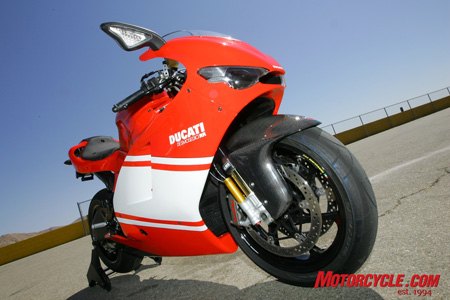
The Desmosedici RR is a lust-inspirer of the first order. Just ask D16RR owners like Jay Leno, Brad Pitt and Tom Cruise.

The engine itself is a jewel. It features the same bore and stroke measurements (86.0mm x 42.56mm) as those on Ducati’s 2006 racebike, the D16GP6. It uses the “Twin-Pulse” firing order in which the crankpins are offset by 70 degrees (cylinders fire at 0°, 90°, 290° and 380°) to generate what Ducati terms as “soft pulse timing.”
No soft pulses are felt from the D16’s saddle – this thing snorts and sprints around a racetrack like a rampaging demon, as we found out during a few lapping sessions at Willow Springs Raceway.
Our test unit was equipped with the race ECU and exhaust system included with each Desmosedici, a no-brainer swap for the standard street exhaust. So equipped, it is said to achieve the magic 200-horsepower mark at 13,800 rpm when measured at the crankshaft. As for rear-wheel power numbers, those who have had it on a Dynojet dyno say it’s pushing nearly 180 hp. Peak crankshaft torque of 85.3 ft-lbs arrives way up at 10,500 rpm.
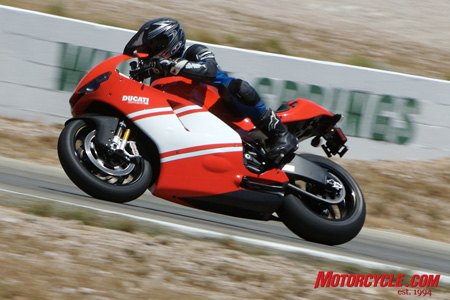
Duke wonders how many years he’ll have to work for free to pay off a simple low-side spill.
'The Desmosedici is like a barely tamed wild animal.'

I was anticipating the D16RR to be high-strung, and its rumpity idle and menacing bark when revved did little to assuage those feelings. But then, despite a heavy clutch pull, the 16RR pulled out of pit lane smartly and without frantic revs, despite its light flywheel effect.
Yet this is no pussycat. Get hard on the throttle, and the D16 romps forth like a Gixxer on nitrous! It shows itself to be quite torquey but then comes on with a wicked surge past 10,000 rpm that inhales literbikes on straightaways like they are 600s. Every straight, no matter how short, becomes a passing opportunity. Vibration gets intense at high revs, putting in the mind of the rider a question: “Are you sure you want to use that much throttle?”
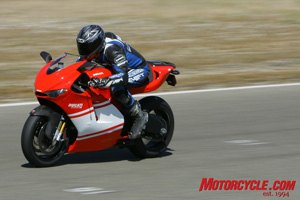
The Desmosedici gathers speed like no sportbike we’ve ever ridden.
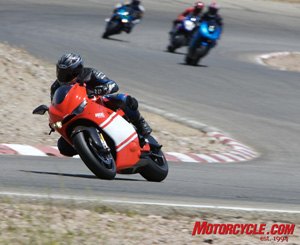
That trio in the background was just three of many at Willow Springs which fell victim to the D16’s outrageous power-to-weight ratio.

Yes we do!
The Desmosedici is like a barely tamed wild animal. It’s highly visceral and with an intensity that threatens to overwhelm a rider’s senses. It sounds downright angry on trailing throttle, as a 13.5:1 compression ratio threatens to skid the rear wheel if not for the racing-style slipper clutch. At neutral throttle it emits a menacing grrrrrr! that would be antithetical to anything from, say, Honda. The throttle response from the 50mm Magneti Marelli throttle bodies with 12-hole 'microjet' above-throttle injectors is a bit snatchy, adding to the brutish impression.
The D16’s handling characteristics are similarly racerish. Its chassis geometry (24.5-degree rake, 3.8 inches of trail and 56.3-inch wheelbase) is said to be identical to the MotoGP racer, but these numbers are fairly conservative in the street-sportbike realm. So, despite the reduced gyroscopic forces from the ultra-lightweight forged-magnesium wheels and a relatively light claimed dry weight of 377 lbs, the D16RR doesn’t flick into corners as quickly as expected.
And, like other racebikes I’ve sampled, the Desmosedici proved to be sprung too stiffly for my minimal weight and talent. The suspension was made more compliant after some adjustments, but its heavy springs remained too unyielding – I could still feel the rear end topping out over bumps. Its pegs are high and very rear-set, making it surprisingly difficult to drag a knee. And the $72K price tag doesn’t encourage pitching it in with abandon! Basically, the supremely capable D16 scoffs at the abilities of mere mortals.
"Never have I ridden a machine more capable of exacerbating my ineptness than this 400-lb pit bull," said senior editor Pete Brissette after a wide-eyed session aboard the Desmo.

The Desmosedici is also unique for its specially developed Bridgestone tire combination. It uses a typical 120/70-17 front, but at the rear is a 16-inch (instead of 17) hoop on which is mounted a 200/55-16 ’Stone. Despite the intended grip enhancement of this oddball size, the D16’s devilish motor proved to be willing and able to spin up the tire exiting Willow’s sweeping Turn 9 and onto the front straight.
'...the most mind-altering aspect of the D16RR is the part when the gloriously wicked V-Four comes on cam and hurls itself into the next corner with a 14,000-rpm wail'
No matter the gear, the Desmo’ pulls ferociously and demands full attention. Shifts from the cassette-type six-speed gearbox are thankfully smooth, as info from the LCD bar-graph tach is impossible to take in during the bike’s banshees-from-hell increase of velocity. The hyper acceleration makes a rider wish for less fore-aft seating room, as there’s no bum stop in the carbon-fiber subframe to prevent a rider’s frightened ass from sliding rearward. A test rider with more skill than I saw a heady 170 mph on the 16RR’s speedometer on Willow’s shortish front straight.
Braking from such considerable speeds is ably handled by a set of Brembos that are reputedly the same as the MotoGP bikes use in wet weather. One-piece monoblock calipers put a firm but not abrupt bite on 330mm steel discs. They actually don’t feel as aggro as the 1098’s sharp front binders but are nonetheless very powerful given a strong squeeze. Corner entries are also aided by an excellent slipper clutch and stiff springs in the gas-charged Ohlins fork.
Like all Ducatis, the Desmosedici is stable when laid over on its side, but a combination of the stiff springs and the possibility of tens of thousands of dollars in damage that a simple crash might entail kept Casey Stoner-esque elbow-dragging thoughts from reaching my hands.

But the most mind-altering aspect of the D16RR is the part when the gloriously wicked V-Four comes on cam and hurls itself into the next corner with a 14,000-rpm wail. Race-prepped R1s easily fall victim to the claimed 200 horsepower on tap like krill to whales.
So, there’s a lot to like about the thrilling Desmosedici, but its big-ticket price tag doesn’t guarantee perfection. Along with the racer-stiff springs, a street rider will also be disappointed in the amount of heat given off by the 102-dB racing exhaust pipes that exit out the upper part of the rear tail constructed from ceramic carbon fiber. And, for as much as this bike costs, we might’ve expected a traction-control system like the potent 1098R’s.
On the plus side, the Desmosedici offers an unparalleled three-year warranty that includes free service. Its first major service is due at 7500 miles – we wonder how long it will take most D16 owners to pile on that many miles! Also, in addition to the race exhaust and ECU, the D16RR is also delivered with a bike cover and a track stand.
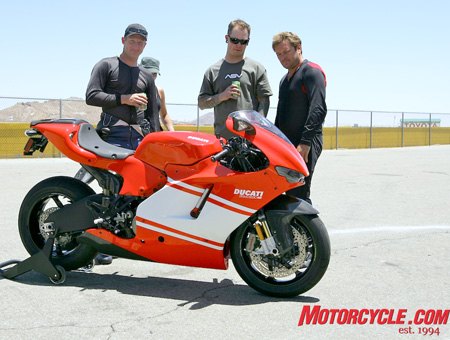
Draws a crowd, every time.

The Desmosedici RR we tested was the so-called “Team Version” that mimics the factory’s Marlboro-sponsored Corse GP bikes with its broad white fairing stripe; a team sponsor decal kit is provided with each bike. Also available is another version in the same “Rosso GP” color (a shade lighter than typical Ducati red) and white number plate on the tailsection but without the white stripe.
Sadly for trust-funders, movie stars or hedge-fund managers, all 1500 examples of the Desmosedici RR have been spoken for. If you’re lucky, you might find a potential customer who has backed out of their $5000 deposit. Otherwise, you’ll be stuck on the rollercoaster that is eBay. If you’ve got deep pockets, you won’t want to miss out on this brilliant and humbling machine that looks as good in a living room as it does on a racetrack.

2009 Ducati Desmosedici Monster Concept

Ducati’s road-going MotoGP replica, the Desmosedici, is the raciest street-legal machine ever available to the public. Its GP-derived 990cc V-Four motor kicks out around 200 horsepower to the rear wheel, creating a top-end surge of power that inhales run-of-the-mill literbikes.
But behind the Desmosedici’s aerodynamic bodywork is a riding position that is kindly referred to as “committed.” The less-limber among us would describe its ergos as “torturous.”
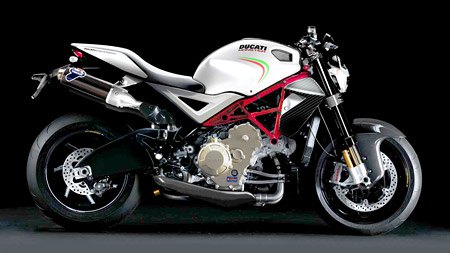
But what if you could get that gloriously devastating motor in a naked sportbike with upright ergos? Well, the Ducati factory briefly toyed with this fanciful idea, according to European contributor Tor Sagen who commissioned this photo rendering from Italian designer Luc1.
“We have called it the Monstersedici,” explained Sagen. “In the world of B-Kings, Vmax and Brutales, such a concept wouldn't be too way off, and that's why Ducati actually did a small study of such a concept.”
Not surprisingly, any plans for a production bike were nixed by the enormous costs of producing the Desmosedici’s exotic and hand-built V-Four engine.
More likely to enter production, however, is a Monster stuffed with the 1098’s V-Twin motor, which may debut as soon as this fall’s Milan show.
“Ducati would not give us any official comment on this story,” said Sagen, “But off the record, one of my sources stated that he wouldn't buy such a bike because it would have too much power. Any Suzuki B-King owners or potential Yamaha Vmax II buyers that beg to differ?”

2011 Aprilia Shiver vs. 2011 Ducati Monster 796 Shootout


Other times, a good motorbike battle is off the table by merely a day or two between the return of one model and the acquisition of another. Such is the case for our time with Ducati’s 2011Monster 796 and Aprilia’s Shiver 750. The return date of one just slipped by the pick up date of the other.
However, since these machines are so close in performance and market category, a little spec sheet jockeying and drawing on overlapping memories of riding impressions seems in order – enough to whip up a pseudo comparo!


Engine
Both two wheelers are powered by a Twin: an 803cc, air-cooled, SOHC, 90-degree two-valver for the Monster, and a 749cc, liquid-cooled, DOHC, 90-degree four-valver for the Shiver.
Despite what sounds like a lower-tech engine in the Monster, it is actually the more powerful of the two. The Ducati’s grunty low-rpm force was evident in its recent battle with Triumph’s Street Triple R. In the comparative horsepower and torque charts with the Shiver, the Monster once again shows that it isn’t a Twin to trifle with just because it lacks the latest and greatest technology.


The 796 pulls strong off bottom, and never looks back, besting the Shiver’s 44 ft-lbs of peak torque by a full 9 ft-lbs. Although the margin in peak horsepower is narrower, from roughly the 4500 rpm mark the Ducati opens a sizable gap over the Aprilia – by as much as 10 hp at certain points.
Yet the Shiver’s graph reveals it’s the bike with the smoother, more linear power development. Compared to the Ducati’s squiggly torque and hp graph lines, the Shiver’s charts look as though a laser level was used to draw them. But despite the hard numbers in the dynos, the Monster’s mill seems the mellower of the Twins.
The 796’s tall gearing (in order to meet stringent European emissions standards) somewhat hampers spirited acceleration, with the Shiver providing a revvier, more assertive engine feel. If we owned the Duc, we’d bolt on a rear sprocket with a couple more teeth to provide acceleration with extra immediacy.
The Shiver suffers from abrupt throttle response when in Sport mode, but so does the Monster. As seems typical for a lot of modern Ducatis, the Monster 796 is equally as guilty of jerky acceleration at small throttle openings.


However, with the Aprilia a rider can mitigate the abruptness without losing any peak power by switching over to Tour mode. In case you’re unaware, the Shiver offers three rider-selectable engine mappings (Sport, Tour, Rain). No such mechanism exists on the Duc.
As noted in the Monster’s initial review, its gearbox was Notchy (that’s notchy with an N). But the 796 got a passing grade in light of the fact that it likely received no break-in time before it was turned loose into the media test pool. Also, its APTC slipper-type clutch is a functional asset.
The Aprilia cannot claim a slipper clutch, but its six-speed transmission is otherwise smooth and trouble-free.
Chassis
Just as each of these naked middleweights are motivated by Twins, they each also hold their powerplants with a frame combo of steel-tube trellis joined to aluminum side pieces. The Monster’s frame is predominantly trellis, and, frankly, the more attractive of the two frames.
The Shiver’s now narrower rear wheel changed rear tire profile to better match the front tire’s profile, improving overall steering and handling compared to the previous model Shiver.
Suspension components are similar for each bike.
The Ducati sports a 43mm inverted fork where the Aprilia utilizes a 41mm inverted unit, but neither fork offers any type of external adjusters. That said, each fork works quite well. Good damping and bump compliance is a testament to tuning work the manufacturers did before finalizing spring rates and damping performance.
Each bike’s shock provides for spring preload adjustment along with the ability to tweak rebound damping. And, as with the fork sets, both shocks perform adequately.
No question each bike is a genuine treat to twist through the bends, however, when the pace picks up, the 796 remains surefooted and stable throughout the turn. The Aprilia may protest with a wiggle or wallow at the back end.
But take these comments on Aprilia’s occasional wobble at speed with a grain of salt. It’s a matter of splitting hairs, really. As ably as the Ducati tracks through serpentine tarmac, the Shiver probably meets the Duc’s standard by 90%, if not more.
We enjoyed exploiting the composed, sure-footed nature of the Monster’s chassis.
For 2010/11 the Shiver’s rear wheel is half an inch narrower than the previous model year’s 6.0-inch wheel – one of a number of updates to the current Shiver. The new, narrower wheel reshaped the 180/55 x 17 Pirelli Diablo Corsa III rear tire to better match the front tire’s profile, which in turn gives the Shiver linear, predictable steering.
The Shiver has a marginally shorter wheelbase (56.6-inches vs. 57.1-inches) while the 796 counters with a shallower 24.0-degree rake compared to the Shiver’s 25.7-degrees. Regardless of differences in geometry, each naked Standard provides sporty, nimble steering.
Going up against the name Brembo (what the Duc wears) is always tough, but the Shiver’s Aprilia-branded binders go tit-for-tat in terms of ultimate stopping power. Also, as part of the Shiver’s upgrade package, it was graced with wave-type rotors. Braking excellence is almost a dead heat ‘tween this pair, but the Duc impresses more for its overall better sensitivity at the lever.
The Shiver received updates to its ergonomic layout that Aprilia says gives the rider a sportier seating position. Although the ergos are slightly more aggressive, it’s still a bit more upright compared to the Monster – and that’s just fine by us.

Ergos ‘n’ Stuff
If you’re familiar with the Monster 696 or 1100, then you’ve got a pretty good feel for the 796’s layout even if you haven’t ridden it yet.
The Monster’s rider triangle is pretty darn comfortable. It’s saddle is broad with supportive foam density, and pegs are rear set enough that it takes some serious lean angle to start scraping.
But reach to the Duc’s one-piece, tapered aluminum motocross-style handle is more forward than the position the Shiver places its rider in.
The name says it all.
Although changes to peg placement, seat width and handlebar height ostensibly have given the Shiver a more aggressive rider ergo package, it seems to offer a more open and upright position compared to the 796. Yet it gives up nothing to the Monster in terms of sport riding.
Seat height is basically a wash with 31.5 inches for the 796 and 31.8 inches for the Shiver.
Mr. Monster wears a hi-tech dashboard kit with its all-digital single-unit LCD panel. It’s essentially the same unit found on Ducati’s high-end superbikes. Unfortunately, the 796’s all-LCD bar graph tachometer can at times seem difficult to read, like during midday sun.
An instrument package consisting of a prominently displayed analog tachometer joined by an LCD panel handling the rest of the data – just like is on the Shiver – is preferable to most staffers at here at Motorcycle.com.
Pretend Shootout Conclusion
These I-talian sleds weren’t ridden back-to-back on the same day, but that doesn’t prevent one simple conclusion: each one is a doggone good bike.
The Shiver’s Twin provides tractable power, belying peak power deficits to the Ducati. And the Shiver also has the features of rider-selectable fuel mapping and true throttle-by-wire. You’ll have to decide if the Aprilia’s electronics are bona fide benefits, but for sure they are the way of the future.
Aprilia graced the Shiver with worthwhile improvements to handling this year, and it also has what feels like a slightly more neutral, upright riding position compared to the Duc.

On the other hand, the Ducati is, well, a Ducati. Nowadays that name is golden whether you’re a real rider or a style-conscious diva.
The Monster 796 package presents a strong Twin, stable chassis, user-friendly ergos, easy effort at the clutch lever (albeit with a chunky transmission) and sex appeal – all for a $996 premium above the Shiver’s $8,999 MSRP.
Once again, despite our best efforts to discern a clear winner amongst modern two wheelers wedged in the same category, all that’s left to say is: six of one, half dozen of another.

2011 Harley-Davidson Sportster XR1200X Review


When Harley announced in late ’07 the XR1200 as a 2008 European-only model, the decision seemed confounding to Americans who couldn’t buy the Americana-infused XR.
Here’s the XR1200 that we didn’t get first.
First and foremost because it is, after all, a Harley-Davidson; secondly because its styling is directly inspired by the iconic XR750, Harley’s famous, purpose-built flat-track dominator.
It seemed crazy the States wouldn’t see this “all-American” machine. However, sensible marketing logic was behind excluding the XR1200 from the U.S. market.
As we’ve noted in numerous reviews, the European sport-standard segment is remarkably stronger than is the same segment in the U.S. For reasons not very well understood, we just don’t seem to have an appetite for the nakeds and standards.
Despite this reality of poor sales for sport-standards in the U.S., Harley said it heard enough requests for the XR from its home market, and so by the end of 2008 the Milwaukee-based company introduced the XR1200 for America as a 2009 model.
Now we, too, get the new XR1200X that was first released in Europe. For 2011 the X model will come in White Hot Denim or Black Denim colors and will replace the XR1200.
As something of a cautious homage to the original XR750, the XR1200 saw an initial limited run of only 750 units. Hurray for us anyway!
However, only one year later we were back in that “Europe first” loop.
For 2010 the European market received the XR1200X: an XR with uprated suspension and some additional touchups. American XR owners could have the same suspension package, but only as an optional kit on the order of $1500. Dang.
Welcome home! Round two
Finally, we, too, will now have the XR1200X. It’s the first release of Harley’s 2011 models and it’s slated to hit dealers by this August.
The X model trades the XR1200’s 43mm non-adjustable inverted fork for Showa’s fully adjustable 43mm Big Piston Fork, first seen in wide release on the ’09 ZX-6R. Also swapped out are the fairly basic twin coil-over shocks in favor of fully adjustable 36mm Showa shocks.
The front half of the XR’s suspension consists of Showa’s Big Piston Fork.The new Showa shocks retain ramp-style preload adjustment, but the simple compression damping adjustment dial atop the piggyback reservoir(s) is handy.
Also easy to access is the rebound damping adjustment screw found at the bottom of the shock. One caveat: the exhaust impedes access to the right-side shock’s rebound adjuster, so it’s not as easily reached as the left side.
Although the XR-X still employs the same powerful dual, four-piston Nissin calipers from the previous XR model, the 292mm rotors are now of the floating variety.
The spirited 1200cc Sportster engine in the X model gets the black-out treatment, as does the dual upswept exhaust system that’s reminiscent of the XR750’s high pipes. The XR1200’s engine and exhaust were finished in a silvery color.
Orange pinstripes for the three-spoke cast aluminum wheels round out the cosmetic updates.
But perhaps best of all is the X’s MSRP of $11,799, a $1000 increase over the XR1200 model. Recall that the same suspension that’s now on the X model was last year offered as a $1500 upgrade for the standard XR.
The X model’s engine and exhaust are all black, creating a more cohesive appearance, especially on the Black Denim color scheme.
Also worth noting, the XR1200X model will replace the XR1200 in 2011.
An American track for an American bike
Harley-Davidson chose a street-only setting for the December 2008 press launch of the XR1200; but for the X’s launch it was wheels up on a famous American racetrack!
New fully adjustable Showa coil-over shocks offer easy access to compression damping via the simple dial atop the piggyback nitrogen reservoir. Rebound adjuster is at the shocks’ mount point.
Brake rotors are now floating type. The XR-X retains the dual four-piston caliper set from the XR1200.
Road America, located in the lush countryside of Elkhart Lake, Wis., – about an hour north of Harley’s Milwaukee home – was the venue where American motopress would sample the X. This track was also the first stop in a five-race schedule for the AMA Vance & Hines XR1200 Series.
We ran an abbreviated version of the 14-turn, 4-mile-long circuit, as there was little point in subjecting the XR and its 7K-rpm redline to Road America’s long front straight.
As it was, while in top gear (5th) with the throttle twisted to the stop, the rev limiter routinely cut in to limit my top speed to around 122 mph on the shorter straight between turns 11 and 12. The thing to take away from my rev-limiter-bouncing is that although the XR’s gearing is a wee bit short for track use, this means it has close to ideal gearing for street riding.
While on the subject of redline, the XR-X wasn’t too keen on high-rpm clutch-less upshifts.
The gearbox often resisted such shifting shenanigans, and generally it felt sticky. But on this issue I’m giving it a pass, as the big flywheel in the Twin means lots of engine momentum, which in turn can contribute to lunky shifting. But this isn’t news for a Harley.
Also, most of the bikes we rode displayed low three-digit figures on the odometer. Additional miles might see the trans loosen up.
Best shifting practice was to shift as infrequently as possible. Instead I let the Sportster’s copious low-end torque and large flywheel action dig me out of slower turns.
In 2008 I was impressed by the strong initial bite from the Harley-branded Nissin brakes.
The powerful binders are more than sufficient for street duty, but hauling down the X’s claimed running-order weight of 573 pounds (as well as extra weight from the rider!) from racetrack speeds proved taxing for the brakes.
The closing laps of a 20-min session usually meant some brake fade, and a four-finger grab on the lever in order get the XR-X slowed enough at the end of the aforementioned back straight.
If you plan to take your X model to the track (or XR for that matter), a simple swap to race-compound pads should serve well to improve feel and power. If you’ll only ever ride the streets and canyons, then the XR-X has all the brake you could desire.
Something else Road America revealed about the XR was the bike’s limited lean angles. Of course, this wasn’t a big surprise, as even assertive street riding will result in the long-ish footpeg feelers scraping.
Nevertheless, feeling and hearing the lower exhaust heat shield touch down during the long right-hander (Turn 10), known as the Carousel, was a disquieting experience.
Although the XR1200X is reasonably eager to turn and provides good handling, in stock form shallow lean angles are the limiting factor to white-hot lap times. Note the minimum clearance between the lower exhaust heat shield and the track surface. Scrape!
In the time between the first XR’s appearance over two years ago and now, surely Harley would’ve heard enough bellyaching from riders and reviewers about limited ground clearance. It’s a wonder then why The Motor Company didn’t capitalize on the opportunity to increase clearance on the X model, especially in light of its improved performance parameters thanks to the new suspension.
Despite good grip and feedback from the Dunlop Qualifier D209 tires, I wasn’t in a hurry to lever them off the ground by way of grinding the exhaust header into the track surface. These lean-angle annoyances aside, we must remember the XR-X is a streetbike, not a race-prepped supersport.
With that in mind, I must give due credit to how easily the X bike set into turns considering its ready-to-ride weight mentioned above along with its un-sportbike-like 60.0-inch wheelbase. Transitioning from left to right required deliberate action, but leverage offered from the XR’s wide handlebar helped reduce steering input effort.
On the subject of the new suspension, I was content with its performance.
Damping qualities and spring rates seemed perfectly suited for my weight (geared up, roughly 170 lbs) and abilities. Stability was sufficient, as was front-end feedback. However, I can say – again considering weight and skill level – the XR1200 was also up to the task of track duty.
I seized the opportunity to ride an XR1200 back-to-back with the new X model. Although the new BPF front-end and improved shocks provided a moderately firmer feel, the standard suspension on the XR12 wasn’t far off pace in terms of stability and damping quality.Despite the reality that the XR1200X isn’t ideally suited for racetrack duties, caning a street bike powered by a big Harley Sportster engine around Road America provided endless entertainment.
Although the previous model’s suspension performed well enough for me on the track, it’s likely a heavier or much more aggressive rider would give a different report and thereby see big benefits from the X model’s adjustable springy parts.
I also took the opportunity to do a 75-mile or so street ride aboard the 2011 XR1200X.
Suspension action was forgiving without sacrificing feel, and it generally provided a decent ride over even the crummiest sections of pavement. All this performance without ever having tweaked suspension settings speaks highly of the upgrades on the new XR1200X.
Small price to pay
The new XR1200X brings the ability to fine-tune suspension adjustments, and as such most riders will find they can resolve most individual handling issues they might encounter on this sportiest of the Sportsters. For this reason alone I cannot conjure a good reason to lament the X’s added cost.
With this latest update to the modern XR series, we can once more thank our motorcycle-loving European brethren (sisters, too, I suppose).
Back on home soil: the 2011 Harley-Davidson XR1200X.
Though it seemed a little odd we were runner-up for an American motorcycle with such an iconic American appearance, I guess, as the saying goes, it was worth the wait, even the second time.

Harley-Davidson India Assembles First Units


The first two units, a 2011 SuperLow and an Iron 883, were assembled atHarley-Davidson’s plant in Haryana, India, from complete knock-down kits with components produced at the company’s American facilities in Wisconsin, Pennsylvania and Missouri, as well as various suppliers.
Harley-Davidson India will begin accepting orders for the new sportsters Jan. 1, 2011. The 2011 SuperLow is priced at 550,000 rupees (US$12,100) and the Iron 883 at 650,000 rupees (US$14,320). By comparison, American pricing for both sportsters is $7,999, but the Indian prices would have been higher if they were shipped whole from the U.S. instead of in kits.
2011 Harley-Davidson SuperLow XL 883L
The 2011 Harley-Davidson XL 883L SuperLow will retail for 550,000 rupees (US$12,100) in India.
Indian Harley-Davidson dealers will still offer 2010 stock which were imported as completely built units and subject to higher tariffs.
2011 Harley-Davidson Iron 883 XL 883N
The 2011 Harley-Davidson XL 883N Iron 883 will be available in India for 650,000 rupees (US$14,320).


Aprilia RSV4R vs. Yamaha YZF-R1 – Liter-Bike Outliers


Yamaha YZF R1
Aprilia RSV4R

Suzuki Hayabusa v's Honda Blackbird 1999


When co-ordinating this years motorcycle schedule, there was one comparison that always stood out and I knew would re-write my idea of motorcycle testing. Take the leading two bikes from two leading manufactures at the pinnacle of technology and test them again each other. A Suzuki and a Honda, with a combined top speed of 380+mph, 330+bhp and just under £16,000 for the pair. Ladies and Gentlemen I introduce you to the Suzuki Hayabusa and the Honda Blackbird. Two extraordinary machines one built to beat the other, both built with one thing in mind; to push the limits of motorcycling that one step closer to and beyond 200mph. But at the expense of what and how good are these bikes to an everyday rider and are they both worth risking life and limb over?
Two years ago Honda reviled its CBR 1100XX Super Blackbird and it took the world by storm. Not only did it look like it a spyplane but also like the US Air Force airplane, was the fastest in its class. With an estimated top speed of 190 mph and 150 bhp, the Blackbird was, by all accounts, the most complete motorcycle ever constructed. It stole the Kawasaki ZZR1100's crown as fastest production bike. Now improved with PGM fuel injection, taken from Honda's RVF/RC45 Superbike racer and two lowered inlet Direct Air Intake System ducts the Blackbird hosts many new and improved performance features. Including; rearranged exhausts, speeding up the exit of spent gasses boosting low-rev torque, and a new refined gearbox. The Blackbird at the same time is a beautiful machine, sleek and modern to the most visible extreme; it's handsome and elegantly subtle at the same time, unlike it's new rival the Suzuki GSX1300R Hayabusa.
The Hayabusa, some could say has been purposefully built to, not only beat the Blackbird in a straight line, but also it's looks have been designed to assist the bike and rider through wind-tunnel designed aerodynamics. It's aggressive and ostentatious in one breath; it sounds as fast as it goes and like its nemesis is unbelievably easy to ride. With a top speed of 200+ mph, coming from 170 bhp, the Hayabusa is the first motorcycle I have ever ridden that should come with seatbelts fitted. The 99ft-lb@6750rpm of torque is outstanding, even at the lowest of revs the Hayabusa wants to take off at the slightest hint of acceleration powering from under you, but due to a slightly longer wheelbase and a smooth power curve it is no wheelie monster. But it's the Hayabusa's weight distribution that scores top marks. Although the bike does feel a little heavy at first, as soon as you get moving it's the easiest and most stable bike out there. Riding around town, the Hayabusa is comfortable, stable and very easy to get in and out of tricky, potential risky situations.
Where the Hayabusa is aggressive the Blackbird's hidden power remains discretely hidden under it's carefully, yet almost traditionally designed bodywork, rightly so, for the Honda's ride is far more pleasant than the Hayabusa's. Aerodynamically though, there is little in it. Both are extremely comfortable on the motorway with well-designed fairing keeping the wind well away from the body. In fact riding both machines, one can very easily find oneself riding far faster than usual, due to the very good overall wind deflection. 100mph on either the Blackbird or Hayabusa feels like 60mph on most other bikes. Then there's the hum of both engines, quiet and hypnotic, begging the rider to go those extra miles. Both bikes are equally comfortable, although I personally prefer the Suzuki's two seats and easy access to the under seat compartment. The Blackbird has one molded seat, that may offer a pillion a slightly more reassuring ride but again there's very little in it. Underneath, both bikes provide adequate storage space, although the Hayabusa can take that little bit more.
Both motorcycles employ the piggyback headlights; the Hayabusa's new "laserbeam" full beam is very good. Riding at night is quite amusing as the laserbeam headlight looks like a lightsaber battling the darkness. Both bikes have their front indicators incorporated into their aerodynamic design. The Blackbird's are fitted inside the rearview mirrors, and apparently contain 15 electronic parts; you wouldn't want to have to replace them too often. The Hayabusa's are next to the RAM air ducts, fixed into the front fairing. I often found myself wondering whether other riders and drivers could see in which direction I was indicating. Which brings up one fault I did find on the Blackbird. For some reason I found myself leaving the indicators on sometimes after completing a turn, something I never do, but I put it down to an unusually sloppy display by Honda's standards. All seems very badly thought out, and unlike the new CBR 600 it's clumsy and badly positioned. The Suzuki on the other hand, has developed the thinnest display ever, that once again is all part of an integrated design. When you turn the key, the system does and engine check, with both the revs and speedometer going 360 degrees and back, it's quite something. However unlike the Honda Blackbird the speedometer is a little hard to read at high speeds, as its numbers are a little too close together.
All acetic issues, that don't really help to make up ones mind, so how do they ride? Well "yes" the Hayabusa is faster, not only at top speed but in acceleration too. It blasts away, leaving anything and everything in it's wake or perhaps jet-wash. However on twisty roads they are very equal. The Honda feels lighter and a little more nimble where as the Suzuki always feels sturdy and stable. The Honda is a little more fun, although Honda must change the Dual Combined Braking System. I found the brakes to be dangerous; sometimes one needs to stop quickly and safely and it's in those times that I wish I were on the Hayabusa. The dual six piston caliper brakes offer quick and immediate intense stopping power, unlike the Honda's 3 Dual-CBS interconnected 3 piston calipers that progressively stop the bike. What is Honda thinking, the brakes are downright dangerous! Unlike the VFR's brakes, ours on the Blackbird were awful and I often found myself having to dodge around vehicles because even at low speeds the brakes couldn't stop the bike fast enough. Hummm! Both bikes have a large fuel tank, with no reserve aside from a 4-liter warning light. The actual fuel gauges are clear very precise on both bikes, and although the Honda has a slightly larger tank the Hayabusa's full load will go further due to it's better fuel economy.
The question remains, which is the better bike? Well both Nicholas Frankl and I enjoyed both bikes very much. Were it not for the Blackbird's dodgy brakes I would not be able to choose between the two. Then again there is a "slight" tyre issue with the Hayabusa. As I said above many times, "there's very little in it"! Both Honda and Suzuki have constructed beautiful, reliable and very fast bikes. Bikes I felt very safe riding and would strongly recommend to anyone. But to choose between the two is impossible, both have their strong points and their weaker issues that need to be addressed, for now I give them both 9 out of ten and can't wait to test them both again soon.
by Alexis Bachofen