This crop of 2011 and 2012 offerings shows an almost unparalleled variety and further category fracturing and blending. We’re on tap to receive three cool entry-level, small-displacement sportbikes, an Italian power cruiser, a bleeding-edge Japanese literbike and the first inline 6-cylinder motorcycle engine we’ve seen in decades, among many other noteworthy machines.
For this article, we’ve whittled down a list of our 10 most anticipated bikes we’ll see in 2011. In alphabetical order…
Aprilia Tuono V4R
Aprilia is on the gas for 2011, giving us several strong possibilities for selection to our list, including the sporty tiddler
RS4 125. Parent company Piaggio, like Euro rivals Ducati, Triumph and BMW, continues an unabated stream of new product while Japanese brands are being much more cautious.
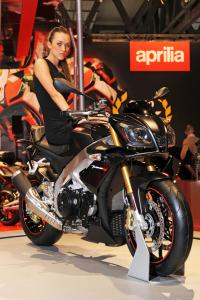
Italian sex appeal.
In our selection process for this list, we had some votes for two new versions of the ultra-desirable RSV4 sportbike. If you have to wonder why this is exciting then you may not have paid attention to a)
Motorcycle.com and/or b) World Superbike racing this year. Veteran road racer Max Biaggi scored 10 race wins on the way to the 2010 World Superbike Championship and the Manufacturer's title at the helm of an RSV4. And earlier this year we picked the RSV4 Factory as the winner of the first part of our
2010 Superbike Shootout.
Now comes the APRC SE version to sweeten the RSV4 Factory pot with the addition of traction control, wheelie control, launch control and a quick shifter, which you can find out more from
our Euro correspondent’s First Ride review. Aprilia went and made one of our favorite literbikes of all time even better! It will retail for $22,499 when it arrives on our shores mid-2011. And if you really have extra coin burning a hole in your pocket and you must ride like Max, Aprilia offers a WSBK-spec, 200 hp race-ready Biaggi Replica for the paltry sum of $64,000.
Yet it’s the new Tuono V4R that really gets out blood pumping. The previous version with its liter-sized V-Twin is one of our all-time favorite nakeds, with a composed chassis, edgy Italian styling, and all-day-comfy ergos. Aprilia has now graced the Tuono with a retuned version of the compact but potent V-4 powering the RSV4, rated at an exciting 162 crankshaft horsepower. The V4R Tuono will also be available with the APRC (Aprilia Performance Ride Control) package that uses gyros and accelerometers to control traction, wheelies and launches.
“Although it’s just a paper lion at the moment,” Pete comments, “the all-new Tuono V4R has me salivating like no other new bike announced for the coming season.” Unfortunately, the V4R isn’t scheduled to hit North America until early 2012 at a price still to be determined.
You can read more about it here.
Aprilia Dorsoduro 1200
As noted above, the old Tuono was our favorite offering from the Noale, Italy-based Aprilia, but the new V4R will lose the previous model’s 1000cc V-Twin character. However, twin-cylinder fans needn’t fret, as the 1197cc Dorsoduro steps in to fill that void.
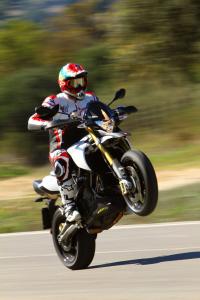
The Dorsoduro's new V-Twin packs the grunt we wished the 750 had.
The 750cc Shiver and Dorsoduro are very appealing in their own right, yet performance from their three-quarter-liter V-Twins have been a little underwhelming. But after years of rumors about larger-displacement version of the same engine, Aprilia has finally delivered with the Dorsoduro 1200.
The Max Dorso has already been introduced in Europe, and our correspondent Tor Sagen brought back a glowing review
you can read here. Although no lightweight (at a stated 457 lbs dry), the Dorso 12 comes to the party with a claimed 130 crankshaft horses to give it midrange grunt the 750 can’t approach. The big Dorso’s appeal is also expanded with high-end features like traction control and optional ABS.
“The Dorsoduro 1200 is all I ever wanted from the 750 that wasn’t there,” said Sagen after his ride. “The 1200 engine has got all that full richness I always look for in V-Twins. That sorted, the bike is now 100% pure fun.”
Just as intriguing, this new 1200cc V-Twin will surely find its way into other Aprilia models. We anticipate a Shiver 1200 to be unveiled during 2011, and it’s possible the new powerplant may find its way into a pseudo adventure-tourer like Ducati’s weird but successful Multistrada.
The only downside is that we’ll have to wait until mid-2011 until the Dorsoduro 1200 arrives in North America. MSRP is set at $11,999.
BMW K1600GT and GTL
BMW thrilled us with news of the first inline 6-cylinder motorcycle engine in almost 30 years, this one the centerpiece of a pair of high-end touring bikes. BMW says the undersquare 1649cc mill will produce a prodigious 129 ft-lb of torque at its peak, culminating in a 160-horse shove down the highway of your choice.
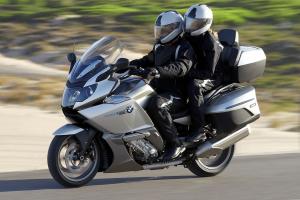
The K1600GTL packs big power and loads of comfort and convenience niceties.
The sporty-ish K16GT will replace the 4-cylinder K1300GT, and the K1600GTL becomes the luxury-touring
wagen of the reputable German brand. Both are available with a gamut of technology and luxury options, including electronically adjustable suspension, traction control, heated seats and grips, and multi-mode engine mapping, among a host of other options that should deliver a truly regal ride. And the engine sounds delicious, as we heard when
we saw the K16 revealed at Jay Leno’s garage last month.
“A six-cylinder motorcycle engine is a rare thing, no matter the era,” Pete notes. “But one from BMW promises high levels of refined technology and presumably lots of smooth power. Wrap that mill in a techy BMW chassis and all kinds of pushbutton electronic gadgetry, and the K16GT screams über-tourer.”
Yet to be announced are the prices in America, but
read here for Canadian pricing that starts at $24,100 for the GT. We’ll have to wait till April to sample the newest Six on the block.
Ducati Diavel
Last year Ducati smacked us with an adventure-touring surprise in the form of the oddball Multistrada, which we’ve since tested and loved several times. For 2011, Ducati further expands its customer base with
the Diavel, a weird new roadster built within the power-cruiser idiom.
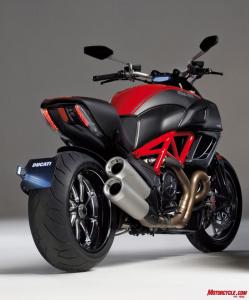
Pirelli developed a new rear tire in conjunction with the Diavel, purported to offer sportier handling than any other 240mm tire.
Despite the cruiser analogies, those at Ducati who have ridden the Diavel say it doesn’t really share any cruiser qualities. They promise a level of handling far beyond anything with a cruiser label, including a respectable 41-degree lean angle. And with a retuned version of the strong 1200cc V-Twin from the Multistrada, expectations are for a unique and stimulating ride.
“Let's see,” Pete muses. “A motorcycle with a claimed 162 hp and 94 ft-lbs joined by ABS, traction control, rider-selectable engine mapping, a slipper clutch and a monstrous 240mm rear tire from Pirelli. I like most cruisers, but I think I'll like Ducati's interpretation of a cruiser even more.”
Diavel prices start at $16,995 when they hit dealers around March, 2011.
Honda CB1000R
We love naked bikes around here. Their combination of sporty handling and power combined with day-to-day livable ergonomics ticks most of our boxes of what we look for from a motorcycle. The aforementioned Tuono is a good example, as is Kawasaki’s recent Z1000.
With that in mind, we’re sure to enjoy Honda’s CB1000R, even if it’s been available since 2008 across the Atlantic badged as the Hornet. Its edgy and futuristic appearance looks advanced without being too outlandish. Its engine is derived from the previous CBR1000RR, detuned with smaller throttle bodies and lower compression to yield a claimed 123 crankshaft horsepower at 10,000 rpm, nearly matching the output of Kawasaki’s Z1000 and Ninja 1000 siblings.
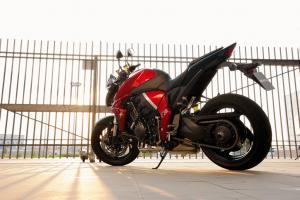
The CB1000R comes to North America after enjoying sales success in Europe.
Despite the 1000R’s retuned motor, it is no slow poke. Our Canadian correspondent says it was still pulling at an indicated 150 mph when he sampled it on a racetrack earlier this year. The CB’s chassis behavior was also judged to be good, as it uses an aluminum frame, a fully adjustable 43mm inverted fork, and a shock adjustable for rebound damping and spring preload.
“Turn-in is quick enough to give the impression we were riding a middleweight roadster,” reported our Canuck tester.
The CB1000R will arrive in American dealers this spring at a $10,999 MSRP. CBs destined for the U.S. will have standard radial-mount brakes, while Canadian versions will ship only with Honda’s Combined ABS, retailing for CDN$13,999 up north.
“The bike ought to be a tremendously versatile, fun machine able to do anything from sport touring to track days,” Jeff predicts. “It ought to be a great model, and give a fight back to Kawasaki.”
Honda CBR250R
Honda is well known for its refined products and superlative R&D efforts, but American Honda has neglected the entry-level segment in recent years. This changes for 2011, as a quarter-liter CBR sportbike will arrive in North America this spring.
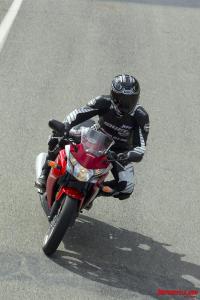
Building the CBR250R in Thailand helps keep its price down to just $3999.
It’s powered by a fuel-injected 249.4cc single-cylinder engine with double overhead cams actuating four valves. A gear-driven counterbalancer should keep it smooth up to its 10,500-rpm redline. Peak power of 26 horses is said to come in at just 8500 rpm, with 17 ft-lb of torque arriving at 7000 rpm. This indicates a relatively broad and torquey powerband. For comparison, Kawasaki’s Ninja 250, which has had this class virtually to itself, makes its torque and horsepower peaks at 9500 and 10,250 revs, respectively.
“I'm quite interested in Honda's attempt to snatch away market share from Kawasaki's venerable Ninja 250R,” Pete observes. “The CBR250R is powered by a Single, and so should produce a neat Thumper-style exhaust note and should also make good, grunty low-end power, all while looking like a larger, more upscale Honda sportbike.”
The new CBR is clearly targeted at the Ninjette – Honda has set its MSRP at an identical $3999. Honda one-ups the Kawi by offering ABS, a $500 option, and standard fuel injection.
We’ve already had the chance to spin some early miles on the littlest CBR, and we found there’s lots to like.
“Is the CBR250R a Ninja 250R killer?” Jeff asked in
our CBR250R review. “No. Is it solid competition? You bet. At this juncture, we can tell you it may not win a drag race with some other 250s, but it is a winner in its own right. I wish I had a bike this cool when I was starting out.”
Kawasaki ZX-10R
Kawasaki has upped the ante in the literbike wars with the most technically advanced sportbike it’s ever created. Its traction-control system is not only highly sophisticated, it is also standard equipment and is the first high-performance TC to be fitted to a Japanese sportbike.
A few weeks ago, lucky canine Pete came away from riding the new Ninja at Road Atlanta gushing about the transparent nature of the Sport-KTRC TC. “The system’s activation is notably seamless and not nearly as assertive as Ducati’s DTC,” he wrote in his
First Ride review. He also praised its improved chassis and rippin’ 170-horse powerplant. And the MO staff agrees that this is one of the most attractive Ninjas ever.
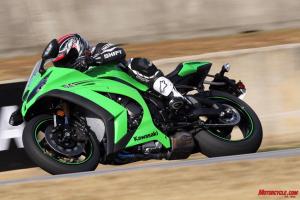
The ZX-10R elicited no negative comments at its press launch at Road Atlanta.
One caveat: Kawasaki recently placed a “technical hold” on ZX-10Rs, withdrawing shipped models from the market until it solves a still-undisclosed problem, rumored to be within the engine but not something that could cause catastrophic failure. Kawasaki is playing conservative with this issue, but you can bet they’ll have it sorted promptly.
Anyway, you can’t buy a cheaper TC-equipped sportbike than the ZX, ringing in at $13,799. A racetrack-developed ABS system adds $1000 to the price.
Although we still need to sample the 10R on the street and in the company of its rivals to judge its ultimate potency, we’re already believers in the potential of this exciting new literbike. Pete ended up his review warning the other Japanese brands: “Honda, Suzuki and Yamaha had better step up their game ASAP or risk a shrinking profile in the literbike wars.”
MV Agusta F3
When it comes to understanding motorcycles, Italians perhaps do it better than any other nation. So when attendees at last month’s EICMA show in Milan were polled to find the “Most Beautiful Bike,” MV Agusta’s F3 was the easy winner, pulling in an extra 18 percentage points over the runner-up Ducati Diavel.
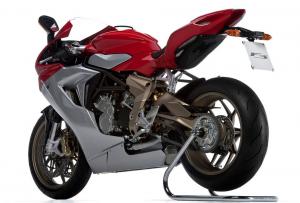
We're expecting big things from MV's new middleweight.
It only takes a short glance at the F3 to realize it’s something special. Its chiseled styling makes for an immediately positive first impression, which is then underlined by a sexy single-sided swingarm and one of the coolest exhaust systems ever, a triple-pipe shorty outlet that is a symphony of design.
Symphonic, too, should be the sound of the 675cc three-cylinder engine at full song. We’re huge fans of Triumph’s 675 Triple, both its sound and character, so we’ve got some high expectations for MV’s version.
“I think the Triumph is such an excellent performer, and so a bike of the same displacement and intent from legendary maker MV Agusta could have as much or more potential as the Triumph,” Pete comments. “Bonus to the forthcoming F3 is MV’s promise of traction control for the sleek-looking Italian Triple.”
“It will be an awesome middleweight scalpel, I bet you,” Jeff predicts.
Suzuki GSX-R600 and GSX-R750
After taking a year off in 2010, American Suzuki comes out swinging with a ground-up redesign of its GSX-R600 and GSX-R750 fraternal twins. The Gixxer 600 has long been Suzuki’s best-selling streetbike, so the engineers in Hamamatsu made countless top-to-bottom improvements to the 2011 model to compete with some excellent class rivals.
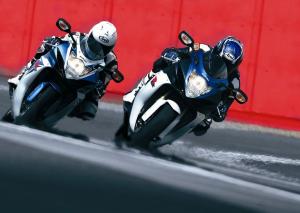
Only $400 separates the GSX-R750 from its 599cc brother, making the Gixxer 750 an instant contender for best bang for the buck among sportbikes.
A significant 20 lbs were lost in the transition to the ’11 model, trimming weight from its aluminum frame, wheels, bodywork, engine and exhaust. The addition of Showa’s highly regarded Big Piston Fork should aid handling, and the GSX-R brothers now feature Brembo monoblock brake calipers.
The Gixxer Six seems to have taken a big leap forward, but what excites us most is the 750cc version. The GSX-R750 is virtually identical to the 600, but it’s packing 20% more power while carrying just 6 lbs extra. The best part is its $11,999 MSRP, just $400 more than the GSX-R600.
“
BAM!” Pete exclaims. “How many times more than that puny price gap do you think 600cc owners spend on full exhaust systems, Power Commanders, engine work, etc., to eek out an extra, what, 5-10 hp, maybe? Here Suzuki gives you perhaps as much as 20 hp more in the form of the 750.
“Were I a consumer in the market for a new sportbike in 2011, and wasn’t necessarily interested in racing the currently popular classes of 600s and literbikes, call me a fool if I didn’t buy the GSX-R750 for a few clams more. Puh!”
Triumph Tiger 800 and Tiger 800 XC
The Tiger is reborn! And this time with a nearly identical twin.
It's great to see Triumph update its long-running Tiger, a bike that for years had inclinations of riding rugged roads, but wasn't really ready to take on BMW in the adventure-touring segment. Not only is the Tiger 800 all new, Triumph offers it in a ready-for-the-wild XC version that includes wire-spoke wheels, knobby tires, extra suspension travel, and switchable ABS, to name a few things.
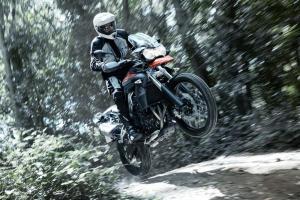
The Tiger 800 has received solid reports from those who have ridden it.
But perhaps the best part is that the Tiger is powered by a mid-size (799cc) inline-Triple that spits out a purported 94 ponies. The Tiger's three-cylinder is of smaller displacement than Triples used in many of Triumph's other models but should still offer the smooth, linear performance that its bigger-engined brothers are known for. And it'll no doubt have a similarly raspy exhaust note, too.
The Tigers are expected to arrive in the U.S. in March 2011. The Tiger 800 will retail at $9,999 ($10,799 with optional ABS). The 800XC has an MSRP of $10,999 ($11,799 with optional ABS).
The bourgeoning A-T segment has thus far been dominated by 1200cc engines, but these are often too big and heavy for serious off-road work, which is why we’ve given BMW’s F800GS our Best On/Off-Road award for two years running.
“Looks like the F800GS has a Tiger on its tail,” Pete pointedly quips.
Five bonus Hot Bikes, just missing the Top 10
Aprilia RS4 125: Riding a small bike was never as sporty as this. Aprilia adapted a 2-stroke GP bike’s chassis and fitted a fuel-injected 125cc 4-stroke motor wrapped in RSV4-style bodywork. It won’t arrive in the U.S. until the fourth quarter of 2011 as a 2012 model.
Honda Crossrunner: This Multistrada-esque crossover uses adventure-bike styling encasing a 782cc V-Four derived from the old Interceptor. It might be worth talking more about if it was coming to America, but it’s not.
Horex VR6 Roadster: This naked is powered by a 1218cc narrow-angle (15-degrees) V-6 engine boosted by a supercharger. Do we have to explain why this is interesting? If so, perhaps you need to
hear this video clip.
KTM 125 Duke: Like the little Aprilia above, the lil’ Duke is powered by a fuel-injected four-stroke single-cylinder engine. Americans might not get a chance to see if the eighth-liter Duke would sell to entry-level sportbikers, as it’s doubtful it will be imported over here.
Yamaha Super Tenere: The Super Ten proved to be a worthy BMW GS fighter when we tested it last month in Arizona. This will be a tight competition when we bring them together for an adventure-touring shootout.
 We took to the Circuito De Jerez to test out Aprilia’s exciting RSV4 Factory APRC SE.
 Here’s a look at mission control. There’s an awful lot to take in.
 You can bet there’s a big smile hidden behind that tinted visor as he whips this high-tech rocket around Jerez.
 With its closer-spaced gearbox and quick shifter, acceleration is impressive.
 Suspension is all top-notch Ohlins goodies, which is what you should expect in a bike in this price range.
 Our tester says this bike exits corners faster than any other liter-sized sportbike.


 The UK-designed Sprint GT edges toward upscale without the sting in price and stands alone without any direct price-to-performance and features competitors.
 The new rear view of the Sprint includes a single exhaust in place of the triple trumpet found on the previous ST version.
 Tidy details abound. The black-finished cast bits, and polished pieces complement the single-sided swingarm. The ignition key detaches the one-piece saddle.
 This knob adjusts the rear spring preload.
 Headlights are improved, and look bright enough here. We’d still opt for aftermarket extra lighting if it were ours.
 Cockpit view: Instruments are functional. Polished handlebar weights roll freely when twisted. Hitting the red right-side kill button shuts off the electricity to the instruments but leaves headlights on. Note lockable right side compartment in fairing. Very handy.
 Large 31 L: (8.2 gallon) saddlebags detach and attach easily.
  With chain drive, single-sided swingarm, large bags, ABS and centerstand included, the Sprint GT is an able-bodied pavement scraper that encourages riders to keep dipping it lower.
 I could get used to this. Longish peg feelers touch down first.
  Safety first! How do you like my sporty blaze-orange hunting vest and classic white AGV T-2 helmet? If the cagers tailgate me with this get-up on, it’s purely negligence or malice, but no worries here, because they’ll never keep up.
 We loaded the bags to near their max recommended weight. The bike falls into corners better with weight in it.
 The Triumph Sprint GT is a handsome bike, and ready to carry on the legacy of the former ST.
 Ducati’s MotoGP rider Nicky Hayden smokes the Diavel’s tire next to an AMG CLS 63. AMG announced sponsorship of Ducati’s GP team at the LA Auto Show.
 A throng of auto journalists gather around the new Ducati Diavel. Ducati CEO Gabriele del Torchio stands next to his GP rider Nicky Hayden, while AMG and Mercedes brass enjoy the shared spotlight.
  Nicky Hayden, the 2006 MotoGP world champion, leans on the Diavel shortly after making a grand entrance at the LA Auto Show. He may be smiling because he likes the bike, or it might be because he was just told he’ll be getting an AMG Mercedes as part of a new sponsorship agreement.
  Ducati’s CEO Gabriele del Torchio astride his company’s bold new model while Mercedes-AMG CEO Ola Källenius wishes his CLS 63 looks as cool as the Ducati.
  Ernst Lieb, CEO of M-B USA, aboard the Diavel. Note the rider ergonomics that are comfortable yet sporty.
  The Diavel’s rear view is perhaps its most striking. The massive exhaust pipes and tire make for an imposing impression.
 The Diavel’s front end shows its sportbike heritage, with Brembo radial-mount brakes, DLC anti-stiction fork tubes and gargantuan exhaust headers. The high-end Carbon version seen here features forged-aluminum wheels with machined accents.
 Although you won’t see Nicky Hayden piloting the Diavel around Grand Prix circuits, Ducati promises its niche-exploding bike will outrun anything in the cruiser class.
  We love Aprilia's V-Four engine, so we're pleased to see it used in the new Tuono V4R.
 Italian sex appeal.
 Aprilia's V-Twin heritage continues with the 1200cc Dorsoduro. We expect a 1200cc Shiver to emerge in 2011.
 The Dorsoduro's new V-Twin packs the grunt we wished the 750 had.
 A new 6-cylinder engine is at the core of BMW's new K1600 series.
 The K1600GTL packs big power and loads of comfort and convenience niceties.
 Ducati intends to reach a new audience with the Diavel. Factory-rated at 162 horsepower, you're sure to be at the front of the pack heading to the next roadhouse.
 Pirelli developed a new rear tire in conjunction with the Diavel, purported to offer sportier handling than any other 240mm tire.
  With the CB1000R, Honda once again will offer a naked sportbike to American consumers.
 The CB1000R comes to North America after enjoying sales success in Europe.
 We're glad to see Honda finally offering a sporty entry-level machine to the American market.
 Building the CBR250R in Thailand helps keep its price down to just $3999.
 Kawasaki's new ZX-10R continues to grab headlines.
 The ZX-10R elicited no negative comments at its press launch at Road Atlanta.
 MV Agusta's F3 is endowed with a new 675cc three-cylinder motor. As with all MVs, it's gorgeous.
 We're expecting big things from MV's new middleweight.
 After taking a virtual hiatus in 2010, Suzuki strikes back for 2011 with the new GSX-R600 and GSX-R750.
 Only $400 separates the GSX-R750 from its 599cc brother, making the Gixxer 750 an instant contender for best bang for the buck among sportbikes.
  Triumph added stroke dimensions to its 675cc three-cylinder to create the Tiger's new 799cc Triple.
 The Tiger 800 has received solid reports from those who have ridden it.


